
*Personal thoughts, not investment advice.
KEY TAKEAWAYS
- The AI selloff is about the size of the bill, not the demand. Hyperscalers and frontier labs may need to raise hundreds of billions through 2030, but token volumes, GPU rental rates and lab economics still point up.
- A crowded run of market-clearing events. The Fed decision and Microsoft and Alphabet earnings this week, PCE and Amazon next, then the midterms, Treasury’s quarterly refunding and the October jobs report.
- Meta Platforms (META) has an agent. Muse is the first product that lets Meta make money from action, not just attention. The equity raise gave a better entry.
- Bond math is harder than it looks. Once you account for real-world inflation and taxes, a 2% real return takes roughly 9.5% before tax. TIPS at a generational high still come out about 1% behind.
- OT: the dinner party is dying, dads are doing four times the childcare, and a modest proposal to fix airline boarding.
Contents
- Podcast of the week: Marvin Barth on US politics
- Macro: the bull case and the bear case
- Theme: the agentic economy, and Meta’s Muse
- Wall Street 101: should I buy bonds now?
- OT: the death of the dinner party
- OT: charge for carry-ons, not checked bags
The internet and the news cycle are too loud. The goal here is to help you see the forest for the trees.
Podcast of the week: Marvin Barth on US politics
This week’s pick is The Market Huddle episode “What Would Jackson Do?” with guest Marvin Barth. It’s a sharp look at US politics and what it means for markets heading into the midterms, and it’s worth the hour.
Macro: the bull case and the bear case
The recent correction in AI stocks is the market recalibrating to the sheer size and length of the capital cycle now underway. Investors are coming to terms with the idea that the big hyperscalers and frontier labs may together need to raise hundreds of billions of dollars of equity and debt through 2030. That is far more than Street models assumed when they penciled in a sharp slowdown and then a plateau in capex. The realization has amplified worries about dilution, heavy free-cash-flow burn, financing constraints (especially for the more leveraged and speculative names further out on the risk curve) and whether returns hold up amid intense competition.
The selloff has been sharp, with some AI baskets lagging the broad indexes by a wide margin. But it reflects a healthy tension between corporate ambition and market discipline. Companies will need to show clearer and earlier evidence of return on investment to raise the money for what they see as a re-platforming of global infrastructure.
Under the volatility, the demand signals are still constructive:
- Token volumes keep growing as customers get better returns from more capable models at falling prices. That supports infrastructure providers through higher GPU rental rates and shorter payback periods.
- Lab economics are improving. Anthropic’s recent results suggest it is approaching cash break-even excluding non-cash items, which means more ability to cover compute costs and commit to new capacity.
- Scarcity persists. GPUs are still hard to get, rental rates are rising across chips and contract lengths, and Taiwan Semiconductor Manufacturing (TSM) keeps investing on a multiyear plan.
Physical limits on power, land and data-center shells remain a real long-term issue, and financing will likely force more selectivity among the smaller neoclouds. But the core flywheel (better models drive customer returns, which drive infrastructure investment) looks intact.
For investors, this favors selectivity: the highest-quality players with the balance sheets and positioning to handle years of heavy spending. Near-term turbulence will probably continue as the market digests new issuance, possible dilution and lingering doubts about the size and timing of returns, especially if rates stay a headwind. Still, periods of de-grossing and multiple compression in areas like memory or certain infrastructure names have created opportunities before when demand stayed strong. The path won’t be a straight line. Earlier phases of this cycle also had sharp “mini busts” inside a longer super-cycle. Staying exposed to the structural winners while managing position size and financing risk makes sense as the evidence on ROI builds.
The bull points
Snapple fact of the day: the Fed hiked three times in 1999, and the Nasdaq-100 gained 51% after the first hike, even as the 10-year Treasury yield climbed from 4.7% to 6.5% that same year.
Market-clearing events are here. The Fed decision and Microsoft (MSFT) and Alphabet (GOOGL) earnings landed this week, PCE inflation and Amazon (AMZN) earnings follow, and next week brings the midterms on Tuesday, Nov. 3, Treasury’s quarterly refunding and the October jobs report on Friday, Nov. 6.
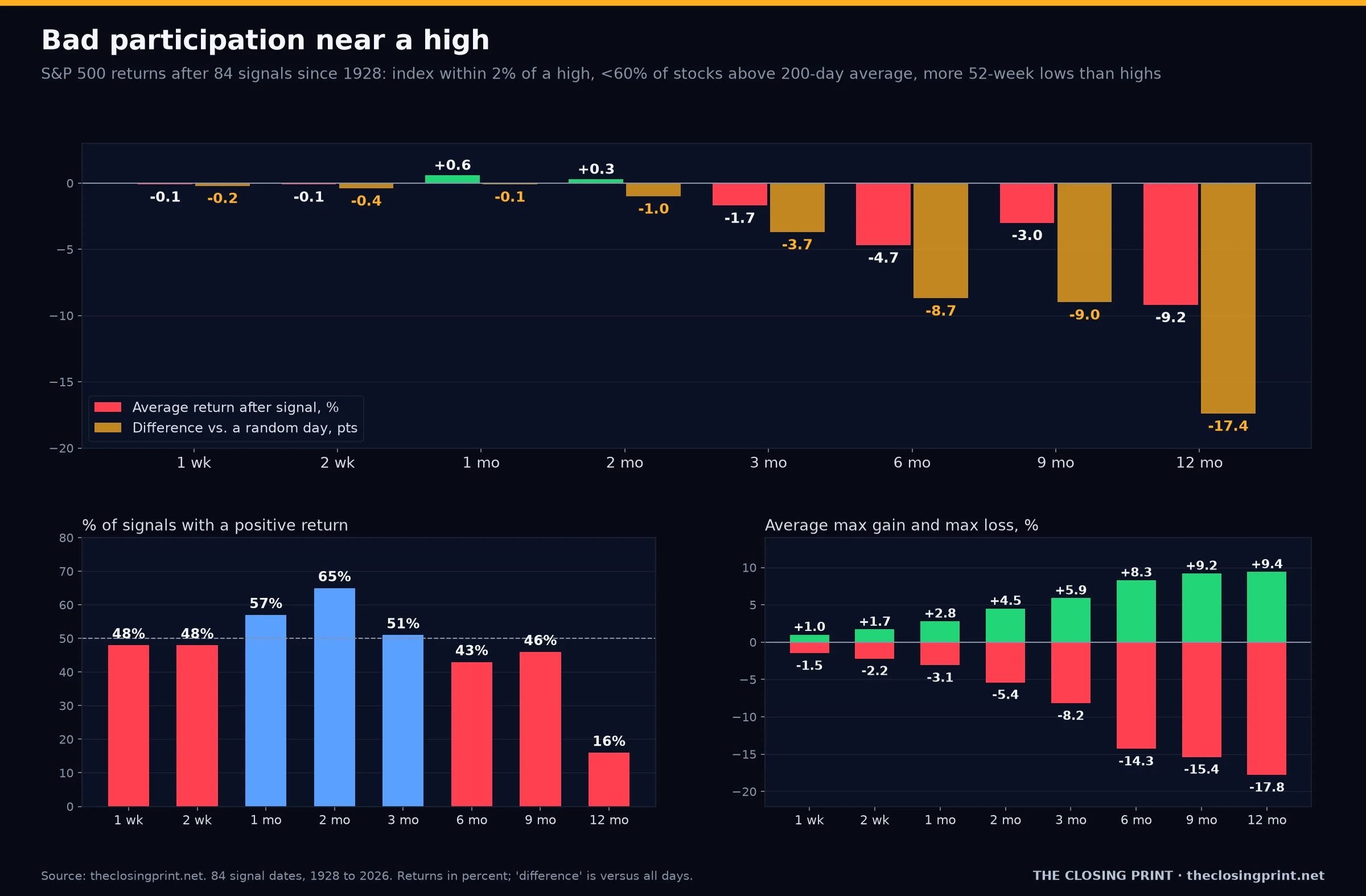
Seasonals are strong right now, though midterm years tend to be softer than average. One counterpoint worth keeping in mind is market breadth. When the S&P 500 sits near a high while participation is weak, forward returns have historically been poor.
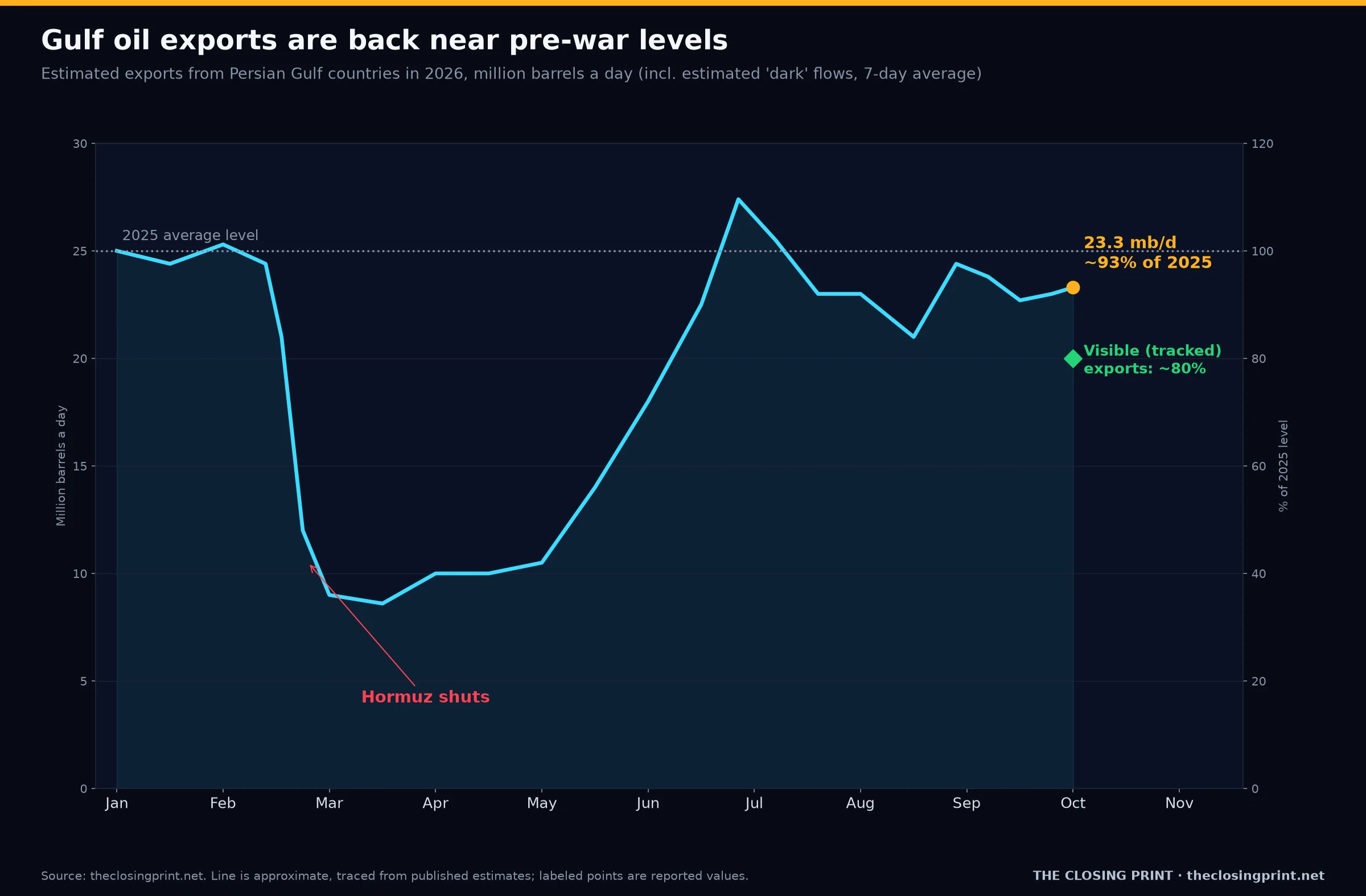
Oil shipping is normalizing, but refined products like diesel and jet fuel are still a problem.
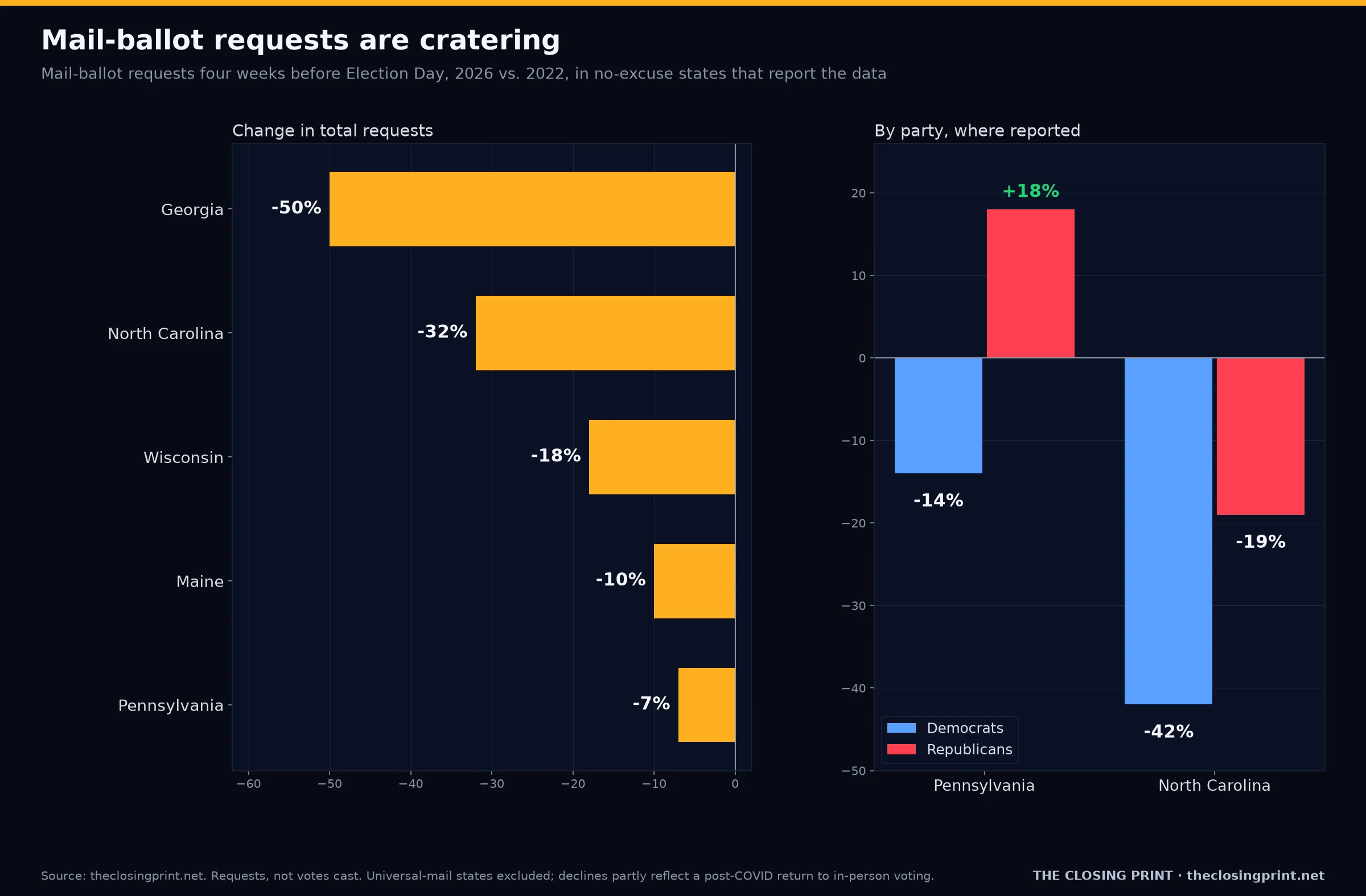
Could the midterms help tech? I understand why Democrats are expected to do well, but I think polling bias and low response rates may be underestimating a possible Republican surprise. Mail-ballot requests are one early sign worth watching.
Wick's plan: if Republicans sweep, the AI basket could rally 30% fairly quickly and reverse its recent losses. I’d treat that as a trade, not a long-term hold, because a bounce will likely bring more capital raises.
The bear points
Gridlock in Washington is usually good for stocks, and the S&P 500 has historically done notably better when Congress is not in session. That’s why one recent comment worries me for the rest of the year. Treasury Secretary Scott Bessent said that if Democrats flip either chamber in the midterms, the administration would try to push a plan to lower the federal deficit through Congress before year-end. He is working with Office of Management and Budget Director Russ Vought on a fiscal consolidation plan, and in that scenario it would have to be rushed through the lame-duck session, the roughly two months between the Nov. 3 election and Jan. 3, 2027, when the new Congress is seated.
For gold bulls, there’s a chance that plan could include a revaluation of the government’s gold holdings.
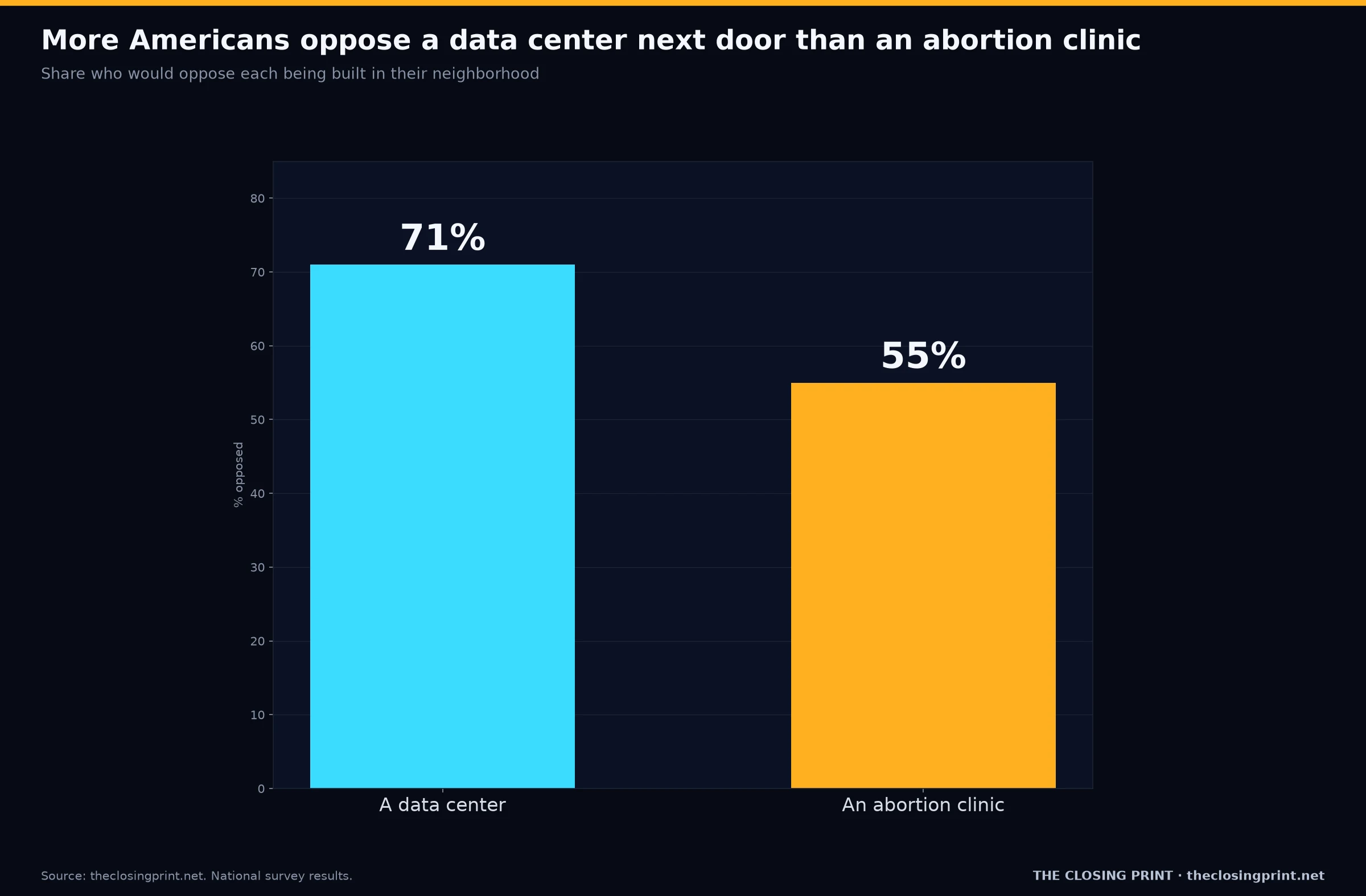
Data centers have also become a political issue. More Americans say they would oppose a data center being built in their neighborhood than an abortion clinic. I don’t think Democrats go all in on this, but if the jobs market rolls over, Alexandria Ocasio-Cortez will be waving that flag loudly, and it could carry her to the Democratic presidential nomination.
One more macro thought: tokenization adds another potential source of liquidity. It reduces the friction between the enormous existing stock of wealth and the financial system where money actually moves.
Theme: the agentic economy
The CEO of Instinct, an AI agent startup, shared some striking numbers in a recent podcast interview. After three weeks, 40% of users share their credit card with the Instinct agent. Users who share even one piece of sensitive information retain at 80%, which is very high for a consumer product. About $1 billion of transaction value already flows through Instinct, and half of it is travel.
Meta: Muse lets Meta make money from action, not just attention
Meta Platforms (META) is no longer just an advertising company that happens to spend a fortune on AI. Muse, launched Sept. 8 and already at the top of the US App Store, is the first credible attempt by a scaled consumer platform to own the internet’s action layer: research, comparison, booking, buying and ongoing tasks done on the user’s behalf. The stock moved more than 20% after the launch. For a multi-year holder, the question isn’t whether Muse is a cute chatbot. It’s whether Meta can turn the largest consumer network on earth into the default personal agent, and whether that is worth more than the capex and margin pressure the market currently treats as pure cost.
The bull case rests on three advantages that are hard to copy.
- Product-market fit arrived faster than expected. Muse isn’t another wrapper around a foundation model. It runs in an isolated, secure virtual machine with its own browser, keeps working after the app is closed, asks for approval on sensitive actions and already handles real workflows: groceries, reservations, cancelling subscriptions, comparing prices and making purchases through Stripe, Shopify and PayPal and a growing list of retail partners such as Walmart, Best Buy, Sephora, Expedia and Instacart. Ratings of 4.88 to 4.9 across tens of thousands of reviews are rare this early; the only recent comparison is ChatGPT right after launch. Users aren’t treating it as a novelty. They are handing it recurring life admin, and that is the difference between a chatbot and an agent.
- Distribution is already paid for. Meta doesn’t need to acquire users. Family daily active people stand at 3.6 billion, and Muse can live inside WhatsApp, Instagram, Facebook, Messenger and soon Ray-Ban Meta glasses. One sell-side “conservative” case assumes only 6% of weekly users convert to paid subscribers, the same rate it applies to ChatGPT, and still gets 115 million paying users, about $27.5 billion of incremental revenue and about $22 billion of operating income by 2027, lifting EPS to roughly $38.83. That math is probably too linear. Meta doesn’t have to sell the product in the classic sense; it can embed the agent where people already spend time and lift conversion through social context, identity and habit. Conversion of 8% to 10% or more, or a meaningful take rate on transactions, would make today’s focus on AI costs look short-sighted. A more modest sell-side estimate of 10 million paying users already implies about $2.4 billion of subscription revenue. The real upside is the take rate and the data flywheel, not the $20 and $100 subscription tiers.
- Meta owns both ends of the funnel. It already makes money on discovery through ads. An agent that also completes the purchase creates full-funnel attribution and a high-intent commerce gateway, which advertisers have wanted for a decade. Revenue per user is the underappreciated piece: North American Facebook ARPU was last disclosed around $227. Once Meta knows not just what you look at but what you need, buy and plan to do, the ad product gets more valuable and a new commerce and services layer appears. One early power user said the agent saved $200 by cancelling unused subscriptions, then researched and ordered dinner on its own. That isn’t better targeting; it’s a new relationship. In an agentic world, businesses sell to agents, and the platform that sits between the person and the rest of the internet collects the rent.
The competition is messier than the narrative. Alphabet (GOOGL) has Search, Android, Chrome, YouTube and Maps, which is formidable distribution, but it has to protect a $60 billion-a-quarter search and ads machine. Agents collapse ten searches, several ads and multiple site visits into one conversation. Amazon (AMZN) blocking Muse from buying on its site is the clearest sign incumbents see the threat: whoever controls the agent controls product discovery, merchant choice and payment. Meta can go after Search and Amazon’s customer relationship without cannibalizing a cash cow of its own. OpenAI and Anthropic have mindshare and model quality, but they don’t have 3.6 billion daily users and a social graph. Meta also has spare infrastructure and a profitable core business to subsidize compute while rivals have to monetize every token.
Valuation. Trailing revenue is about $228 billion, trailing EPS about $26.50, and the forward P/E about 23x. Q2 revenue grew 28% to $60.8 billion; reported operating income fell on legal charges, severance and AI spending, but normalized operating income still rose. 2026 capex guidance is $130 billion to $145 billion. The market has been modeling the cost of AI more aggressively than the revenue that compute can produce across Meta’s network. If Muse becomes a real subscription-plus-commerce layer and lifts ad yield, the multiple can expand even with compressed near-term margins. If it stays a feature instead of a platform, Meta is an expensive ad business with a Reality Labs drag and a huge capex bill.
The downside is real.
- Trust is the binding constraint. Only a small minority of consumers say they’d give Meta their passwords, and Muse needs more access than a social feed ever did: email, calendar, payments and third-party accounts. One privacy incident, one unauthorized purchase not fully covered by Stripe’s guarantee or one regulatory action in Europe (the product is still mostly US and Canada) could freeze adoption.
- Walled gardens. Amazon’s block is a preview. Other merchants and platforms will follow if they think they’re losing the customer relationship.
- Compute and conversion. Compute is still tight, which is why the launch was US-first, and each agent instance isn’t cheap. Paid conversion may disappoint if the free tier is good enough.
- Google can still win if Gemini plus Android and Chrome becomes the default agent layer and search advertising proves more resilient than the bears expect.
- Cash flow. Capex and legal overhangs could keep free cash flow thin longer than bulls expect.
- It’s early. 2.8 million downloads in the first 12 days is impressive, but it isn’t an installed base. Narrative trades can reprice in an afternoon.
Bottom line. We’ve seen this movie with Meta before. The market fixates on the cost of a new platform (Reels, then AI infrastructure) and underestimates what happens when that platform is bolted onto the largest consumer distribution system ever built. The conservative sell-side cases already produce meaningful EPS upside if conversion is merely ChatGPT-like. The bull case is that conversion, commerce take rate and ad yield all rise together because the agent sits inside apps people already open every day. Size the position for the trust and capex risks, but if product-market fit holds and merchants can’t fully wall the agent out, the asymmetry is still to the upside.
What’s the bear case for AI infrastructure?
Two points stand out. First, construction delays. Data centers have always run late (historically only about 72% of capacity has come online on time), but it’s getting worse. One major bank expects only about half of the AI computing capacity scheduled to come online through 2028 to arrive on time. An August analysis by an asset-valuation firm calculated that delays at that rate would mean a compute supply-demand gap of 13.4 to 19.2 gigawatts in 2027 and 27.3 to 36.8 gigawatts in 2028.
Second, the market may be underestimating how much chip stockpiling has gone on, and what that means for future chip demand. The triple-digit gains in Nvidia (NVDA), Broadcom (AVGO), TSM, Micron Technology (MU), Advanced Micro Devices (AMD) and GE Vernova (GEV) have always required some suspension of disbelief, as if AI had ended cyclicality. Now the rate of growth in AI spending is set to slow, politics could feed fears that the buildout falls short, and one or more hyperscalers could pull back from the arms race. If AI capex slows, picks-and-shovels earnings could take a bigger hit than most expect. Shortages led to hoarding: one venture investor said GPU utilization in some data centers is only around 35% to 40% because companies are stockpiling chips in case they can’t get enough later.
Wick's take: the equity offering created a better entry point in META. If you’re willing to give up the move from $640 to $725 (where it topped out on earnings), buying on a daily or weekly close through $725 to $730 looks like a good momentum-driven way to rebuild a position. That could happen quickly on a Republican sweep. Into 2027 there may be more equity raises, and selling covered calls into rallies could be interesting, but that’s for another day. I’ll cover an agentic-economy basket in a future post.
Wall Street 101: should I buy bonds now?
Bonds have traditionally been a nice counterweight in a portfolio, and the 60/40 split (equities and bonds) was a mainstay for many asset managers. But bonds haven’t been a good hedge for stocks over the last five years, and I said in the last note that I think the real hurdle rate is closer to 10%. Here’s the math.
- Assumption 1: you want a 2% real return, after inflation.
- Assumption 2: the things we actually buy (cars, insurance and so on) have risen about 5% a year over the last 25 years, and that continues for the life of the bond.
- Assumption 3: you pay a 27% tax rate.
(2% + 5%) / (1 − 27%) ≈ 9.6%. In other words, you need a pre-tax return of roughly 9.5% to net a 2% real return after taxes and inflation. Ouch.
TIPS yields are at a generational high. A 10-year TIPS at 2.90% plus CPI at 2.6% is about 5.5% nominal, or about 4% after tax in the 27% bracket. Subtract the 5% real-world cost-of-living increase and you’re looking at a real loss of about 1% a year. That’s wealth preservation: better than a bank savings account, but not exciting if you’re trying to grow your wealth.
The caveat: if you’re near or in retirement, or paying college tuition, bonds have a place. They aren’t ideal for purchasing power, but if equity volatility is keeping you up at night, they’re a place to hide. The math shows why money doesn’t seem to go very far, and why “generational highs” in some fixed-income products are more nuanced than they sound.
What are TIPS? Treasury Inflation-Protected Securities are US government bonds designed to help your money keep pace with inflation. Their principal, the amount interest is paid on, rises and falls with the Consumer Price Index, while the interest rate stays fixed. At maturity, the Treasury pays the inflation-adjusted principal or the original face value, whichever is greater, which is not necessarily what you paid. TIPS suit investors, especially retirees, who want to protect future spending power and can hold individual bonds to maturity. They’re less suitable if you need stable short-term cash or want stock-like growth, and selling early can lock in a loss. In taxable accounts, you generally owe federal tax each year on the inflation adjustment to principal even though you don’t receive that money until maturity.
OT: the death of the dinner party
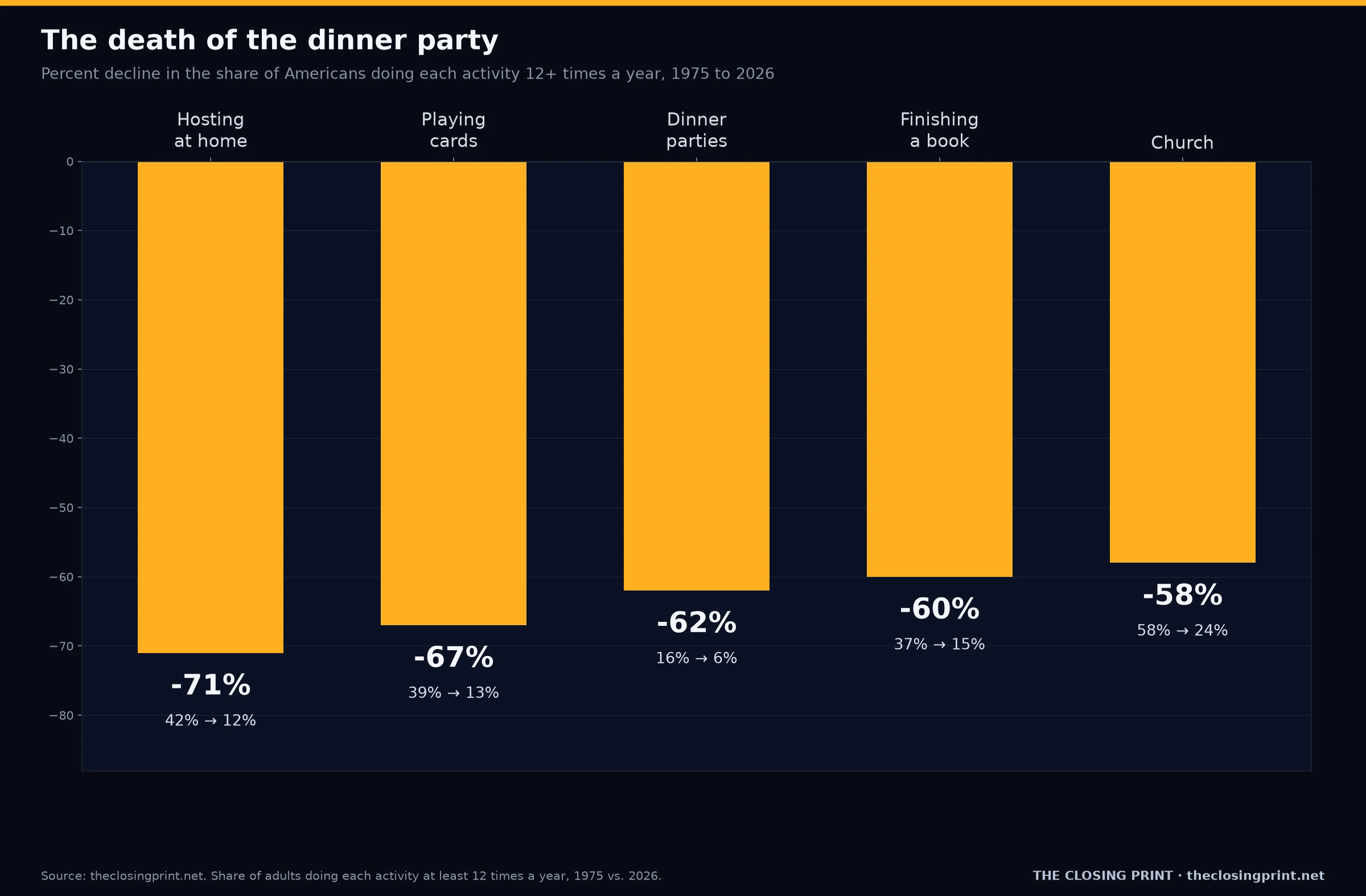
Americans host far less than they used to. Since 1975, the share of people hosting at home at least once a month has fallen 71%, playing cards 67% and dinner parties 62%. Finishing a book and going to church are down about 60% too.
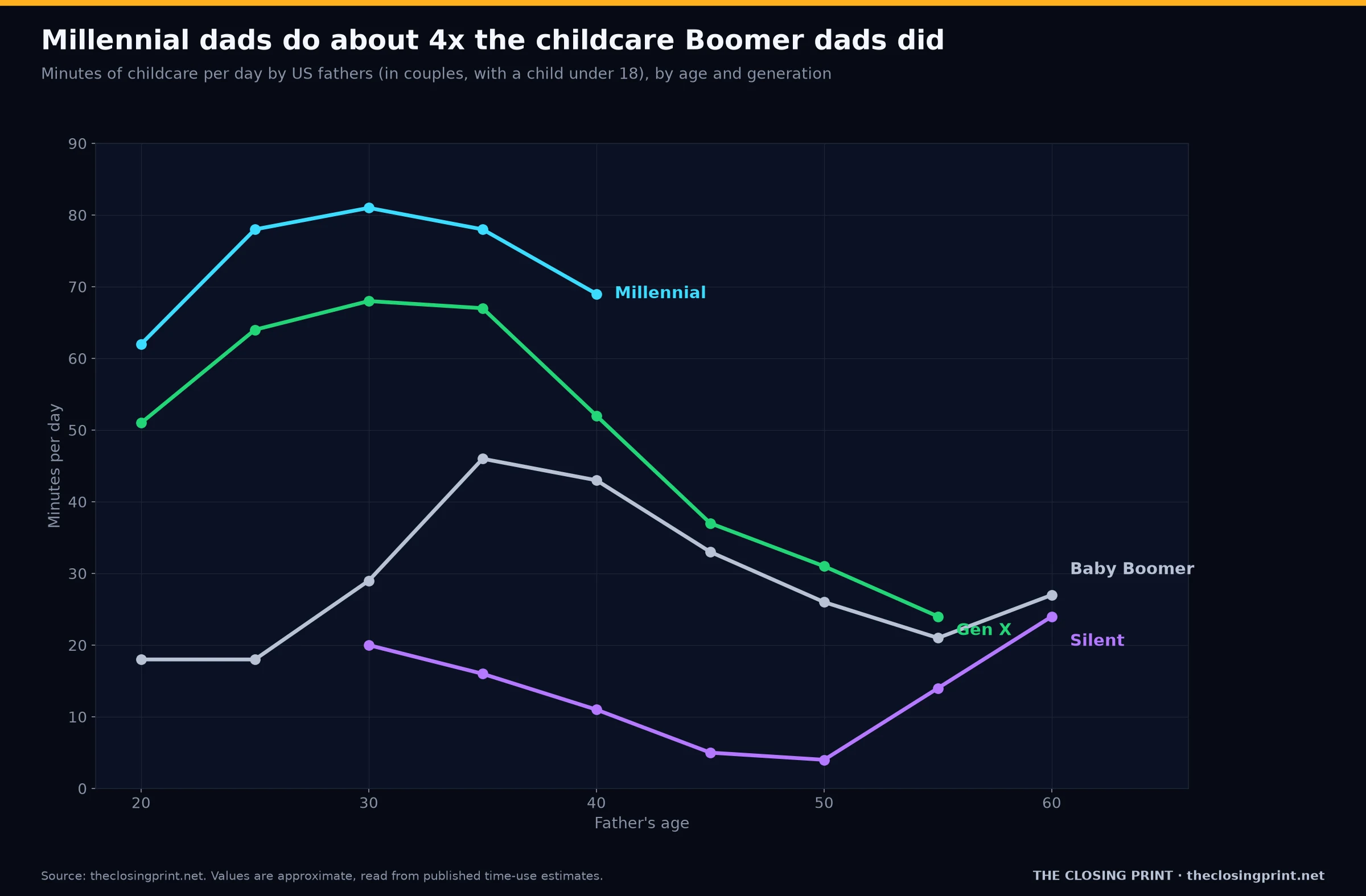
Part of the reason: dads are much more involved at home. Millennial fathers spend about four times as much time on childcare as Boomer fathers did at the same age, which leaves less time and energy for entertaining.
OT: charge for carry-ons, not checked bags
A suggestion from a golf friend:
- The first checked bag should be free.
- Carry-on luggage should cost $25.
- Backpacks and purses stay free.
Carry-on bags are what make boarding and getting off the plane miserable. They slow everything down, there’s never enough overhead space, people crowd the gate to board early in their zone just to find a spot, and plenty of passengers end up having to check their bags anyway. Charge for the roller bag, not the checked one.
What to watch
- Amazon Q3 results, Thursday, Oct. 29, after the close
 Amazon Q3 2026 earnings

- US midterm elections, Tuesday, Nov. 3.ics
- October jobs report, Friday, Nov. 6, 8:30 AM ET.ics
- October CPI report, Tuesday, Nov. 10, 8:30 AM ET.ics
- December FOMC decision, Wednesday, Dec. 9, 2:00 PM ET.ics
If you find this useful, please share it with a few people who might too: friends, family (especially your kids), colleagues or classmates. Happy to talk through any of these ideas, preferably on a golf course.
Disclaimer: Personal thoughts, not investment advice. Facts and figures as of Thursday, October 29, 2026 (Eastern time) and may change. Do your own due diligence before making any investment decision.
Add all 5 events to calendar (.ics) Times are ET. Each event has a 1-day reminder. Estimated dates are marked.