
Written about 8:00 AM ET Wednesday, Nov 4, 2026, with counting still going on. All times Eastern. Seat counts are called races as of about 7:50 AM ET; market levels are pre-market quotes against Tuesday’s close. About an 8-minute read.
- Democrats won both chambers. The Senate stands at 54 Democrats and 44 Republicans with Alaska and Mississippi not called. In the House, 228 Democratic wins were called early Wednesday, ten more than a majority, with Democrats leading in 34 more.
- Seven Senate seats flipped: North Carolina, Ohio, Iowa, Maine, Texas, Kansas and South Carolina. Democrats also flipped the governor’s offices in Texas, Georgia, Ohio, Iowa and Nevada.
- Markets fell first and then bought it. S&P 500 futures dropped 1.3% and Nasdaq 100 futures 2.2% around 10 PM, then rallied to +0.9% and +0.4% by 7:45 AM. The 10-year yield slipped to about 4.92%, the dollar fell 0.5% and gold rose 2.7%.
- The rotation is clear: solar, banks, small caps and drugmakers up; defense, health insurers, private prisons and stocks tied to Elon Musk or the president down.
- Wick's take: this is gridlock with a veto, not a policy reversal. Base case (50%): the rotation holds and the S&P ends the week within 1.5% of Tuesday’s 7,568.92 close.
Who controls Congress now
Both chambers were called for Democrats overnight, with the first network projection of a Democratic House coming around 10 PM. It is the first time since 2006 that a Republican president has lost both chambers in a midterm. Hakeem Jeffries is in line to become speaker when the 120th Congress is sworn in on Jan. 3, 2027, and Chuck Schumer is in line to become majority leader.
Senate. Republicans went in with a 53–47 edge, so Democrats needed a net gain of four seats. They got seven, and the called count is now 54 Democrats to 44 Republicans. That number could still grow. Two races are not called. In Alaska, Mary Peltola led Sen. Dan Sullivan by 626 votes out of 213,873 as of 3 AM, with thousands of absentee and early ballots still to count; neither has a majority, so a ranked-choice count is set for Nov. 18. Mississippi was separated by dozens of votes this morning.
| State | Result | Status |
|---|---|---|
| North Carolina | Roy Cooper (D) defeats Michael Whatley | Called, D flip |
| Ohio (special) | Sherrod Brown (D) unseats Sen. Jon Husted | Called, D flip |
| Iowa | Josh Turek (D) defeats Rep. Ashley Hinson | Called, D flip |
| Maine | Troy Jackson (D) unseats Sen. Susan Collins | Called, D flip |
| Texas | James Talarico (D) defeats Ken Paxton | Called, D flip |
| Kansas | Adam Hamilton (D) unseats Sen. Roger Marshall | Called, D flip |
| South Carolina | Annie Andrews (D) unseats Sen. Darline Graham | Called, D flip |
| Georgia | Sen. Jon Ossoff (D) defeats Rep. Mike Collins | Called, D hold |
| Michigan | Abdul El-Sayed (D) defeats Mike Rogers | Called, D hold |
| New Hampshire | Rep. Chris Pappas (D) defeats John Sununu | Called, D hold |
| Nebraska | Sen. Pete Ricketts (R) defeats Dan Osborn (I), about 50% to 44% | Called, R hold |
| Alaska | Mary Peltola (D) leads Sen. Dan Sullivan by 626 votes of 213,873, about 48.0% to 47.7% | Not called; ranked-choice count Nov 18 |
| Mississippi | Separated by dozens of votes | Not called |
House. Democrats needed a net gain of four seats. Early Wednesday 228 Democratic wins had been called, with Democrats ahead in 34 other races. Network projections put the final number at about 250 to 258 seats. Many races are still uncalled, especially in the West, where California takes weeks to finish counting. The Republican total is not final, so treat any seat count you see today as a floor, not a final tally. Democrats held two Florida districts that were redrawn this year to favor Republicans and won a third.
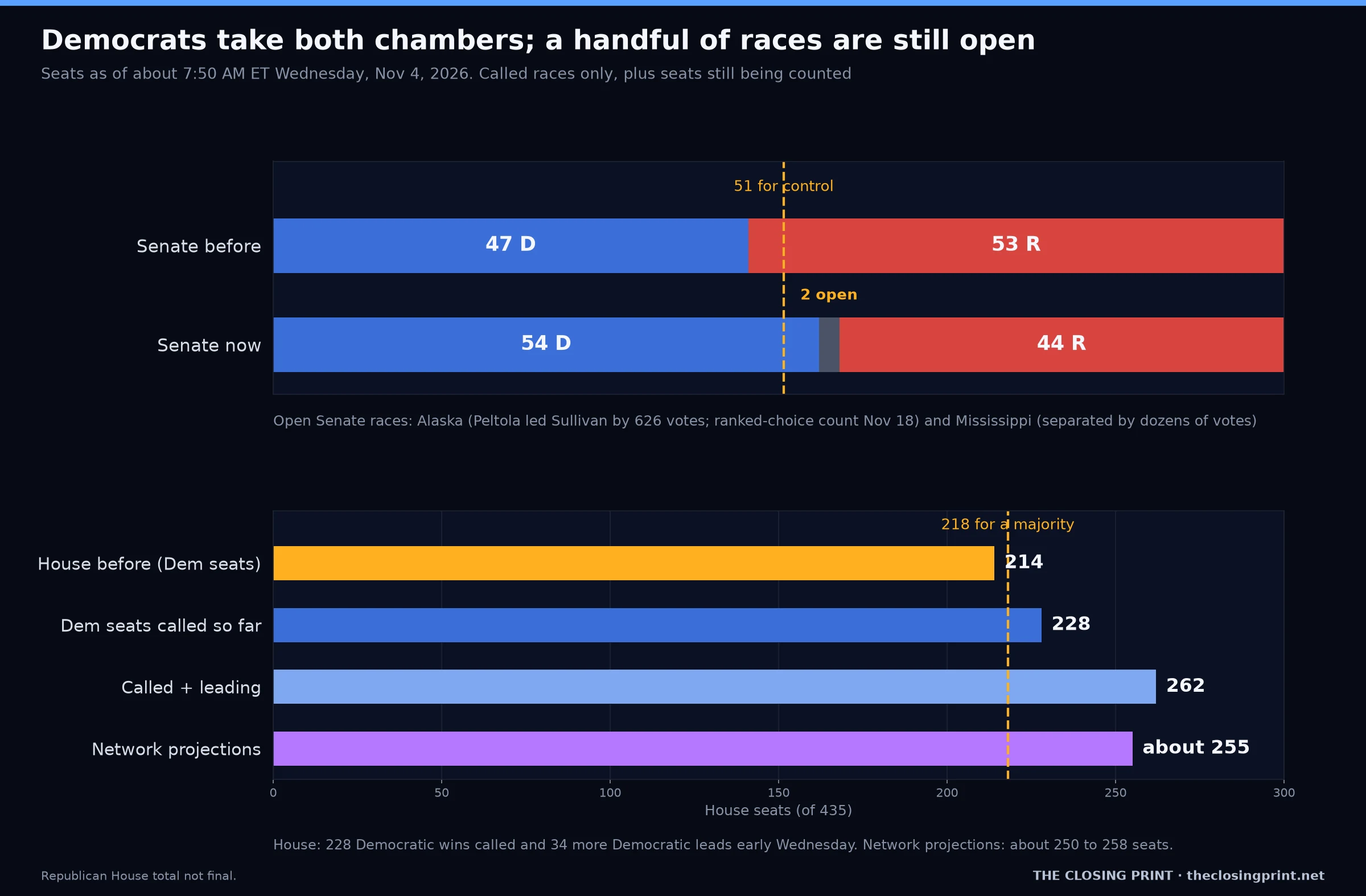
What a majority this size can’t do. Fifty-four or 55 senators is not 60, so the filibuster still blocks most bills. And neither chamber is near the two-thirds needed to override a veto: 67 senators and 290 House members. Trump posted a red “veto” cap last night and said he would block Democratic bills. He also said in a phone interview that he would accept the results and that voters “didn’t like the candidates.” What Democrats do get is the agenda in both chambers, committee gavels and subpoenas. They also get control of the Senate’s confirmation calendar.
Key governor races
Democrats now hold 28 governor’s offices and Republicans 20, with two races not called, including Alaska. The Texas result matters most for markets. Gina Hinojosa, who beat three-term Gov. Greg Abbott, has called for a moratorium on new data centers, and Texas is one of the biggest AI build-out hubs in the country. In Georgia, the other big data-center state, Keisha Lance Bottoms won the open seat. In Iowa, Rob Sand campaigned on ending state tax breaks for large data-center projects.
| State | Winner | Note |
|---|---|---|
| Texas | Gina Hinojosa (D) unseats Gov. Greg Abbott | D flip; has called for a pause on new data centers |
| Georgia | Keisha Lance Bottoms (D) defeats Rick Jackson | D flip; wants Medicaid expansion, $15 minimum wage |
| Ohio | Amy Acton (D) defeats Vivek Ramaswamy | D flip |
| Iowa | Rob Sand (D) defeats Zach Lahn | D flip; would end state tax breaks for big data centers |
| Nevada | Aaron Ford (D) unseats Gov. Joe Lombardo | D flip |
| Pennsylvania | Gov. Josh Shapiro (D) defeats Stacy Garrity | D hold |
| Michigan | Jocelyn Benson (D) defeats John James | D hold |
| Wisconsin | David Crowley (D) defeats Tom Tiffany | D hold |
| Arizona | Gov. Katie Hobbs (D) defeats Andy Biggs | D hold |
| New York | Gov. Kathy Hochul (D) | D hold |
| California | Xavier Becerra (D) | D hold |
| Florida | Byron Donalds (R) defeats David Jolly | R hold |
| Alaska | Jonathan Kreiss-Tomkins (D) leads | Not called |
Ballot measures that matter for money
- Colorado Amendment 87 would raise individual and corporate income tax rates to 7.4% above $500,000 and 8.4% above $1 million. It was too close to call, at 50.6% yes as of 10 PM Mountain time. Proposition 136, a countermeasure capping the rate at 4.4%, was short of a majority. Proposition NN, which raises the state’s revenue cap by about $500 million a year, was passing with 55%.
- California voters passed an $11.25 billion housing bond (Prop. 1) and a bigger rainy-day reserve (Prop. 2). Making the high-earner income tax for schools permanent (Prop. 3) was ahead with nearly 60%. The final result on Prop. 40, a one-time 5% tax on billionaires’ net worth, wasn’t in yet. Voters rejected a voter-ID measure (Prop. 39).
The common thread is that higher taxes on top earners did better than expected in blue and purple states. Washington can’t easily raise taxes without the president, so watch the state capitals for tax changes instead.
How markets are trading it
Futures dropped on the first results. Then they turned around. S&P 500 futures hit bottom around 10 PM, down 1.3%, as the House call came in. Nasdaq 100 futures were down 2.2% at that point, as traders priced in more scrutiny of the AI build-out. Buyers showed up after midnight, and by 7:45 AM the S&P contract was up 0.9%, the Dow contract up 1.6% and Russell 2000 futures up 1.4%. Nasdaq futures lagged at +0.4% and the VanEck Semiconductor ETF (SMH) was down 1.1% before the bell, even with Advanced Micro Devices (AMD) up about 7% on its earnings. See our Nov. 3 post-market summary for Tuesday’s session, when the S&P rose 0.36% to 7,568.92.
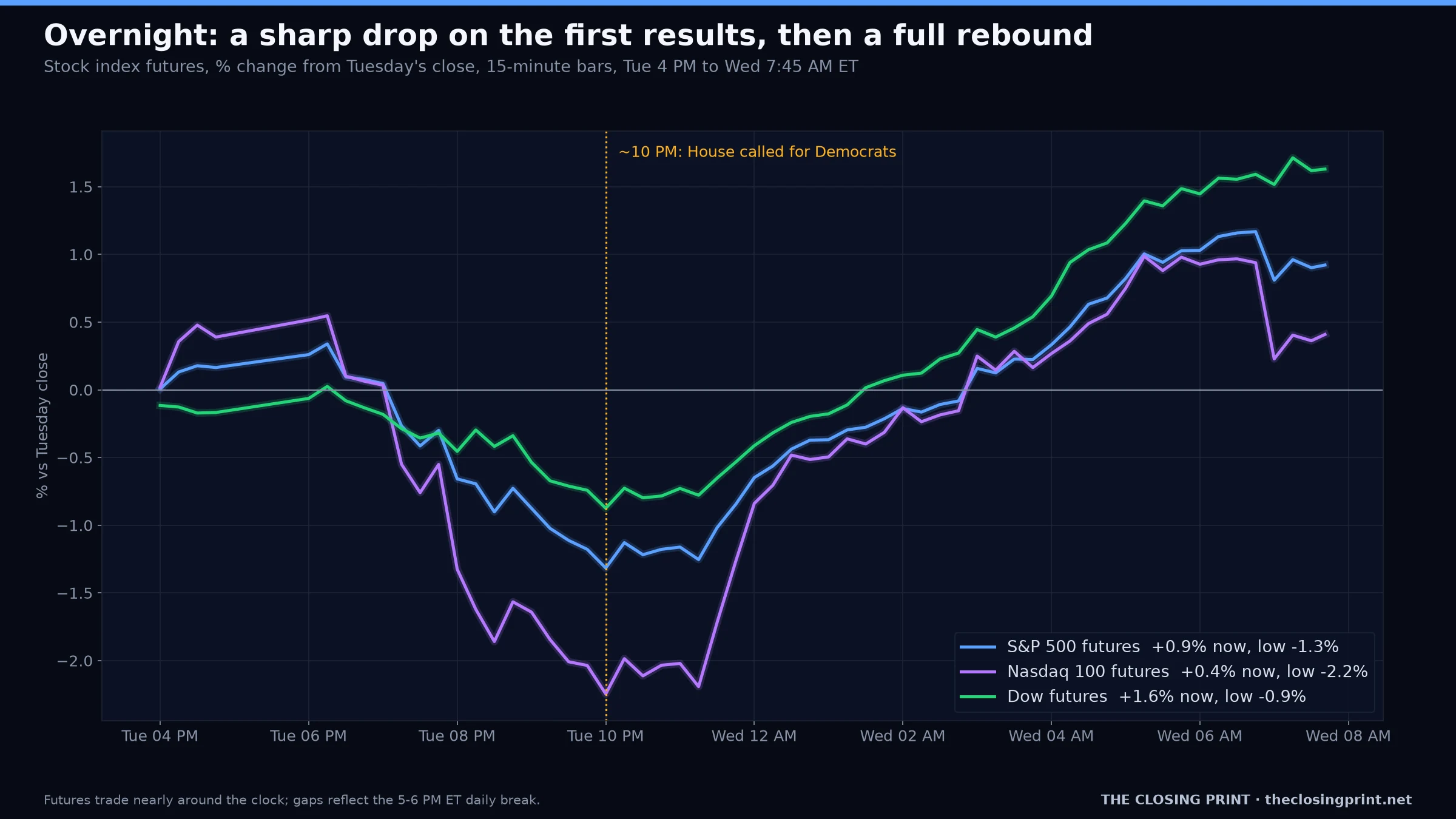
| Market | About 7:45 AM ET | vs. Tuesday close |
|---|---|---|
| S&P 500 futures | 7,666.75 | +0.9% (overnight low 7,496.75, -1.3%) |
| Nasdaq 100 futures | 28,421.50 | +0.4% (overnight low 27,670, -2.2%) |
| Dow futures | 52,741 | +1.6% |
| Russell 2000 futures | 2,864.20 | +1.4% |
| 10-year Treasury yield | about 4.92% | about -3 bp |
| 2-year Treasury yield | about 4.61% | little changed |
| 30-year Treasury yield | about 5.29% | about -4 bp |
| US Dollar Index | 101.34 | -0.5% |
| Gold (Dec futures) | $4,047 | +2.7% |
| WTI crude (Dec) | $94.86 | -1.3% |
| VIX | 18.29 | -2.5 pts |
| Euro Stoxx 50 | 6,247.95 | +1.7% |
| Nikkei 225 (close) | 62,188.63 | -1.4% |
Rates and the dollar. Treasuries rallied. The 10-year fell about 3 basis points to roughly 4.92% and the 30-year about 4 to around 5.29%, while the 2-year barely moved near 4.61%. The bond market reads divided government as tighter deficits, since a Democratic House can block new spending and tax cuts and won’t get its own spending past a veto. The US Dollar Index fell 0.5% to 101.34, and gold rose 2.7% to about $4,047. Oil fell, with WTI down 1.3% to $94.86, on bets that a Democratic Congress will push to end the war with Iran.
Winners. Clean energy led. The Invesco Solar ETF (TAN) was up 5.7%, First Solar (FSLR) 5.8%, the iShares Global Clean Energy ETF (ICLN) 4.1% and NextEra Energy (NEE) 2.4%. A Democratic Congress makes further cuts to wind, solar and storage credits much less likely. Drugmakers and biotech rose too. Eli Lilly (LLY) was up 2.4%, the iShares Biotechnology ETF (IBB) 2.1% and the Health Care Select Sector SPDR (XLV) 1.8%. Banks were up as well, with the SPDR S&P Bank ETF (KBE) +2.1%, the SPDR S&P Regional Banking ETF (KRE) +1.8% and JPMorgan Chase (JPM) +1.5%. That’s a little surprising given the regulatory overhang, and it looks like part of a broad move into cyclicals and small caps. Importers that tariffs have hit also rose: Nike (NKE) +2.5% and Walmart (WMT) +2.4%.
Losers. Defense was hit hardest. Lockheed Martin (LMT) fell 3.7%, Northrop Grumman (NOC) 3.5%, RTX (RTX) 3.4% and General Dynamics (GD) 2.5%, as investors price in war-powers votes and Pentagon oversight. Health insurers fell even as drugmakers rose: UnitedHealth Group (UNH) was down 2.3%, CVS Health (CVS) 2.2% and Humana (HUM) 1.4%. Investors expect closer scrutiny of Medicaid managed care and Medicare Advantage. Private prison operators GEO Group (GEO) and CoreCivic (CXW) fell 6.0% and 4.8% on the prospect of immigration-enforcement oversight. Tesla (TSLA) fell 5.7% and Trump Media & Technology Group (DJT) 11.6%. SpaceX (SPCX) was down about 4% early, since Elon Musk was a big Republican donor. Caterpillar (CAT), which has leaned on data-center power demand, fell 2.7%. Energy was mixed, with Exxon Mobil (XOM) down 0.6%.
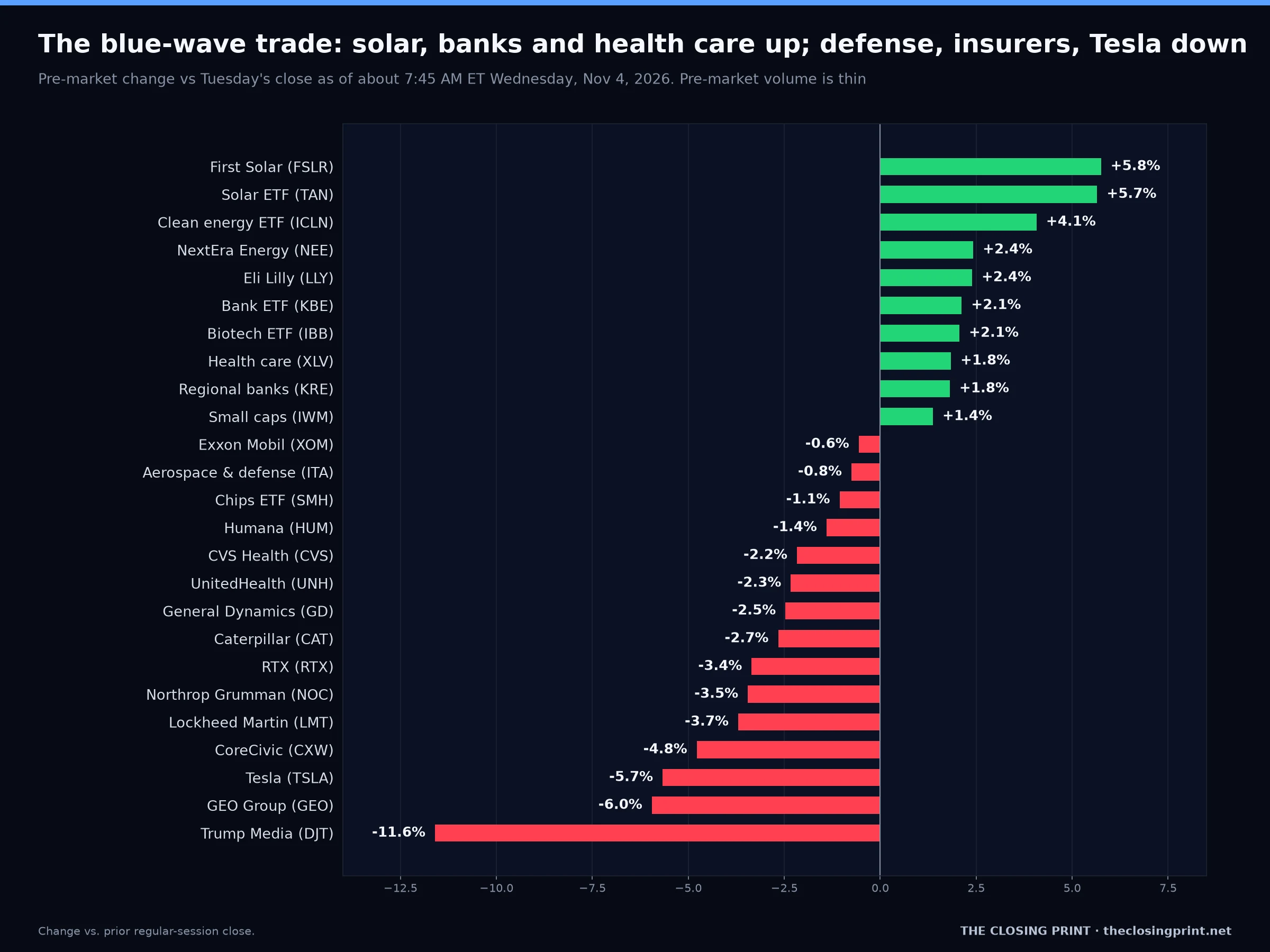
Pre-market volume is thin, and single-stock moves before 9:30 AM often fade or grow once full trading starts. The VIX’s drop from 20.83 to about 18.3 says the market sees less uncertainty now that the result is in.
What divided government means for policy
Trump has two years left and now faces a Congress that can block his plans but can’t pass its own over his veto. That makes Washington slower and noisier, but not more radical. House Democrats have named four priorities: reversing Medicaid cuts, extending the Affordable Care Act subsidies, taking back power over tariffs, and ending the Iran war. Each of those needs Trump’s signature or 60 Senate votes, so the near-term changes come through oversight, funding and confirmations, not new laws.
| Issue | Under split control | Market read |
|---|---|---|
| Taxes | The 2025 tax-and-spending law stays. Repeal needs Trump’s signature, so no big federal tax change before 2029 | Neutral for earnings; the tax fights move to the states |
| Spending | Democrats run House appropriations from Jan 3; Senate rules still need 60 votes for most bills | Tighter deficits help bonds; higher odds of a shutdown |
| Tariffs | Trump’s tariffs came from executive power. Congress can vote to end them, but he can veto | Hearings and headlines, not repeal; China truce date Jan 10 still matters |
| Fed | Warsh stays chair. A Democratic Senate confirms or blocks any new Fed board picks | Less risk of a politicized board; a small plus for long bonds |
| Debt limit | Expected back in play during 2027 | Old-style standoff risk returns in the second half of 2027 |
| Oversight | Subpoena power over agencies, war spending and companies close to the White House | Headline risk for defense, immigration contractors and Trump-linked stocks |
The next deadlines come fast. Government funding runs out on Dec. 11, while the outgoing Republican majorities are still in charge during the lame-duck session. Republicans can try to pass a long-term spending bill before Democrats take over, or kick it into January, when Democrats will have far more leverage. Either way, the odds of a shutdown fight early in 2027 just went up. The debt limit, raised in the 2025 law, is expected to come back into play during 2027.
The Fed. Nothing changes at the Dec. 8–9 meeting because of this. Kevin Warsh is chair. But from January a Democratic Senate decides whether any new Fed board nominee is confirmed, which lowers the risk of a board stacked to push rates down. Long bonds like that. Lower oil and a softer dollar, if they hold, also make the inflation math a little easier.
Scenarios


Wick's take
Wick's view: the overnight sell-off was the right instinct for the wrong reason. The blue wave doesn’t raise federal taxes. A veto and a 60-vote Senate rule that out until 2029. What it changes is risk. There is now oversight risk for defense, managed care, immigration contractors and companies close to the White House. There is state-level risk for AI data centers in Texas, Georgia and Iowa. And there is shutdown and debt-limit risk for Treasuries next year. The flip side is a smaller fiscal deficit, which is good for bonds, and a likely end to federal rollbacks of clean energy.
Positioning: Wick would follow the rotation but not chase it on day one. Solar and regional banks are up more in one pre-market than they usually move in a week. Defense looks oversold if the war spending stays funded, but there’s no rush before the first oversight hearings. The thing to own is the bond rally: lower yields help small caps and housing more than they help mega-cap tech. What would change the view: a final House count well above 260, or Alaska and Mississippi both going to Democrats for 56 seats, would add to the oversight story. A Trump push to settle the December funding before January would take the shutdown risk off the table.
What to watch
- Wed Nov 4, 10:00 AM: ISM services index for October, the first data point after the election.
 .ics

- Thu Nov 5: reported court hearing in the White House case against Fed Gov. Lisa Cook..ics
- Fri Nov 6, 8:30 AM: the October jobs report..ics
- Tue Nov 10, 8:30 AM: October CPI..ics
- Wed Nov 18: Alaska’s ranked-choice count, which could decide the Senate race between Peltola and Sullivan..ics
- Wed Dec 9, 2:00 PM: FOMC decision with new projections..ics
- Fri Dec 11: government funding runs out unless Congress acts in the lame-duck session..ics
- Sun Jan 3, 2027: the new Congress convenes with Democratic majorities in both chambers..ics
- Sun Jan 10, 2027: the US-China tariff truce extension expires..ics
Earlier coverage: our Nov. 3 pre-market summary set up election day, and the Nov. 3 post-market summary covered the close.
Analysis and opinions by Wick. Seat counts and race calls were changing as this was written; uncalled races are labeled. This post is informational only and is not financial advice. Scenario odds are our estimates.
Add all 9 events to calendar (.ics) Times are ET. Each event has a 1-day reminder. Estimated dates are marked.