
Written about 7:00 PM ET Wednesday, Oct. 28, 2026. All times Eastern. Closing prices are from the 4:00 PM regular session. After-hours quotes were thin and still moving when this was written.
The short version
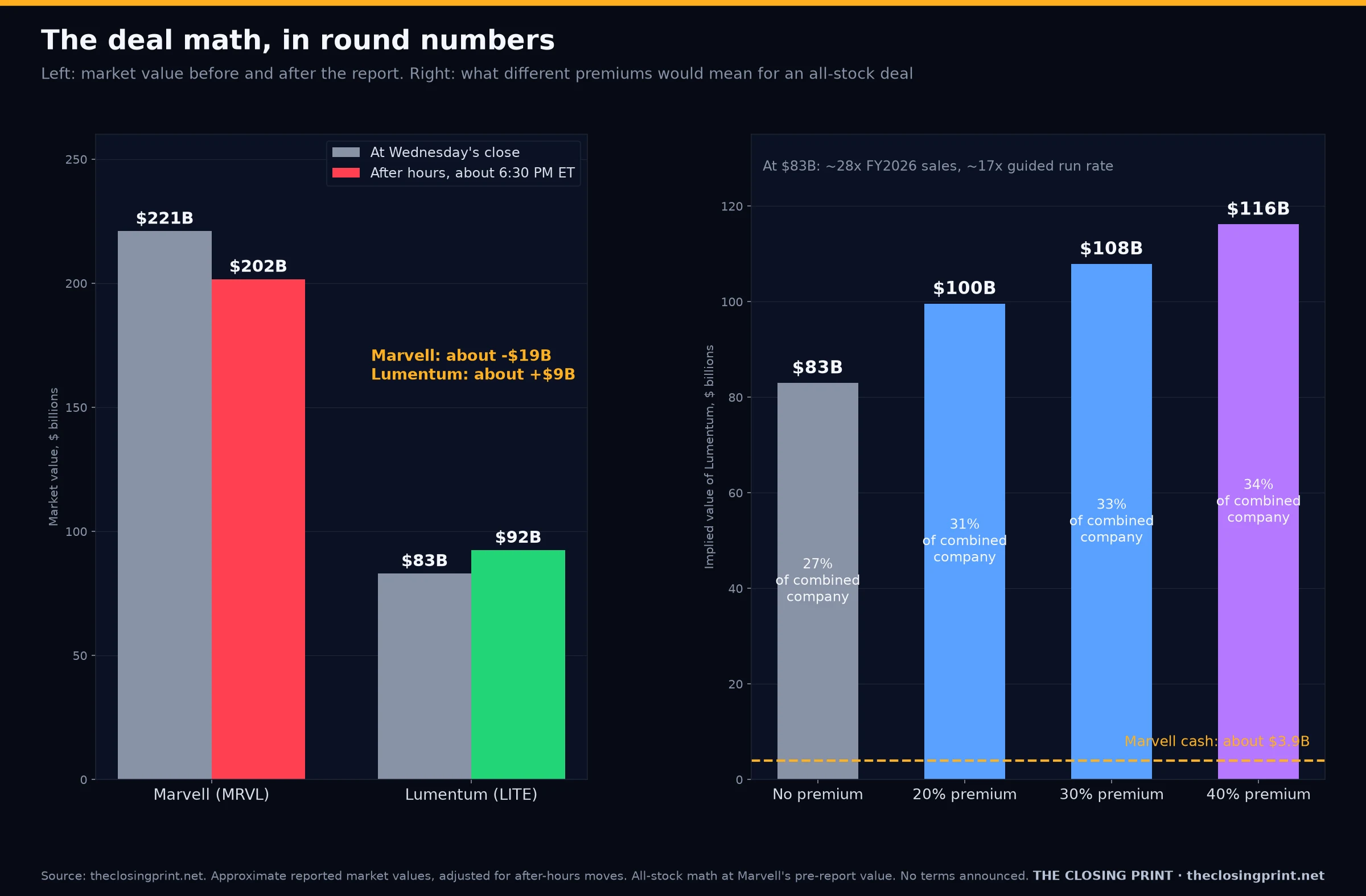
Marvell is in advanced talks to buy Lumentum, according to reports that came out after Wednesday’s close. An agreement could come as soon as next week. Lumentum was worth roughly $83 billion before the news and Marvell about $221 billion, so this would be one of the biggest chip deals of the year and the largest bet yet that optics, not just chips, is where the AI bottleneck sits.
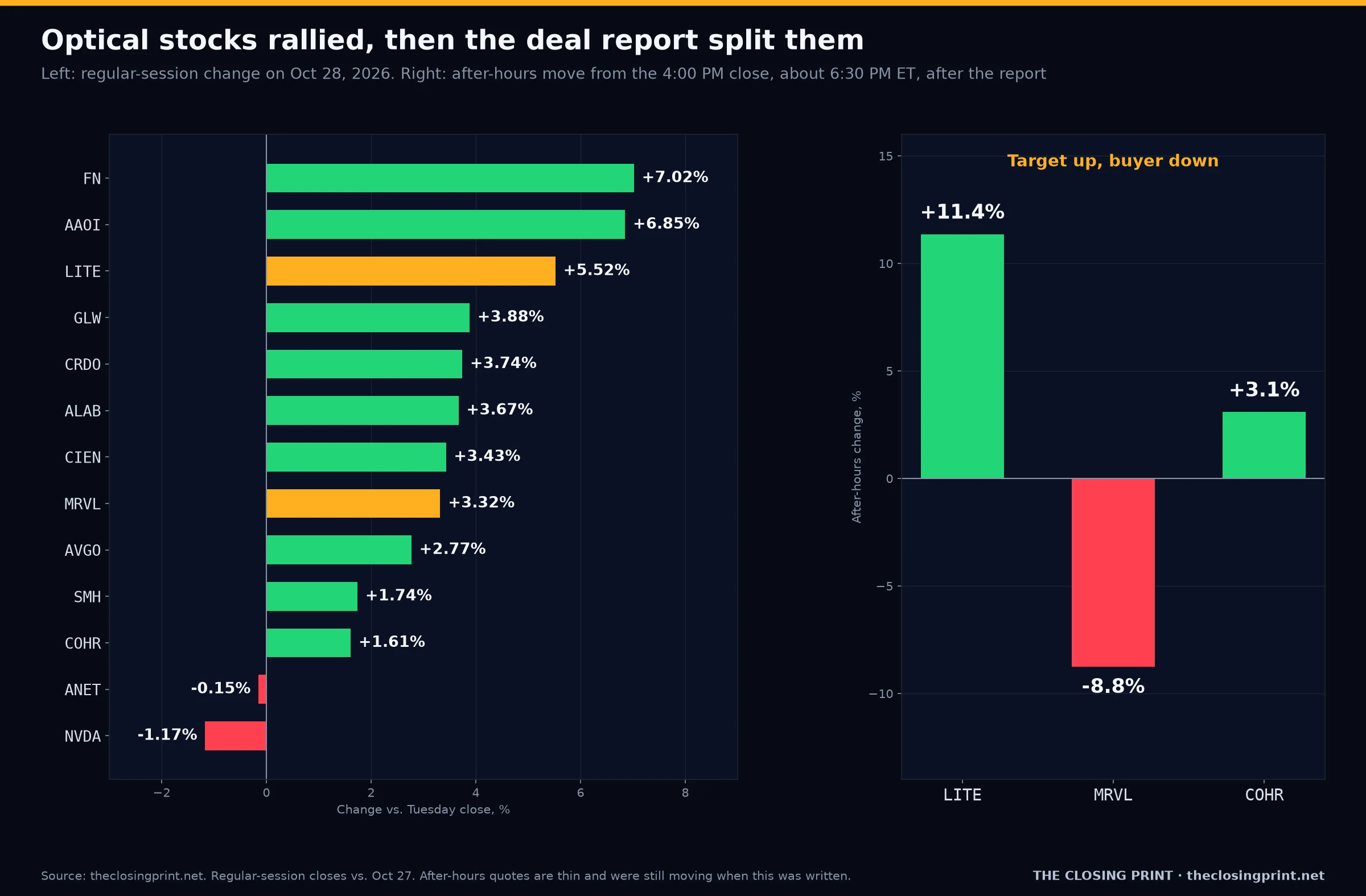
The after-hours reaction tells you how the market sees it. Lumentum rose about 11% to near $1,018. Marvell fell about 9% to around $229.60, wiping out roughly $19 billion of value, about twice what Lumentum gained. Investors like the strategy and don’t like the price. It also comes after a strong day for optical stocks, with Lumentum up 5.5%, Fabrinet (FN) up 7.0% and Corning (GLW) up 3.9% during regular trading, as the Fed held rates at 3.75%–4.00%.
| Stock | Close Oct 28 | Day | After hours (about 6:30 PM) |
|---|---|---|---|
| Lumentum (LITE) | $913.95 | +5.52% | about $1,018, +11% |
| Marvell (MRVL) | $251.65 | +3.32% | about $229.60, -9% |
| Coherent (COHR) | $239.59 | +1.61% | about $247, +3% |
| Corning (GLW) | $131.20 | +3.88% | little changed |
| Fabrinet (FN) | $367.30 | +7.02% | little changed |
| Ciena (CIEN) | $363.21 | +3.43% | little changed |
| Astera Labs (ALAB) | $297.20 | +3.67% | n/a |
| Broadcom (AVGO) | $351.81 | +2.77% | n/a |
| Nvidia (NVDA) | $215.38 | -1.17% | n/a |
| VanEck Semiconductor ETF (SMH) | $567.67 | +1.74% | n/a |
What’s reported, and what isn’t
Nothing has been signed or announced, and neither company commented right away. Reports describe the talks as advanced and private, which in deal terms usually means price and structure are mostly settled and the lawyers are working on documents. It can still fall apart. Here is the line between fact and guesswork as of tonight:
| What we know | What we don’t know yet |
|---|---|
| Marvell is in advanced talks to buy Lumentum, according to people familiar with the matter cited in reports after Wednesday’s close. | The price, the premium, and whether Marvell pays in stock, cash or a mix. |
| An agreement could be announced as soon as next week. | Whether the boards have signed off, or whether talks could still fall apart. |
| Lumentum was valued at roughly $83 billion and Marvell at about $221 billion going in. | How Marvell would fund any cash portion. It had about $3.9 billion of cash at the end of its last quarter. |
| Neither company commented right away. | How Nvidia’s $2 billion convertible preferred stake in Lumentum, bought in March, would be treated. |
| Lumentum reports fiscal Q1 results Nov. 5, with guidance of $1.225 billion to $1.275 billion in revenue. | How long antitrust reviews would take in the US, Europe and China. |
Why Marvell wants Lumentum
Marvell’s AI story has two parts. One is custom accelerators, the XPUs it designs with cloud customers. The other, which is growing faster, is connectivity: the electrical and optical links that move data between those chips. At its Oct. 6 investor day, Marvell raised its fiscal 2028 revenue target to about $20 billion from $18 billion, set a fiscal 2031 goal of $70 billion to $90 billion, and said interconnect is the fastest-growing piece of data center spending, at roughly 65% a year through 2030. It guided fiscal Q3 revenue to $3.15 billion, give or take 5%, after a $2.739 billion second quarter that was up 37% from a year earlier.
What Marvell doesn’t own is the light. Its DSPs, the signal-processing chips inside every high-speed optical module, are among the best in the industry, but they need a laser, a modulator and a module around them, and Marvell buys those from others. Lumentum is one of the few companies that can make indium phosphide lasers in volume, including the electro-absorption modulated lasers (EMLs) used in 800G and 1.6T transceivers and the very high-power lasers that co-packaged optics need. Those parts have been in short supply all year. Nvidia (NVDA) put $2 billion into Lumentum in March through convertible preferred stock, along with a multibillion-dollar purchase commitment and capacity rights, which tells you how scarce they are.
| Layer | Marvell today | Lumentum adds |
|---|---|---|
| Signal processing | PAM4 and coherent DSPs that sit inside optical modules; custom AI chips (XPUs) for all four big US cloud companies | None. Lumentum buys or partners for DSPs |
| Light sources | Relies on outside suppliers | Indium phosphide EML lasers and ultra-high-power continuous-wave lasers for silicon photonics and co-packaged optics, with a new US fab under way |
| Modules | Some module work, mostly through partners | Cloud transceivers including 1.6T modules, external laser source (ELS) modules |
| Switching | Ethernet switch silicon | Optical circuit switches (OCS), which route light without converting it back to electricity |
| In-rack optics | Photonic fabric work from its Celestial AI purchase | Near-packaged and co-packaged optics engagements; ultra-high-power lasers for CPO |
Put the two companies together and you get something close to a complete optical link from one supplier: the laser, the DSP, the module and the switch. That matters most for the next step in AI networking. Today the links between racks (scale-out) already use optics, but the links inside a rack (scale-up) are still almost all copper. As speeds rise, copper runs out of reach, and the industry expects optics to start moving inside the rack later this decade through near-packaged and co-packaged optics. Lumentum said in August that rising orders for ultra-high-power CPO lasers, an initial ELS module order and several NPO engagements were “the first signs that optics are starting to penetrate in-rack connectivity.” Marvell already bought Celestial AI, the photonic-fabric startup, for the same reason. Lumentum would give it the manufacturing behind that idea.
The deal math
Lumentum is not cheap. At $83 billion, it traded at about 28 times its fiscal 2026 revenue of $3.01 billion. On the current quarter’s guidance midpoint of $1.25 billion, or about $5 billion a year, it’s closer to 17 times. Its margins are moving fast: guidance for the September quarter is a 39.5%–40.5% non-GAAP operating margin and $4.05–$4.35 in non-GAAP earnings per share, against $1.10 a year earlier. Analysts expect about $4.22. The after-hours price of around $1,018 is already about 11% above the close, so the market is guessing at a premium of 15% to 30%.
Marvell can’t pay cash for this. It had about $3.9 billion at the end of last quarter, less than 5% of Lumentum’s value before any premium. That means it pays mostly in stock, and the chart below shows what that means. At a 30% premium, Lumentum would be worth about $108 billion, and its holders would own about a third of the combined company. That’s the dilution Marvell holders sold after hours. The real question is whether Lumentum’s laser margins and growth make up for giving away that third. If Lumentum gets to the $5 billion-plus run rate its guidance implies and keeps 40% operating margins, the combined earnings can support the price. If optics pricing turns, Marvell will have issued a lot of stock at the top.
Three other things to watch in the terms:
- Nvidia’s stake. Its preferred shares convert one-for-one into Lumentum common stock, so in a stock deal Nvidia would likely end up holding Marvell shares. It also has supply commitments with Lumentum. How that relationship carries over matters, because Nvidia buys lasers and also competes with Marvell’s custom-chip customers.
- Customer conflicts. Lumentum sells lasers to module makers and chip companies that compete with Marvell, Broadcom (AVGO) among them. Some will look for a second source if Lumentum belongs to a rival. That gives Coherent (COHR) and the Asian laser makers an opening.
- Regulators. In the US, this is a vertical deal between companies that aren’t direct rivals, which usually gets through with conditions. China is the bigger risk. Its market regulator (SAMR) has to approve deals between companies with large sales in China. It has slowed or blocked US chip deals before, often during trade fights. A 12–18 month review with a breakup fee is the realistic planning case, not a quick close.
The supply chain: who gains and who’s exposed
Consolidation like this usually lifts the companies that are left, because it shows what scarce optical capacity is worth. It also changes who buys from whom. Here is how we see the rest of the group:
Coherent (COHR) is the closest public comparison: a large US maker of indium phosphide lasers and transceivers that also took $2 billion from Nvidia in March. It rose about 3% after hours. If Lumentum goes for close to 30 times sales, Coherent’s discount looks too wide, and it may win business from customers who don’t want to buy from Marvell. It reports Nov. 4 after the close.
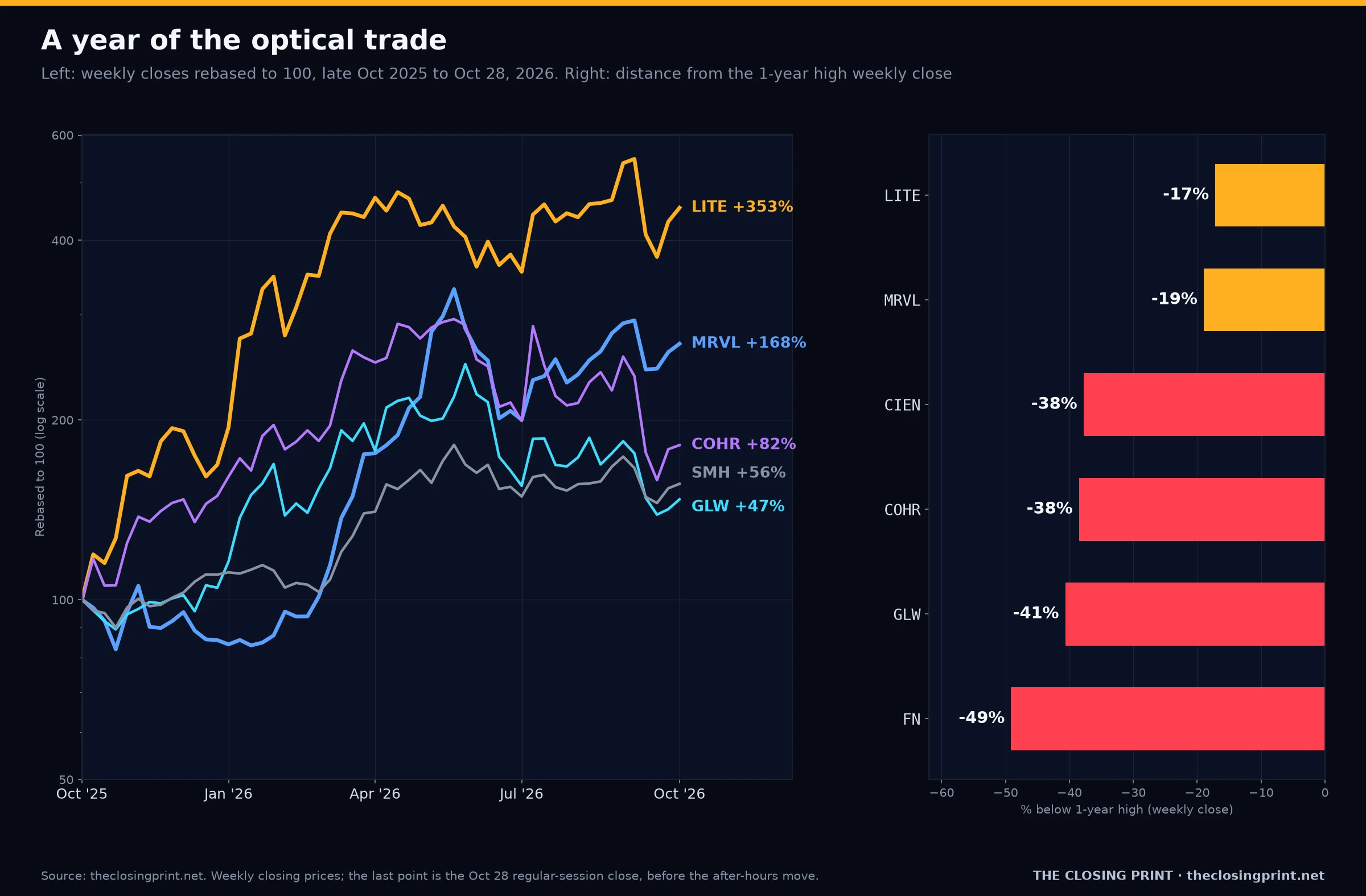
Corning (GLW) sells the fiber and connectivity, which every optical link needs no matter whose laser is inside. Its third quarter showed how strong that demand is: core sales of $5.08 billion, up 19%; core EPS of $0.91, up 36%; and optical communications sales up 44% to $2.38 billion, with enterprise networks up 84% and generative AI products more than doubling. Q4 guidance calls for about 19% sales growth again. Corning says AI clusters use about 16 fibers per GPU for scale-out today, and that a fully optical scale-up design could push that toward 160, ten times as much. It expects that move to start speeding up in 2028. Corning has also been working with Lumentum on high-density optical links for PCIe-over-optics and die-to-die connections, so a Marvell-owned Lumentum stays a partner, not a threat. The bear points are real: a lot of growth is already in the price, cloud spending could slow, and the tenfold scale-up case isn’t locked in. But customer prepayments ($639 million so far this year) and long-term supply deals with hyperscalers and carriers such as AT&T and Verizon take a lot of the volume risk off the table. Core operating margin rose 310 basis points to 22.7%, and the stock is down about 41% from its high weekly close.
Fabrinet (FN) builds optical modules under contract, so more optics means more work. A Marvell-Lumentum combination could keep more module assembly in-house over time, though, and Fabrinet is down about 49% from its peak. It reports Nov. 2.
Broadcom (AVGO) is Marvell’s main rival in custom AI chips, optical DSPs and co-packaged optics switches. In the near term, a Marvell busy with a large integration helps Broadcom. Over time, Marvell would have something Broadcom doesn’t: its own laser fab.
Ciena (CIEN) and Astera Labs (ALAB) sit next to the deal. Ciena competes with Marvell in coherent optics for links between data centers, so a stronger Marvell is a mixed signal for it. Astera’s business is mostly copper-based connectivity today, and it is moving toward optics with partners. Neither has a direct stake in the terms, but both trade on the same theme.
How we rate the group
| Company | Wick's rating | Why |
|---|---|---|
| Lumentum (LITE) | Hold | After hours it already trades near $1,018. More upside needs a premium above about 20% to Wednesday’s close and a clean path through regulators. |
| Marvell (MRVL) | Accumulate on weakness | The strategy makes sense, but the price and the share dilution decide whether it works. We’d add in pieces after terms are out, not before. |
| Coherent (COHR) | Accumulate | The other large US laser and transceiver maker with scale. A deal at a rich price puts a value on Coherent’s own laser capacity. Reports Nov. 4. |
| Corning (GLW) | Accumulate | It sells the glass for every optical link no matter who wins the laser and DSP fight. Down about 41% from its high weekly close. |
| Fabrinet (FN) | Hold | It builds modules for others, so it benefits from more optics but could lose share if buyers bring more of the work in-house. Reports Nov. 2. |
| Ciena (CIEN) | Hold | It’s a beneficiary of data center interconnect, but its competition with Marvell in coherent optics makes this deal a mixed signal. |
| Astera Labs (ALAB) | Hold | Its connectivity business depends on copper today and optics later. Its partners consolidating is a risk and an opportunity. |
| Broadcom (AVGO) | Accumulate | It’s Marvell’s main rival in custom chips, DSPs and co-packaged optics. A Marvell distracted by integration helps Broadcom in the near term. |
For how this fits the bigger picture of who is paying for the AI build-out, see our AI financing deep dive.
Risks
- Price. Paying about 28 times trailing sales for a component maker assumes the laser shortage lasts. Optics has had boom-and-bust cycles before, in 2001 and again in 2018–2019.
- Dilution. An all-stock deal hands about a third of Marvell to Lumentum holders. If Marvell’s own growth slows, that hurts more.
- Regulators. A long Chinese review could leave both stocks in limbo into 2028. Trade tensions could make it worse.
- Customers. Lumentum’s customers that compete with Marvell may shift orders to Coherent or Asian suppliers.
- Spending. Everything here depends on cloud and AI capex staying high. A capex cut would hit the most expensive stocks hardest, and Lumentum is the most expensive in the group.
Scenarios


Wick's pick: Base (50%). The strategy is right: owning the laser is the best defense in AI networking right now, and Marvell can’t build that in time. But we wouldn’t chase Lumentum at around $1,018 until we see the price and the regulatory timeline. For Marvell, we’d wait for the terms and buy in pieces. The cleanest way to play it is the supplier no one needs to buy: Corning, which gets paid for every fiber and is far below its highs.
What would change our view: a cash-heavy structure funded by debt (more bearish on Marvell), a competing bidder for Lumentum (bullish for LITE and COHR), signs of SAMR resistance (bearish for both), or Lumentum guiding above $1.3 billion on Nov. 5 (it would make the price look more reasonable).
What to watch
- Mon Nov 2, after the close: Fabrinet fiscal Q1 2027 results.
 .ics

- Wed Nov 4, after the close: Coherent fiscal Q1 2027 results..ics
- Thu Nov 5, 4:05 PM: Lumentum fiscal Q1 2027 results, call at 5:00 PM. Guidance was $1.225 billion to $1.275 billion..ics
- Next week: a possible announcement of the Marvell-Lumentum deal (reported, no date).
- Fri Nov 6, 8:30 AM: October jobs report..ics
- Tue Dec 1, after the close: Marvell fiscal Q3 2027 results (estimated)..ics
Market data and opinions by Wick. This post is informational only and is not financial advice. Scenario odds and ratings are our estimates. Deal terms described as reported are not final, and no agreement has been announced. After-hours prices were thin and may have changed since this was written.
Add all 5 events to calendar (.ics) Times are ET. Each event has a 1-day reminder. Estimated dates are marked.