
Written about 5:45 PM ET Wednesday, Nov. 11, 2026. All times Eastern. Prices are 4:00 PM closes.
This follows our Monday piece on the first day of the selloff, when we said $170.24 was the line that mattered. NVDA closed below it on Tuesday at $168.89, its lowest close since March 30, and bounced today with the rest of the chip group. Our Nov. 11 Post-Market Summary covers the broader rally.
What is confirmed, and what is not
- Confirmed: Huang acknowledged an extramarital affair in a letter to employees on Sunday, Nov. 8, that Nvidia also released publicly. He linked it to the national security concerns in recent reports, apologized, and said he supports the board's investigation.
- Confirmed: The board's Nov. 8 statement said a committee of independent directors, assisted by outside counsel, will investigate reports that Huang was the target of a foreign intelligence effort. It said the board has no reason to believe national security or Nvidia secrets were compromised, and that it has confidence in Huang and his leadership team. On Tuesday the directors retained Joon Kim, a partner at Wachtell, Lipton, Rosen & Katz and a former acting U.S. Attorney for the Southern District of New York, to lead the review.
- Reported, not confirmed by Nvidia: that U.S. intelligence concluded the woman involved, Alice Huang (no relation), a former executive of Singapore-based Megaspeed International, was recruited by China's Ministry of State Security; that companies tied to her helped buy about $7.5 billion of Nvidia chips, including restricted ones; and that the FBI is separately examining the matter. China's foreign ministry calls the spy allegations groundless. Huang said on Oct. 30 that Nvidia had checked Megaspeed's deployments and counted every GPU.
- Reported, not confirmed: that recruiters have begun informal succession searches in case Huang resigns, and that the board would prefer to keep him. Nvidia has dismissed talk that he will step down.
- Not reported anywhere credible: a board vote, a timetable for a decision, or a named successor.
The pressure is political as much as corporate
Sen. Kevin Cramer (R-N.D.), a member of the Senate Banking Committee, called on Huang to resign on Tuesday and repeated it today, citing the risk of extortion. Rep. Suhas Subramanyam (D-Va.) of the House Oversight Committee and Rep. Don Bacon (R-Neb.) have also said he should step down. The chairs of the House Foreign Affairs, China and Intelligence committees asked Huang on Nov. 4 to brief them on Nov. 18 and gave him until the end of today to respond. Two of them said today a subpoena is on the table. Sens. Elizabeth Warren and Jim Banks are pushing to attach the AI Overwatch Act, which would tighten export controls on advanced chips, to the annual defense bill. Democrats take control of both chambers in January, and Warren is in line to chair the Senate Banking Committee.
This matters for the board's math. Huang has been Nvidia's main voice in Washington and argued against strict China export controls. If directors conclude he has become a liability with regulators and Congress, that is a business reason to act, separate from the personal conduct.
How the stock has traded
| Close, Nov. 11 | Price | Today | Since Fri., Nov. 6 | Since Oct. 28 | 2026 so far |
|---|---|---|---|---|---|
| Nvidia (NVDA) | $173.73 | +2.9% | -6.9% | -19.3% | -6.8% |
| VanEck Semiconductor ETF (SMH) | $506.96 | +4.8% | +9.3% | -10.7% | +40.8% |
| PHLX Semiconductor Index | 10,564.11 | +5.7% | +12.5% | -9.6% | +49.1% |
| AMD | $552.90 | +7.3% | +23.1% | -4.4% | +158.2% |
| Broadcom (AVGO) | $345.22 | +4.0% | +17.5% | -1.9% | -0.3% |
| Taiwan Semiconductor (TSM) | $413.35 | +4.3% | +10.1% | -6.0% | +36.0% |
| Nasdaq Composite | 25,466.19 | +1.6% | +3.6% | -4.1% | +9.6% |
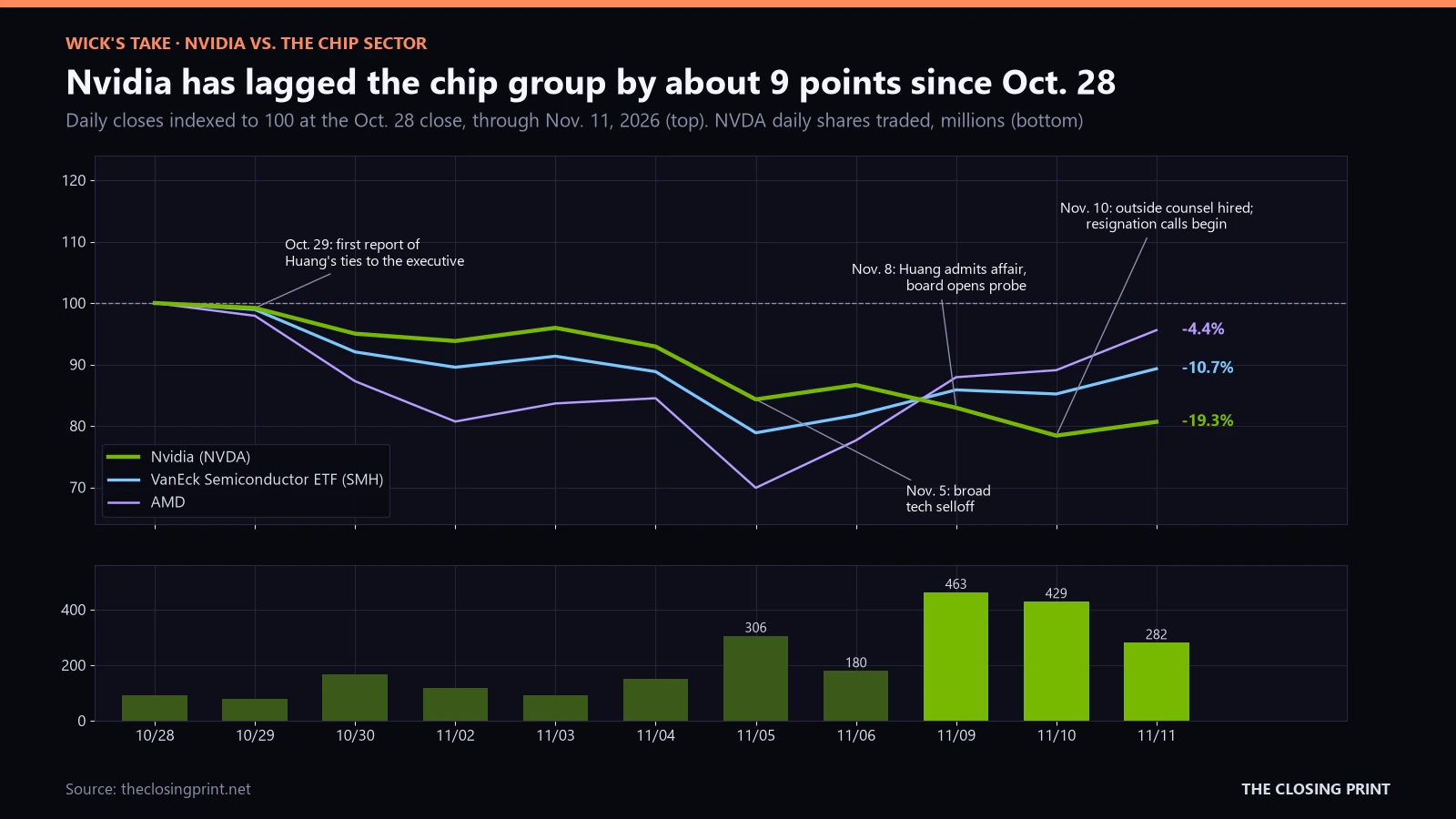
The split is the story. NVDA fell 4.3% on Monday and 5.5% on Tuesday on very heavy volume, 463 million and 429 million shares against an October average of about 100 million. Over the same two days the VanEck Semiconductor ETF (SMH) rose. Since Oct. 28, the day before the first report of Huang's ties to the executive, NVDA is down 19.3% and SMH is down 10.7%. Part of that is the Nov. 5 tech selloff that hit every chip stock, but the 8.6-point gap is Nvidia-specific. NVDA is now 28.6% below its 52-week high of $243.37 and down 6.8% this year, while SMH is up 40.8%. Morgan Stanley removed it from its top-pick list today, saying Huang's leadership is crucial to Nvidia's strategy.
What it would take to remove him
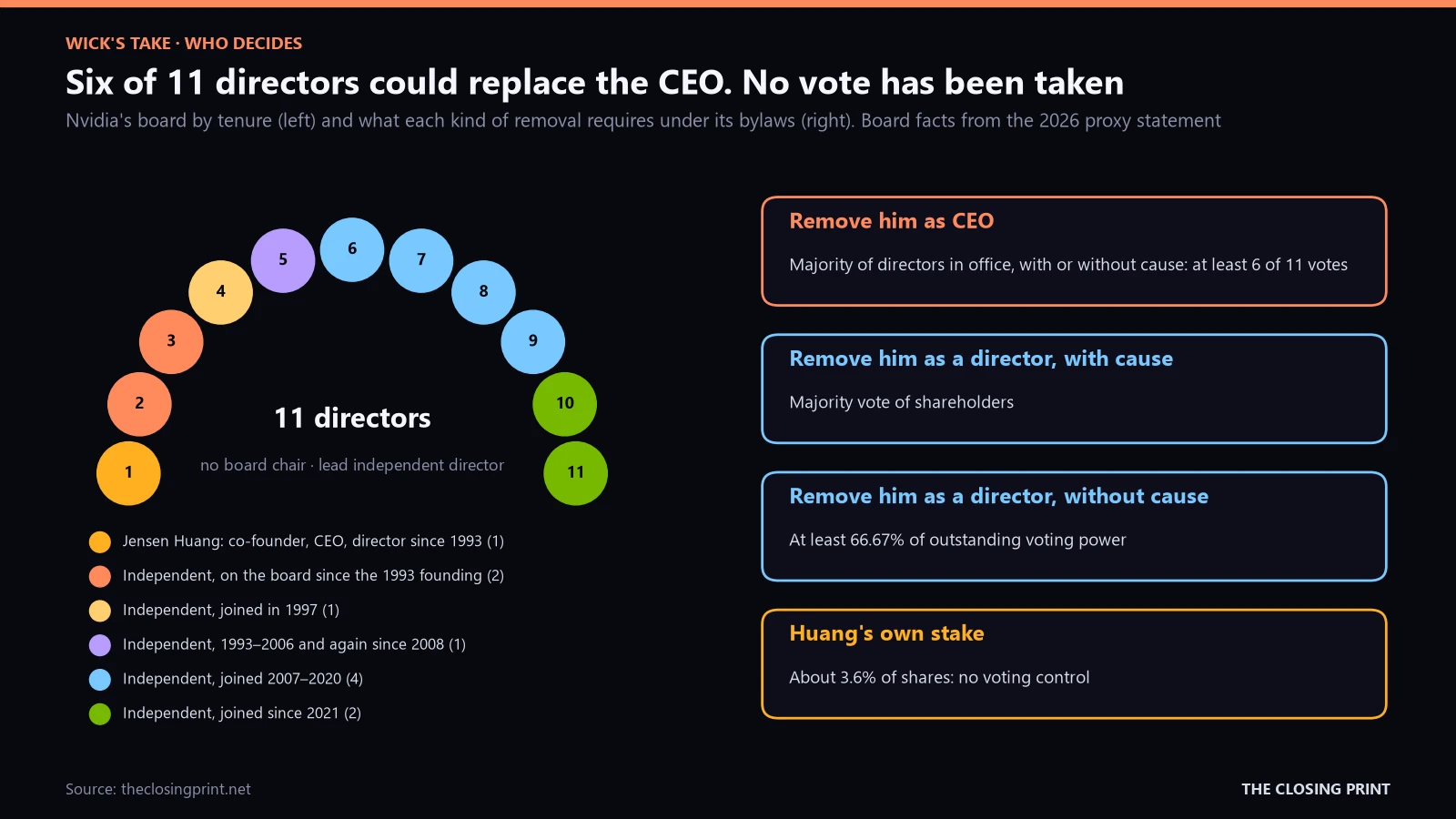
Nvidia's bylaws let a majority of the directors in office remove any officer, with or without cause. With 11 directors, that is six votes. No criminal finding is needed. Removing Huang from the board itself is separate: it takes a shareholder vote, a majority with cause or two-thirds of the outstanding voting power without cause. Huang owns about 3.6% of the shares, so unlike some founder-led tech companies, he does not control the vote. He has said he chose not to be chairman so the CEO can be held accountable and, if needed, removed.
The harder question is whether this board would do it. Nvidia has no board chair. Huang sets agendas with the lead independent director, Stephen Neal, and management prepares the material directors see, according to the proxy statement. Neal can call meetings of independent directors without Huang. Of the 11 directors, three, including Huang, have served since the 1993 founding, one joined in 1997 and another served from 1993 to 2006 before returning in 2008. Only two joined since 2021. The board counts all 10 non-executive directors as independent, but a board this long-tenured will face questions about how independent its judgment is. Whether long-serving directors sit on the investigating committee is worth watching.
There is no succession plan in public view
Nvidia has never named a No. 2. Huang has about 60 direct reports and has said he hopes the next CEO is already at the company, ideally about 20 years from now. Names now being discussed include Colette Kress, the CFO for 13 years, as a possible interim chief; Ian Buck, who helped build the CUDA software platform and runs the data-center computing business; and co-founder Chris Malachowsky. Outside names floated include Advanced Micro Devices (AMD) CEO Lisa Su and Arm Holdings (ARM) CEO Rene Haas, a former Nvidia executive. None of this comes from Nvidia, and an outsider from a direct competitor would be a hard sell. The lack of a plan is itself a governance problem the board can fix without removing anyone.
What the board can do
- Keep Huang, add guardrails. Name a chief operating officer or president, appoint an independent chair, refresh some long-serving seats and publish a succession process. This keeps the founder and answers the governance critique.
- Leave of absence or interim CEO. If the investigation finds Huang was not candid with directors, or if Washington makes him a barrier to export licenses, an interim leader such as the CFO becomes possible while the review finishes.
- Clean bill of health. A quick finding that no secrets or national security were compromised would let the stock re-rate toward the sector. The board's statement suggests that is where it started, but outside counsel was hired only on Tuesday, and reviews like this usually take weeks to months.
Prediction markets this week put the odds that Huang is gone by year-end at roughly one in six and by the end of March at about one in four. On Nov. 17, Nvidia reports fiscal third-quarter results. It guided to $108.0 billion of revenue, plus or minus 2%, after $96.2 billion last quarter, up 106% from a year earlier. Analysts expect about $108.8 billion and $2.47 a share. Huang usually takes part in the call. Whether he does this time, and what he and Kress say about China and the investigation, may matter more than the numbers. AI demand itself looks fine: CoreWeave's beat-and-raise quarter set off today's chip rally.
Wick's take
The headline question has a clear answer tonight: there is no confirmed move to oust Huang. But the stock's path says investors are pricing a real chance of one, and I think that is right. The board has already committed to confidence before its own review started, which makes reversing course costly, and Huang's 33-year record and the lack of a successor argue for keeping him. Against that, the political pressure is still building. A subpoena fight, an export-control bill named after the scandal and a Democratic Congress in January are business risks a board cannot ignore. The scenario I think is most likely is Huang staying with less power: a named No. 2, a board shake-up and a succession plan.
Levels: $168.89 (Tuesday's close) and $164.27 (the 52-week low) are the lines that matter on the downside. $186.64, Friday's close, would mark a full recovery of this week's losses. The gap with SMH is still the cleanest measure of how much the market is discounting the CEO question. What would change my mind: any sign that Huang did not disclose the relationship to the board when he should have, or that the investigating committee is led by the founding-era directors, would raise my odds of a change. A clear statement from the committee with a timetable, or an orderly governance overhaul announced alongside earnings, would lower them.
What to watch
- Tonight: whether Huang answers the House committee chairs by their end-of-day deadline, or whether they move to a subpoena.
- Tue, Nov. 17, about 4:20 PM: Nvidia earnings, call at 5:00 PM. Watch who leads the call, guidance, China commentary and any update from the board.
 .ics

- Wed, Nov. 18: the date the House chairs requested for Huang's briefing.
- Any update from the board's investigating committee, changes to the board, or a named chief operating officer.
- The annual defense bill and the AI Overwatch Act, plus any Commerce Department decision on adding Megaspeed to the entity list.
Not financial advice. This is Wick's analysis and opinion, for information only. Reported allegations are described as reported and have not been confirmed by Nvidia or by us. Scenario odds are Wick's estimates, not forecasts of any outcome.