
Written about 12:35 PM ET Wednesday, Nov. 11, 2026. All times Eastern. This is an evergreen explainer. The worked examples use round, made-up numbers for a hypothetical stock, labeled as such. Short-interest figures are FINRA data for the Oct. 30 settlement, published Nov. 10, and stock prices are trades as of about 12:10 PM ET today.
Our Most Shorted Stocks series tracks which names have the most shares sold short, and readers keep asking the same follow-up questions: who lends the shares, what the short seller pays, and why a heavily shorted stock can suddenly double. This piece walks through the whole trade from start to finish, the rules that govern each step, and the math that makes shorting so different from buying.
Step 1: Borrowing the shares
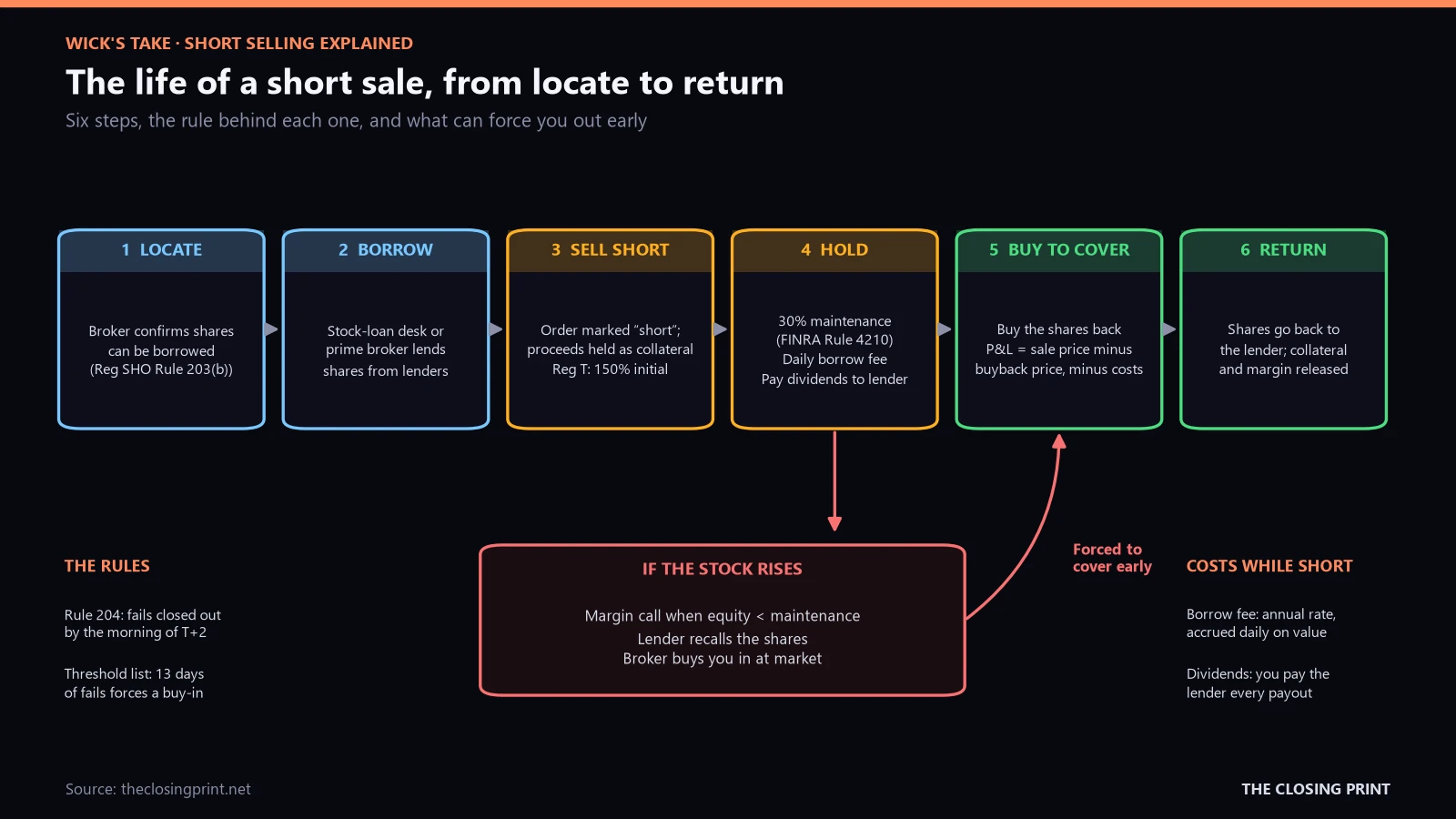
You cannot sell something you do not have, so a short sale starts with a loan. Brokers keep pools of lendable shares, mostly from customers who hold stock in margin accounts (the margin agreement lets the broker lend those shares) and from institutions such as pension funds, index funds and insurers that lend out their holdings for extra income. For hedge funds, the prime broker handles this through its stock-loan desk, which sources shares from its own clients and from agent lenders such as custody banks. Retail brokers do the same thing behind the scenes.
The locate. Under Rule 203(b) of the SEC's Regulation SHO, a broker cannot accept a short-sale order unless it has borrowed the shares, arranged to borrow them, or has "reasonable grounds to believe" they can be borrowed in time for delivery, and it must document that. In practice most brokers keep an easy-to-borrow list, a daily list of stocks with plenty of supply. A stock on that list can be shorted without a call to the desk. Anything else needs a specific locate, which may cost a fee or simply be unavailable. Bona fide market makers have a limited exception so they can keep quoting.
Marking the order. Rule 200 requires every sell order to be marked "long" or "short." The trade then settles like any other sale, one business day later (T+1) since May 2024, and the borrowed shares are delivered to the buyer. The buyer now owns real shares. The lender keeps the right to get its shares back, but gives up the right to vote them while they are on loan.
Step 2: Margin, and how margin calls work
Short sales must be done in a margin account. Two sets of rules apply.
Initial margin (Reg T, 150%). The Federal Reserve's Regulation T requires a short account to hold 150% of the short position's value when the trade is made. The sale proceeds cover 100%, and you put up the other 50% in cash or marginable securities. The proceeds stay in the account as collateral. You cannot withdraw them to spend. FINRA also requires at least $2,000 of equity to open a margin account.
Maintenance margin (FINRA Rule 4210). After the trade, FINRA sets a minimum that depends on the price of the stock:
- Stocks at $5 or more: the greater of $5 a share or 30% of the current market value.
- Stocks under $5: the greater of $2.50 a share or 100% of the current market value.
- Brokers can and often do set higher "house" requirements, especially for volatile or hard-to-borrow names, and can raise them without notice.
That second rule is why shorting cheap stocks ties up so much capital. Hertz Global Holdings (HTZ) traded near $1.53 late this morning, so FINRA's floor of $2.50 a share works out to about 163% of the position's value before any house add-on.
The margin call. As a shorted stock rises, the position's value climbs while the cash collateral stays the same, so your equity shrinks. When equity falls below the maintenance level, the broker issues a margin call. You can deposit cash or securities, or buy back shares to shrink the position. If you do not act fast enough, the broker can buy shares in your account at market without asking you first. Most margin agreements allow that, and in a fast market it often happens before you see the call.
Step 3: What it costs to stay short
Borrow fees. The lender charges an annualized fee, accrued daily on the current value of the borrowed shares, so the dollar cost rises if the stock does. Large, liquid stocks with lots of lendable supply, called general collateral on the street, are cheap to borrow. When demand to short a stock outruns the shares available, it becomes hard to borrow, and fees can jump to double-digit or even triple-digit annual rates. Brokers can change the rate every day, so a short that was cheap to open can become expensive to hold. Securities lenders also track utilization, the share of lendable supply already on loan. Once it gets close to 100%, new borrows are scarce and existing ones are at risk of recall.
Rebates. Institutional short sellers often earn interest on the cash collateral, called the short rebate. The rebate is roughly the cash reinvestment rate minus the borrow fee. With the Fed's target range at 3.75% to 4.00%, a fund shorting an easy-to-borrow stock gets most of that short-term rate back. On a hard-to-borrow name the fee can exceed the cash rate, so the rebate turns negative and the short seller pays the difference. Most retail brokers keep the interest on short proceeds and pay no rebate, which is one reason shorting usually costs individuals more than it costs funds.
Dividends. The lender is still entitled to every dividend, but the company pays it to whoever owns the shares, which is now the buyer. So the short seller pays the lender a payment in lieu of the dividend, charged to the account on the payment date. Being short over an ex-dividend date costs the full dividend, and a special dividend costs the full special amount.
Recalls and buy-ins. Stock loans are generally open-ended, and the lender can ask for its shares back at any time, often because it wants to sell them or vote them. If the broker cannot find replacement shares, it issues a recall and you must return them, usually by buying them in the market. If you do not, the broker buys you in. Recalls tend to cluster when a stock is already squeezing, because that is when holders want their shares back and new supply dries up. That is exactly the worst time to be forced to buy.
The rules: Reg SHO, the threshold list and the uptick rule
The SEC adopted Regulation SHO in 2004 and has tightened it several times since. The main pieces:
- Locate (Rule 203(b)(1)). Covered above. Every short sale needs a documented locate unless a narrow market-maker exception applies.
- Close-out (Rule 204). If a short sale fails to deliver on the settlement date, the broker must close out the fail by buying or borrowing shares by the start of regular trading on the next settlement day. Under today's T+1 cycle that is the morning of T+2. Until it does, the broker cannot short that stock for anyone without first borrowing the shares (the "penalty box"). Rule 204 became permanent in 2009.
- Threshold securities. A stock lands on the threshold list when fails to deliver at the clearing agency have reached at least 10,000 shares and at least 0.5% of shares outstanding for five consecutive settlement days. The exchanges publish these lists every day. If a fail in a threshold security lasts 13 consecutive settlement days, the clearing firm must close it out by buying shares, and it cannot short that stock for anyone until it does without borrowing first.
- The alternative uptick rule (Rule 201). The old uptick rule was repealed in 2007. Its 2010 replacement kicks in when a stock falls 10% or more from the prior close. For the rest of that day and all of the next, short sales can only be executed at a price above the national best bid, so short sellers cannot hit the bid and push it lower.
- Fails data. The SEC publishes fails-to-deliver data twice a month, with a lag. A large or persistent fail is a sign of delivery problems, not proof of illegal activity.
Naked shorting and why it is restricted. A naked short is a sale of shares the seller has not borrowed and has no reasonable expectation of borrowing. The sale can still go through, but the buyer does not receive shares on settlement, so it becomes a fail to deliver. Regulators restrict it because it can put shares in the market that do not exist, and in a small company it can push the price down in a way no real supply would. Rule 10b-21, adopted in 2008, makes it fraud to deceive a broker or buyer about your intent or ability to deliver. The locate rule and the close-out rule above are the practical defenses. Most fails in large stocks are short-lived operational delays, not naked shorting.
What is coming. The SEC's Rule 13f-2 would require large managers to report short positions to the SEC each month on Form SHO, with aggregated data made public. After a court sent the rule back for more economic analysis, the SEC pushed the start date to January 2028, so it does not apply yet.
Reading short interest: % of float and days to cover
FINRA Rule 4560 requires brokers to report the short positions in all customer and proprietary accounts in every equity security twice a month: as of a mid-month settlement date and an end-of-month settlement date. Reports are due by 6 p.m. ET two business days later, and FINRA publishes the totals roughly a week after that. The latest release, published Nov. 10, covers the Oct. 30 settlement. The next one covers the Nov. 13 settlement and is scheduled for Tuesday, Nov. 24.
- Short interest is the number of shares sold short and not yet bought back on the settlement date.
- Short % of float divides that by the float, the shares available to trade after excluding insiders and locked-up holdings. Many traders treat anything above 20% as high. It can top 100%, because a share that is borrowed and sold can be bought by someone who lends it out again.
- Days to cover divides short interest by average daily trading volume. It estimates how many normal sessions it would take for every short to buy back. The higher the number, the more crowded the exit.
- Don't confuse it with daily short volume. FINRA also publishes daily short-sale volume, the share of each day's trades marked short. That number is often near half of all volume, because market makers sell short as part of ordinary liquidity provision and buy back within the day. It says little about how many shares are actually held short.
Here is where some of the names from our October list stand on the Oct. 30 data, with two names we covered this week:
| Company | Short % of float | Shares short | Vs. Sept. 30 | Days to cover | Price (12:10 PM ET) |
|---|---|---|---|---|---|
| HTZ | 72.4% | 125.8M | +2.1% | 5.8 | $1.53 |
| Wolfspeed (WOLF) | 54.2% | 29.0M | +8.0% | 6.0 | $28.07 |
| Shoe Station Group (SHOE) | 53.1% | 9.5M | +0.9% | 10.8 | $14.39 |
| Groupon (GRPN) | 49.2% | 12.3M | +2.0% | 14.4 | $13.10 |
| CleanSpark (CLSK) | 42.9% | 78.7M | +3.2% | 4.5 | $7.00 |
| Ondas (ONDS) | 42.5% | 246.0M | +7.6% | 5.1 | $5.77 |
| LENZ Therapeutics (LENZ) | 37.0% | 7.1M | -33.1% | 7.0 | $4.18 |
| CoreWeave (CRWV) | 23.8% | 74.2M | +23.8% | 1.3 | $60.68 |
| NextNav (NN) | 17.4% | 23.4M | +10.2% | 6.3 | $9.01 |
| GameStop (GME) | 9.1% | 42.4M | -0.7% | 4.2 | $25.27 |
Three things stand out. HTZ still has more than 72% of its float sold short, the highest on our list, and its share price is below $2. Short interest in LENZ fell by a third in October as shorts covered. And short interest in CRWV jumped 23.8% to 74.2 million shares into Tuesday's earnings. It covers in just 1.3 days on its heavy volume, and the stock is up about 24% today after the beat (see our CoreWeave piece). Short interest in NN rose 10% before its report (see our NextNav piece). For contrast, GME, the most famous squeeze of all, now has about 9% of its float short.
Squeezes: short squeezes and gamma squeezes
A short squeeze happens when a rising price forces short sellers to buy back, through losses they will not tolerate, margin calls, recalls or buy-ins, and that buying pushes the price up further, forcing more shorts to cover. High short interest and many days to cover are the fuel. A catalyst, such as earnings, a buyout or a wave of retail buying, is the match. Without one, a heavily shorted stock that keeps falling usually means the shorts are right.
A gamma squeeze runs through the options market. When traders buy lots of short-dated call options, the dealers who sell them hedge by buying stock. As the price rises toward the strike, each call behaves more like stock, so dealers have to buy more shares to stay hedged. Near expiration that effect accelerates, and the dealers' buying can push the price up on its own.
The two can feed each other. In January 2021, GME had reported short interest above 100% of its float and very heavy call buying at the same time. The stock went from under $20 at the start of the month to an intraday high of $483 on Jan. 28, before its 2022 four-for-one split. In October 2008, Porsche disclosed that it controlled about 74% of Volkswagen (VOW) shares through stock and options, leaving very few shares for short sellers to buy back. For a short time Volkswagen was the world's most valuable company. Our Meme Stock Radar covered a buyout-driven squeeze in Bumble (BMBL) this October.
The unlimited-loss problem: a worked example
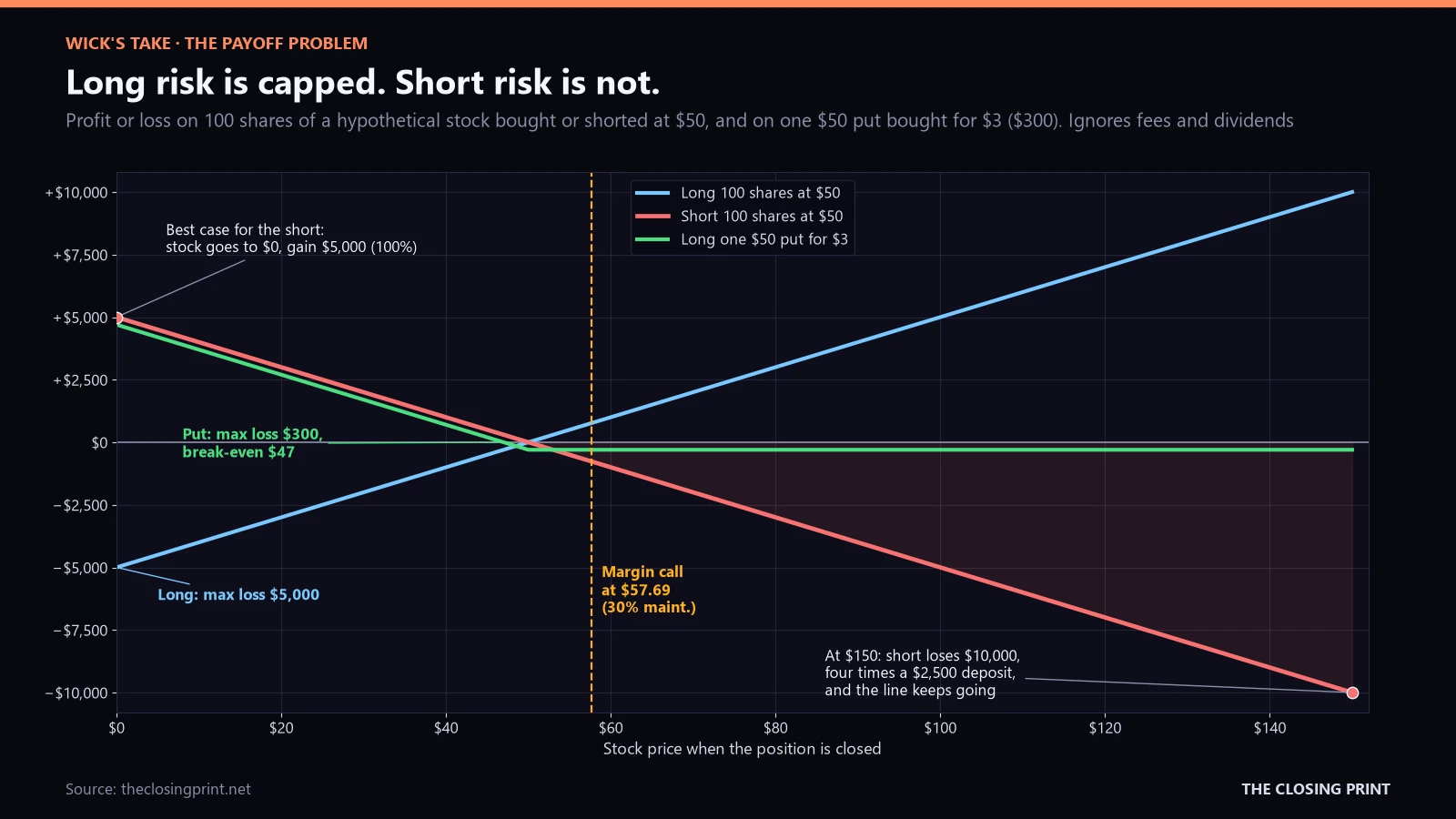
This is the part that makes shorting fundamentally different. A stock bought at $50 can lose at most $50. A stock shorted at $50 can make at most $50, and the loss has no limit. Here is a hypothetical trade with round numbers:
Costs: borrow fee about $5,000 × 2% × 90/360 = $25 (held flat here for simplicity). Payment in lieu of the dividend: 100 × $0.40 = $40.
Margin-call price: with 30% maintenance, equity of $7,500 minus the position's value falls below 30% of that value once the price passes $7,500 / 1.30 / 100 = $57.69. At that point you have lost $769, about 31% of your deposit, on a 15% move.
| XYZ when you cover | Price P&L | After $65 of costs | Vs. your $2,500 deposit |
|---|---|---|---|
| $25 (down 50%) | +$2,500 | +$2,435 | +97% |
| $40 (down 20%) | +$1,000 | +$935 | +37% |
| $50 (flat) | $0 | −$65 | −3% |
| $65 (up 30%) | −$1,500 | −$1,565 | −63%, after a margin call at $57.69 |
| $100 (up 100%) | −$5,000 | −$5,065 | −203%, more than you put up |
| $150 (up 200%) | −$10,000 | −$10,065 | −403% |
At $65, the position is worth $6,500 and your equity is $1,000, while 30% maintenance requires $1,950. The broker would call for $950 more or start buying you in. On a squeeze to $150 the loss is four times the deposit, and that is with a cheap borrow. Make it a hard-to-borrow name at a 50% annual fee, which is not unusual for a crowded short, and the 90-day fee alone is about $625. That would eat almost two-thirds of the $1,000 gain at $40.
Ways to bet against a stock without shorting it
- Buy put options. A put gives you the right to sell 100 shares at the strike price before expiration. The most you can lose is the premium. In the chart above, a hypothetical $50 put bought for $3 ($300) makes $700 at $40 and loses at most $300 even if XYZ triples. The trade-offs are time decay and the need to be right before expiration. Our VIX playbook covers how volatility drives option prices.
- Inverse ETFs. Funds such as ProShares Short S&P500 (SH) aim to return the opposite of an index for one day. They reset every day, so over weeks the result can drift far from the inverse of the index's move, especially in choppy markets. FINRA has warned that leveraged and inverse funds are generally built for holding periods of a day. The most you can lose is what you put in.
- CFDs, outside the U.S. Contracts for difference let traders in the UK, Europe and Australia bet on a price fall without borrowing shares. They are not available to U.S. retail investors. UK and EU rules cap retail leverage on single-stock CFDs at 5 to 1, require brokers to close positions when margin falls to half the requirement, and protect clients from losing more than the account balance. CFD providers' own disclosures show most retail accounts lose money.
- Selling calls or buying bear spreads are other options routes, but a naked short call has the same unlimited-loss profile as a short stock position.
Taxes, briefly
In the U.S., a short sale is taxed when you close it, by buying back and returning the shares. Because the holding period is measured by the shares you deliver, which you usually buy right before closing, gains are generally short-term and taxed as ordinary income, however long the position was open. Payments in lieu of dividends are not deductible if you close the short within 45 days. In that case they are added to your cost basis. Held longer, they may be deductible as investment interest if you itemize. Wash-sale rules apply to shorts too. Shorting a stock you already own ("shorting against the box") is treated as a constructive sale and triggers the gain. The IRS covers all of this in Publication 550. Talk to a tax professional before you rely on any of it.
Wick's take
Short sellers do useful work. They find frauds, push back on bubbles and add liquidity, and a market where nobody can bet against a stock prices it worse. But the trade is built against the person doing it. The upside is capped at 100%, the downside is open, the costs run every day, and the lender, the broker and the rules can all force you out at the worst moment. A short can be right on the company and still lose money because the borrow got recalled during a squeeze.
Next on the calendar: FINRA's Nov. 24 release of Nov. 13 short interest, which will show whether the CRWV shorts covered into this week's rally. We will pick it up in the next edition of the Most Shorted series.
Not financial or tax advice. This is Wick's analysis and opinion, for information only. XYZ is a hypothetical stock, and the fees, dividend and option price in the examples are illustrative. Broker terms, house margin rules and borrow rates vary and can change without notice. Short-interest figures are as of the Oct. 30 settlement date and prices are intraday.