
Written about 10:10 PM ET Monday, Nov 9, 2026. All times Eastern. The October CPI report is due Tuesday, Nov 10, at 8:30 AM ET.
The Bureau of Labor Statistics releases the report at 8:30 AM. The November CPI is not due until Dec. 10, the day after the Fed announces its December decision, so this is the final inflation reading before policymakers vote. The bond market is also closed Wednesday for Veterans Day while stocks stay open, which leaves Tuesday as the only full Treasury session to absorb the number until Thursday.
The set-up is unusually tense after Monday's rally. As our Post-Market Summary covered, the S&P 500 rose 2.35% to 7,549.94, its best day since April, and the Cboe Volatility Index (VIX) fell to 19.92. S&P 500 futures were near 7,583 late Monday evening. A rally like that leaves less room for an upside surprise in inflation.
What comes out Tuesday, and what doesn't
BLS could not collect most October 2025 prices during last year's government shutdown. Its shutdown FAQ says it will not publish 12-month percent changes for October 2026 for indexes where October 2025 data are not available. That includes the all-items index and core. Monthly changes will be published as usual. A few indexes built from non-survey data, such as gasoline, do have October 2025 values, so their annual changes can still appear.
The last official annual rates are September's: 3.7% for all items and 2.6% for core. Any annual figure you see Tuesday morning is an estimate, not a BLS number. The Cleveland Fed's nowcast, which substitutes its own estimate for the missing October 2025 index, puts October at 3.74% headline and 2.48% core. Our own rough math, filling the gap with the midpoint of the September and November 2025 indexes, puts a consensus print near 4.0% headline and 2.7% core. Some calendars show a 3.9% year-over-year "forecast." That is also an estimate, and no official figure will match it.
| Measure | September (official) | October consensus | Cleveland Fed nowcast |
|---|---|---|---|
| Headline CPI, month over month | +0.6% | +0.3% | +0.24% |
| Core CPI (ex food and energy), m/m | +0.3% | +0.2% | +0.21% |
| Headline CPI, 12 months | 3.7% | Not published | 3.74% (unofficial) |
| Core CPI, 12 months | 2.6% | Not published | 2.48% (unofficial) |
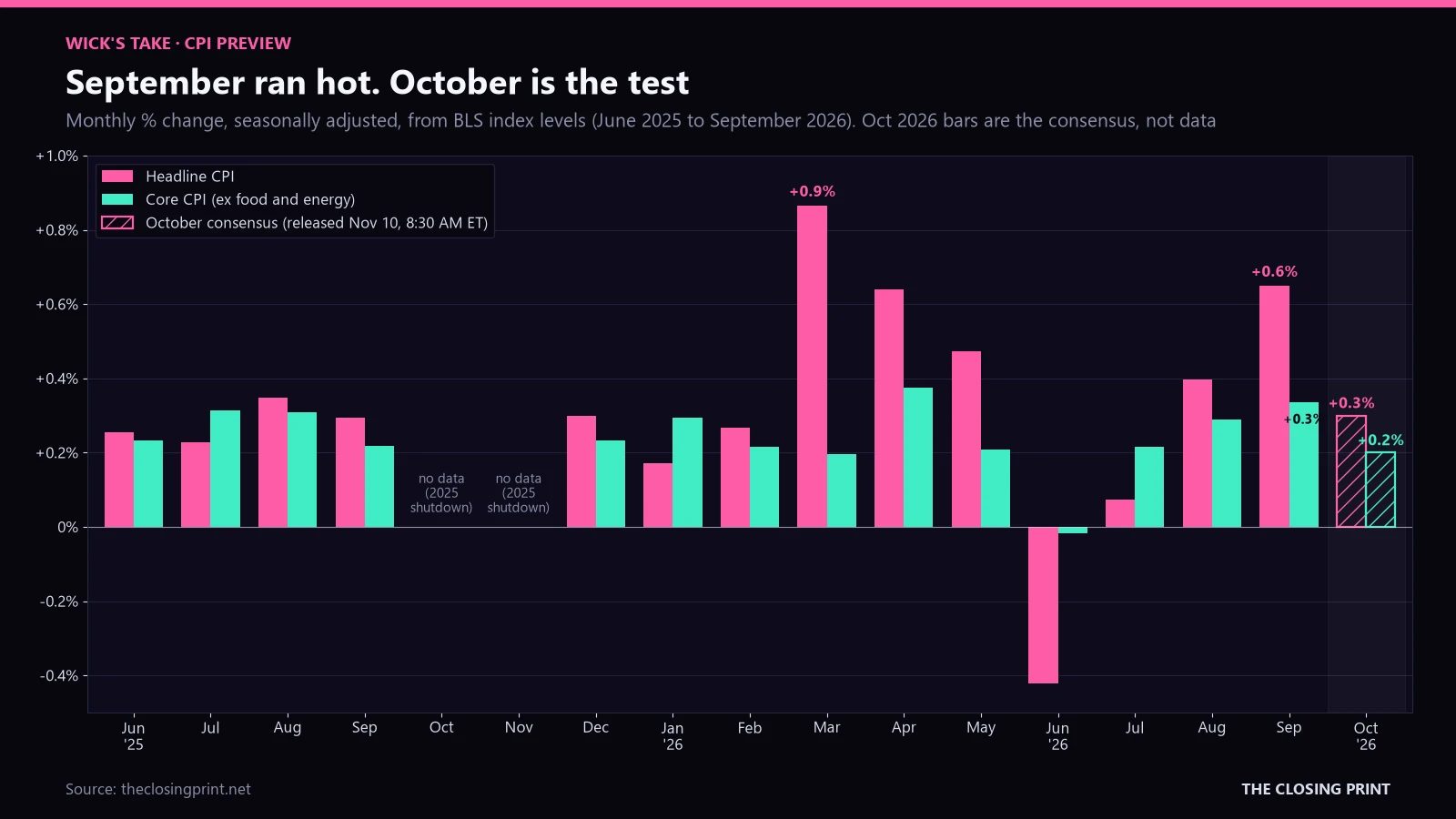
September set a high bar, mostly through gasoline
September's 0.6% gain tied April for the largest since March. BLS said the gasoline index rose 9.1% and accounted for more than half of the increase, and energy rose 5.2%. Core rose 0.3% for a second month. Shelter rose 0.4%, with owners' equivalent rent up 0.3%, rent up 0.2% and hotel prices (lodging away from home) up 2.0% after a 2.4% jump in August. Airline fares rose 1.2% and are up 22.4% over the year, and used cars rose 0.7%. Food was unchanged.
That pattern explains why forecasters expect a calmer October. Hotel prices and airfares are volatile and often give back gains. Goods prices outside food and energy rose 0.3% in September but are up only 0.7% over the past year, so September looks more like a one-off than a trend.
Gasoline: less relief than the pump suggests
The U.S. Energy Information Administration's weekly average for regular gasoline peaked at $4.478 a gallon on Sept. 21 and was down to $4.153 by Nov. 2. But CPI compares monthly averages, and October averaged about $4.31, only about 1% below September's $4.35.
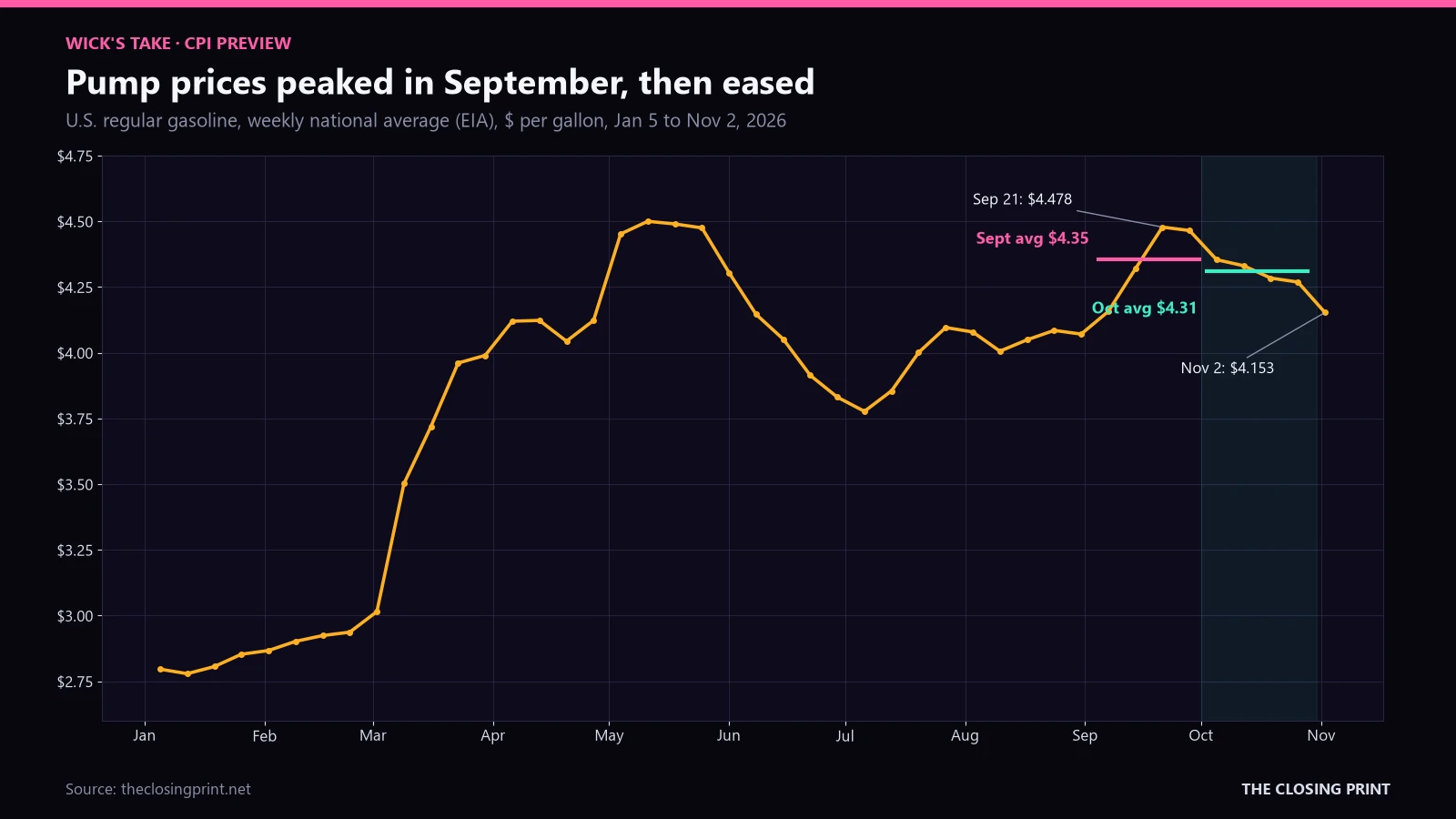
Seasonal adjustment also works against the decline. BLS factors assume pump prices normally fall in October. In each of the past two years, the gasoline seasonal factor dropped about 1.7 percentage points from September to October. A roughly 1% decline in the raw average could therefore show up as a small increase in the seasonally adjusted gasoline index, which is why the headline forecast is 0.3% rather than lower.
Monday's drop in crude, covered in our oil piece, does not change October CPI. Those prices were collected weeks ago. Cheaper oil matters for November's report and for how investors react to Tuesday's number: a hot core print is easier to shrug off if energy is already falling.
What would matter for a December hike
The Fed held its target range at 3.75% to 4.00% on Oct. 28 by a 10–2 vote. Governor Lisa Cook and Cleveland Fed President Beth Hammack dissented in favor of a quarter-point hike. The statement said inflation "remains elevated" and that "the Committee will deliver price stability." Since then, BLS said October payrolls rose 165,000 and unemployment fell to 4.1%. Average hourly earnings are up 3.1% from a year earlier, below September's 3.7% CPI rate, so real wages are falling.
Fed officials are leaning hawkish. On Monday, Chicago Fed President Austan Goolsbee said, "We've got to come to terms with this cost side and inflation side failure in the mandate." He added that the AI data-center build-out "is, to my eye, starting to look more just like old-fashioned demand overheating." CME FedWatch put the odds of a December hike at about 84% Monday evening. Our own read of December fed funds futures, which traded around 95.975 on Monday, implies about 80%. Treasury's par curve showed the 2-year yield at 4.56% and the 10-year at 4.88% on Monday.
That means one soft month is unlikely to change the Fed's plans. What matters is whether the number makes a hike look certain or only likely:
| Core CPI, m/m | Wick's read | Likely first reaction |
|---|---|---|
| 0.1% or lower | A real break in the trend. December becomes a closer call. | Yields drop, small caps and chips extend Monday's rally |
| 0.2% (consensus) | Relief, but not enough to take a hike off the table. | Choppy. The market has largely priced this |
| 0.3% | A third straight 0.3% month. A December hike looks close to certain. | 2-year yield higher, S&P gives back part of Monday |
| 0.4% or higher | Talk shifts to more than one hike. | Sharp sell-off in rate-sensitive and high-multiple stocks |
What to watch in the breakdown
- Core to two decimals. 0.24% rounds to 0.2% and 0.26% rounds to 0.3%, so traders will work out the unrounded figure from the index levels within minutes.
- Shelter. After a 0.4% gain in September, a return to about 0.3% would help. Watch hotel prices, which rose 2.4% and 2.0% in the last two months.
- Core goods. September's 0.3% included used cars (+0.7%) and apparel (+0.3%). A drop back toward 0.1% would suggest the jump was a one-off.
- Services outside housing. Airfares and other transport costs carry fuel costs into core. This is where Goolsbee says the problem has spread.
- Gasoline after seasonal adjustment. A small rise would not be a surprise, for the reason above. A large rise would be.
- Food. Unchanged in September. Some forecasters expect it to pick up as transport costs feed into grocery prices.
Wick's take
The consensus looks reasonable. The Cleveland Fed's nowcast has core at 0.21%, and the September jumps in hotels, airfares and goods are the kind that usually fade. But core has printed 0.3% two months in a row, and Monday's rally priced in a lot of good news. Even a clean 0.2% leaves a December hike likely, which limits the upside. A 0.3% would confirm what the Fed is already signaling.
What would change my mind: a core print of 0.1% with shelter at 0.2% or less. That would be the first real sign that tight policy is working, and it would make the bull case the favorite.
What to watch (ET)
- Tue, Nov 10, 8:30 AM: US October CPI.
 .ics

- Tuesday: Fed officials scheduled to speak include Christopher Waller, Michelle Bowman, Lorie Logan, Jeff Schmid and Anna Paulson. Their first comments after the CPI could sharpen the December debate.
- Wed, Nov 11: Veterans Day. Stock markets are open; the bond market is closed.
- Fri, Nov 13, 8:30 AM: US October PPI..ics
- Wed, Dec 9, 2:00 PM: FOMC decision with new projections; press conference 2:30 PM..ics
Not financial advice. This is Wick's analysis and opinion, for information only. Forecasts, futures quotes and probabilities change quickly and may differ by the time you read this. Unofficial annual inflation estimates are not BLS figures. Scenario odds are Wick's estimates, not forecasts of any outcome.