
Written about 12:30 PM ET Monday, Nov 9, 2026. All times Eastern; quotes as of about noon ET.
Crude is extending one of its worst stretches of the year. Brent finished last week about 16% below its late-October peak of $117.64, and on Monday it touched $92.80 before steadying. WTI's intraday low was $86.21. Both contracts are now back where they traded before the autumn spike in the risk premium.
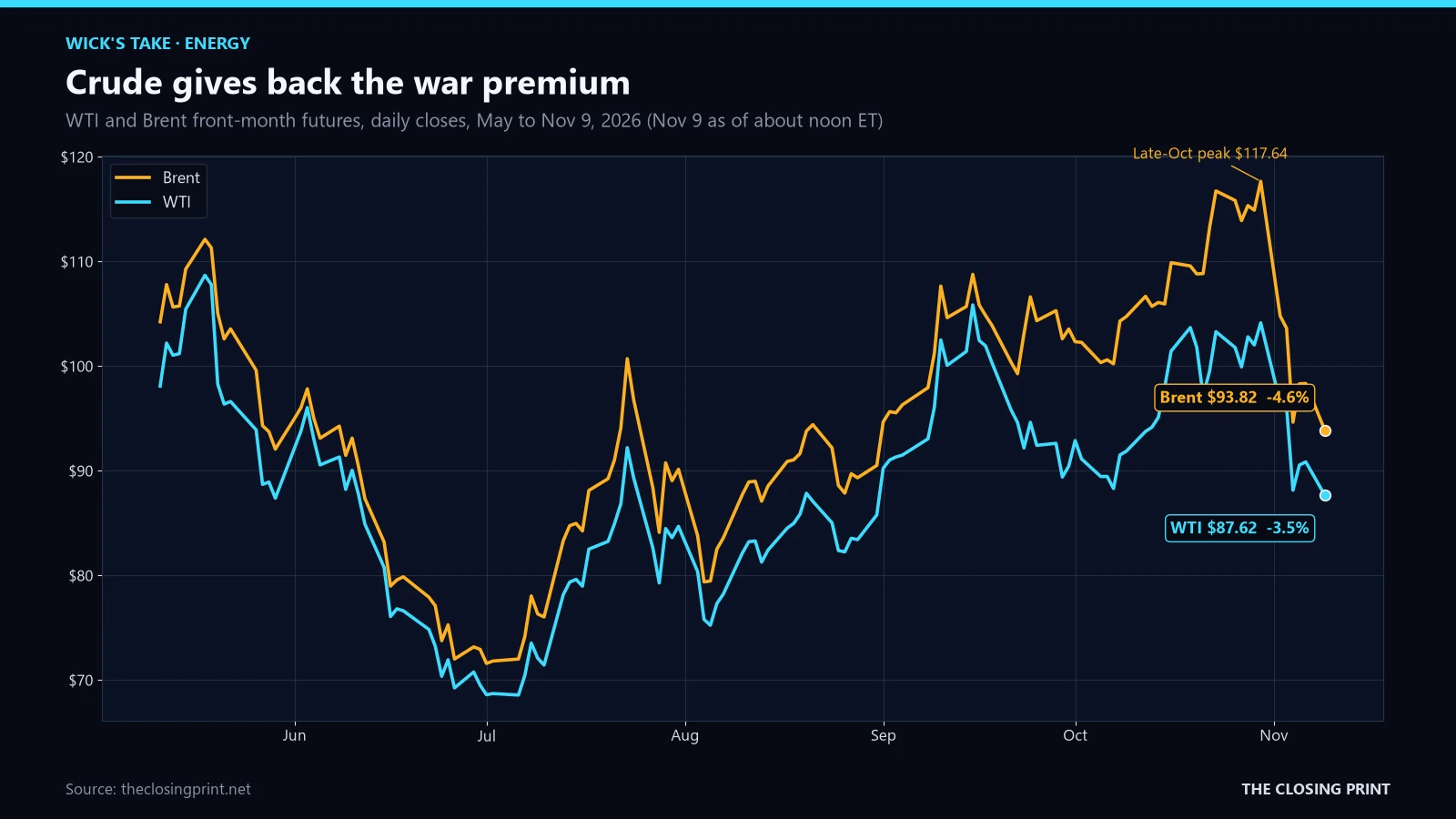
Where things stand (about noon ET)
| Market | Level | Change vs. Friday |
|---|---|---|
| Brent crude, Jan ($/bbl) | $93.82 | −4.58% |
| WTI crude, Dec ($/bbl) | $87.62 | −3.53% |
| RBOB gasoline, Dec ($/gal) | $2.69 | −3.34% |
| Natural gas, Dec ($/MMBtu) | $3.16 | +5.43% |
| Energy Select Sector SPDR (XLE) | $62.08 | +0.74% |
| Exxon Mobil (XOM) | $164.71 | −0.70% |
| Chevron (CVX) | $211.86 | −0.35% |
| S&P 500 | 7,538.61 | +2.19% |
| Cboe Volatility Index (VIX) | 20.57 | −19.77% |
What is driving it
The driver is diplomacy, not barrels. Over the weekend Trump said he was highly unlikely to order new strikes on Iran while talks to end the conflict make progress, and Qatar's prime minister is due at the White House on Monday. Reports describe a Qatari-brokered interim proposal that would reopen the Strait of Hormuz in exchange for easing the US blockade, but neither Washington nor Tehran has confirmed any terms.
The risk has not gone away. Both sides reported attacks on ships in or near the Strait of Hormuz over the weekend, and a similar framework in May fell apart after a tanker attack. Futures are trading the headline, while the shipping lanes are still contested.
Physical demand looks soft too. Prices this high have cut into consumption, and cargo pricing has weakened against futures. That helps explain why the selling has been so steady even without a signed agreement.
Who wins and who doesn't
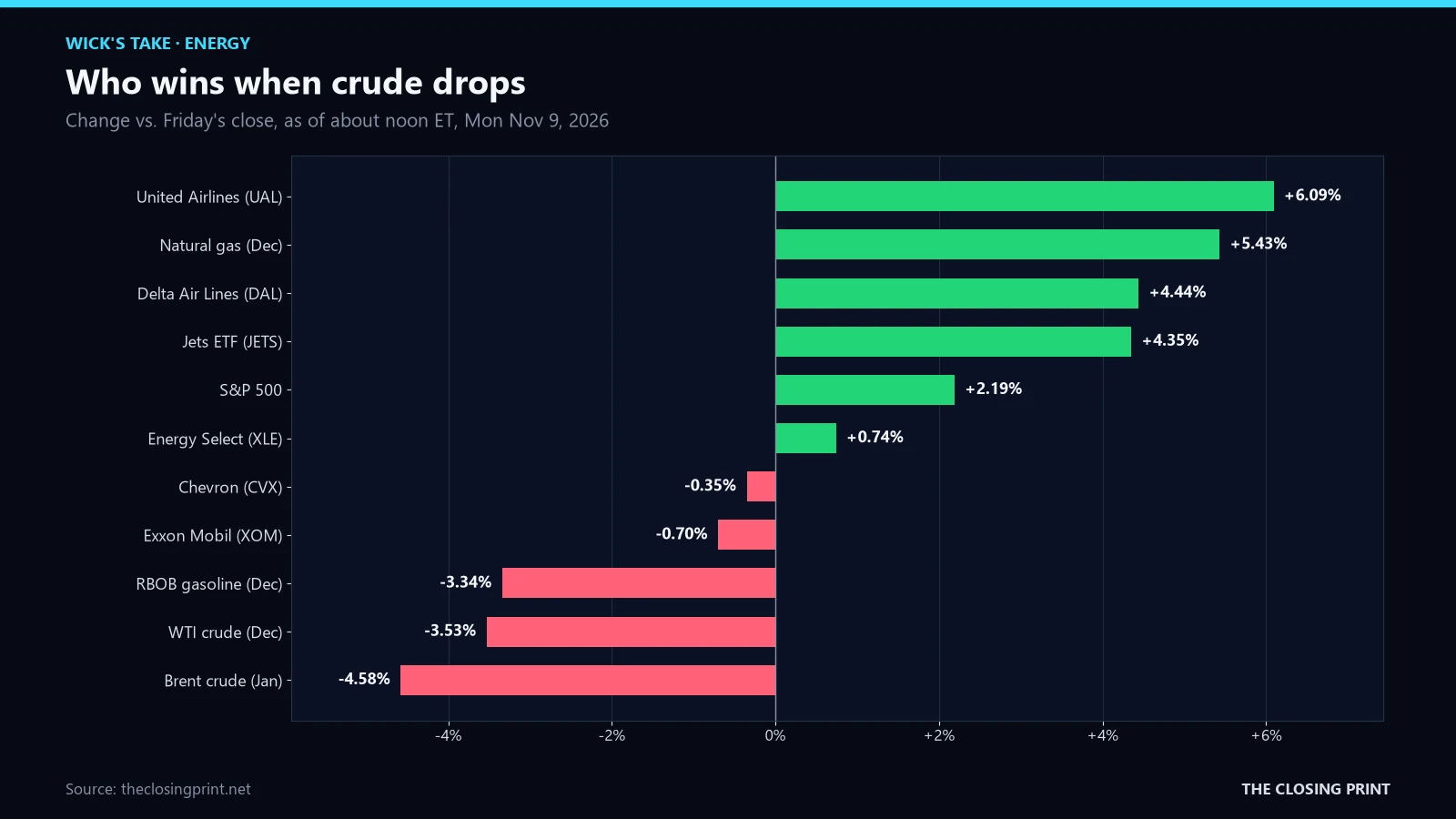
The equity reaction is the tell. Energy stocks already took their hit last week: the Energy Select Sector SPDR (XLE) is down about 12% from its Oct. 30 close of $70.02. On Monday XLE is slightly higher even with crude down more than 3%. Exxon Mobil (XOM) and Chevron (CVX) are only modestly lower. In Wick's view, much of the de-escalation scenario is already priced into the majors, so the next leg down in crude may do less damage to the stocks than the last one did.
The clear winners are fuel buyers. United Airlines (UAL) is up about 6.1%, Delta Air Lines (DAL) about 4.4% and the U.S. Global Jets ETF (JETS) about 4.4%. RBOB gasoline is trading at its lowest level in six months. Natural gas is moving the opposite way, up about 5.4% to roughly $3.16, which is a reminder that it trades on weather and storage more than on Gulf headlines.
For the broader market, cheaper oil is doing what this morning's pre-market note expected. Volatility is falling, with the VIX down from 25.64 to about 20.6. Stocks are rising: the S&P 500 is up about 2.2% at midday, already above the 7,400–7,480 range Wick laid out before the open.
Wick's take
- Levels: Brent $92.80 and WTI $86.21 are today's lows and the first lines to watch. A close back above $98 Brent would mean the de-escalation trade has gone too far.
- Positioning: with energy equities firm on a red crude day, Wick would rather fade further weakness in the majors than chase it, while holding the airline bounce loosely because it rests on one headline.
- Inflation angle: Tuesday's CPI covers October, when crude was still elevated, so the gasoline relief will show up in November's data, not tomorrow's.
What to watch (ET)
- After the close today: Occidental Petroleum (OXY) third-quarter results.
 .ics

- Nov 10, 8:30 AM: US October CPI..ics
- Nov 10, about 12:00 PM (estimated): EIA Short-Term Energy Outlook..ics
- Any confirmed US-Iran terms from Monday's White House meeting with Qatar's prime minister, and any further shipping incidents near Hormuz.
Not financial advice. This is Wick's analysis and opinion, for information only. Intraday futures and stock quotes move quickly and may differ from the settlement and closing prices. Scenario odds are Wick's estimates, not forecasts of any outcome.