
Written about 10:19 AM ET Thursday, Oct. 29, 2026. All times Eastern. Prices are intraday and will move. Lilly reported before the open and held its call at 10:00 AM.
- Q3 revenue rose 39% to $24.4 billion against about $22.6 billion expected. Non-GAAP EPS was $7.48 against about $6.26, even after $4.57 a share of charges for buying drug programs.
- Mounjaro brought in $10.7 billion (+65%) and Zepbound $5.35 billion (+49%). Both beat. Volume rose 53% while realized prices fell 15%.
- 2026 revenue guidance is now $91 billion to $92 billion, up from $85 billion to $87 billion. The EPS range dipped to $35 to $36 only because of the Q3 deal charges; the underlying business added $4.07 a share.
- The soft spot was Foundayo, the oral GLP-1, at $184 million against roughly $217 million to $229 million expected. Novo Nordisk’s (NVO) Wegovy pill still leads in US prescriptions.
- Retatrutide has now succeeded in six Phase 3 trials, including large cuts in sleep apnea severity. It is the main reason the market pays up for Lilly’s next five years.
- About $900 million of the quarter came from milestones and rebate adjustments that won’t repeat. Even without it, revenue beat.
- The quarter against expectations
- Mounjaro and Zepbound
- Retatrutide: the head-to-head win
- Sleep apnea: a second market for the same drugs
- Foundayo and the rest of the pipeline
- Pricing, Medicare and the government deal
- Manufacturing and margins
- Competition: Novo Nordisk and the rest
- The stock today and valuation
- Risks
- Scenarios and Wick's pick
- What to watch
The quarter against expectations
This was a clean beat. Revenue of $24.4 billion was about $1.8 billion above what analysts expected, and Lilly raised its full-year revenue outlook for the third time this year. Volume did the work: worldwide volume rose 53%, while realized prices fell 15%. In the US, revenue rose 34% to $15.1 billion on 41% more volume and 7% lower prices. Outside the US, revenue rose 47% to $9.3 billion, with volume up 76% and prices down 29%, mostly because Mounjaro went onto China’s national reimbursement list in the first quarter.
The EPS line needs a second look. Non-GAAP EPS of $7.48 was up only 7% from a year ago, but it absorbed $4.57 a share of acquired in-process R&D charges, about $4.2 billion, mostly for the AtaiBeckley and Curevo deals. A year ago that charge was $0.71. Before those charges, EPS was about $12.05, up 56%. Reported EPS was $7.22, up 16%.
There’s one caveat. About $900 million of revenue came from items that won’t repeat, mainly $410 million in final Jardiance milestones from Boehringer Ingelheim and favorable adjustments to rebate and discount estimates. Take all of it out and revenue was still about $23.5 billion, roughly $900 million above expectations.
| Q3 2026 | Reported | Expected | Year ago | Change |
|---|---|---|---|---|
| Revenue | $24.40B | about $22.6B | $17.60B | +39% |
| Non-GAAP EPS | $7.48 | about $6.26 (range of estimates roughly $5.60 to $6.70) | $7.02 | +7% |
| Non-GAAP EPS before acquired R&D charges | $12.05 | n/a | $7.73 | +56% |
| Reported (GAAP) EPS | $7.22 | n/a | $6.21 | +16% |
| Mounjaro | $10.72B | about $10.1B | $6.52B | +65% |
| Zepbound | $5.35B | about $5.09B | $3.59B | +49% |
| Foundayo (oral orforglipron) | $184M | about $217M to $229M | n/a | below |
| Non-GAAP gross margin | 84.4% | n/a | 83.6% | +0.8 pt |
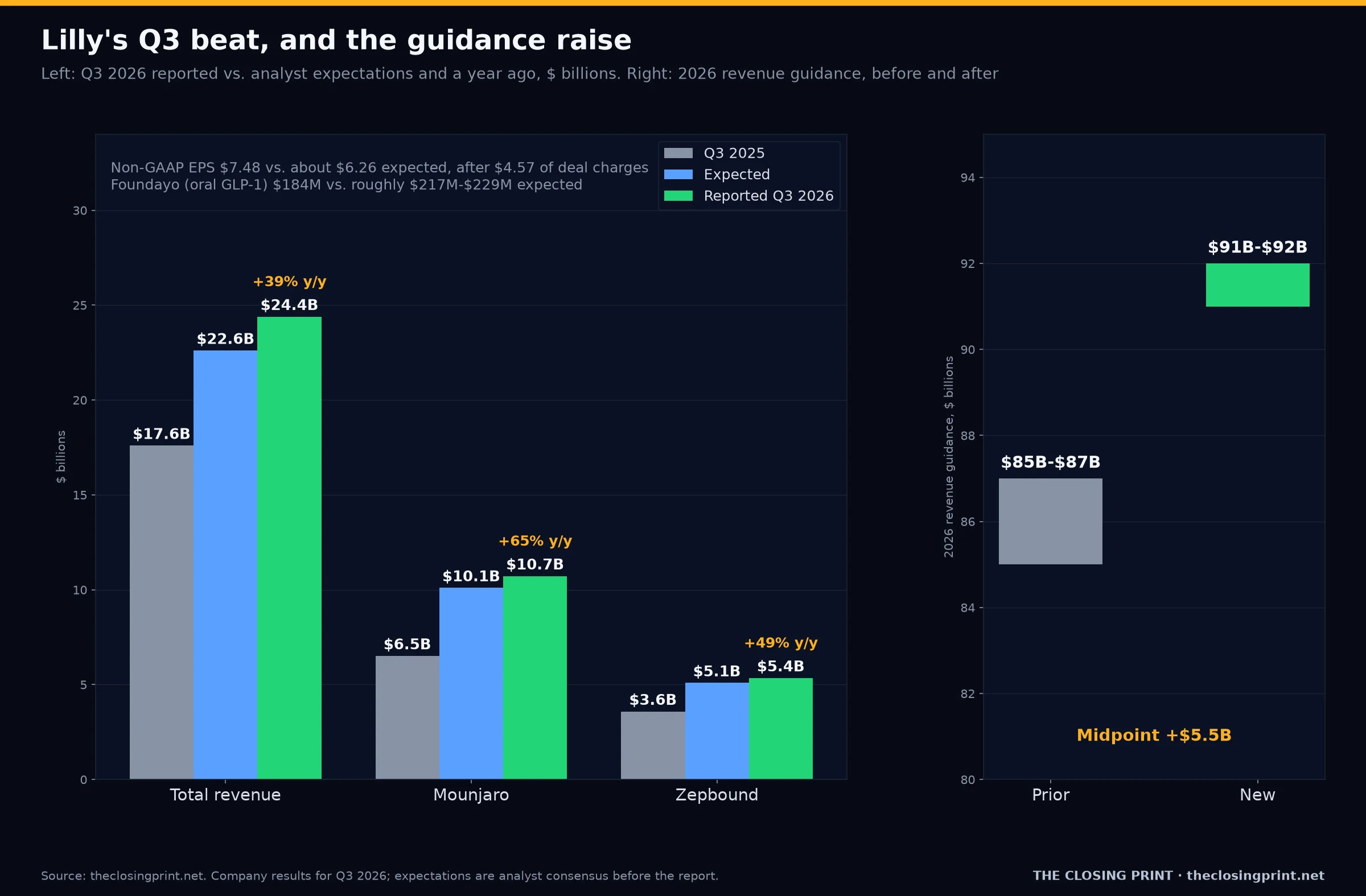
The guidance is the bigger story. The revenue midpoint went up $5.5 billion, to $91 billion to $92 billion, and the performance margin (gross profit minus R&D and selling costs, divided by revenue) went to 52.0%-52.5% from 49.0%-50.5%. The EPS range slipped $0.50 to $35 to $36, but only because Q3’s deal charges are counted in it. Lilly says the underlying business added $4.07 a share at the midpoint. Through nine months non-GAAP EPS is $24.41, so the range implies roughly $10.59 to $11.59 in the fourth quarter, with no deal charges assumed after Sept. 30.
| 2026 guidance | Prior | New | Implied Q4 |
|---|---|---|---|
| Revenue | $85B to $87B | $91B to $92B | $23.8B to $24.8B |
| Performance margin | 49.0% to 50.5% | 52.0% to 52.5% | n/a |
| Tax rate | 18% to 19% | 19% to 20% | n/a |
| Non-GAAP EPS | $35.50 to $36.50 | $35.00 to $36.00 | $10.59 to $11.59 |
| EPS before Q3 acquired R&D charges | n/a | about $40.07 at the midpoint (+$4.07) | n/a |
Mounjaro and Zepbound
Tirzepatide, sold as Mounjaro for diabetes and Zepbound for obesity, brought in about $16.1 billion in the quarter, two-thirds of Lilly’s revenue. Mounjaro alone did $10.7 billion, likely the best-selling drug in the world right now. Its growth is increasingly international. US Mounjaro sales rose 41% to $5.0 billion, and sales outside the US rose 93% to $5.7 billion, now more than half the total. Year to date, Mounjaro is at $29.3 billion, up 89%.
Zepbound rose 49% to $5.35 billion, ahead of the roughly $5.09 billion expected, even though its realized price fell. US demand is broadening: Medicare started covering obesity drugs in July through a temporary pilot, and Lilly’s cash-pay channel keeps growing. Lilly also won a new label for Mounjaro this quarter, to reduce cardiovascular risk in adults with type 2 diabetes, which gives doctors and insurers one more reason to choose it.
| Product | Q3 2026 | Growth | What it is |
|---|---|---|---|
| Mounjaro | $10,723M | +65% | Tirzepatide for type 2 diabetes. US $5.0B (+41%), outside the US $5.7B (+93%) |
| Zepbound | $5,352M | +49% | Tirzepatide for obesity and obstructive sleep apnea, almost all US |
| Jaypirca | $228M | +59% | Non-covalent BTK inhibitor for blood cancers; new first-line CLL label |
| Ebglyss | $202M | +59% | Atopic dermatitis |
| Kisunla | $193M | +175% | Early Alzheimer’s disease |
| Foundayo | $184M | new | Once-daily oral GLP-1 (orforglipron), launched in the US in April |
| Omvoh | $114M | +76% | Ulcerative colitis and Crohn’s disease |
| Inluriyo | $73M | new | Oral SERD for ER+, HER2- breast cancer |
The newer drugs outside obesity are starting to matter. Key products in immunology, oncology and neuroscience doubled from a year ago. Kisunla for Alzheimer’s rose 175% to $193 million, and Jaypirca, Ebglyss and Omvoh each grew 59% to 76%. They’re still small next to tirzepatide, but they’re the start of the answer to the obvious question of what Lilly does if the GLP-1 market gets crowded.
Retatrutide: the head-to-head win
The day before earnings, Lilly reported topline results from TRANSCEND-T2D-2, the first head-to-head Phase 3 trial of retatrutide against Novo Nordisk’s Ozempic at its highest approved dose, 2 mg. Retatrutide is a triple agonist: it hits the GIP, GLP-1 and glucagon receptors, one more target than tirzepatide and two more than semaglutide. The trial enrolled 1,298 adults with type 2 diabetes on metformin, with an average starting weight of 225.8 pounds, and ran 80 weeks.
Both retatrutide doses cut A1C by about 2.2 points, against 1.8 for Ozempic, and weight loss was more than double: 19.5% (44.3 pounds) at 9 mg and 20.9% (47.4 pounds) at 12 mg, against 9.4% (20.9 pounds) on Ozempic. Retatrutide also did better on non-HDL cholesterol, triglycerides and systolic blood pressure. It’s the sixth Phase 3 trial in which retatrutide hit its goals.
| TRANSCEND-T2D-2, week 80 | Retatrutide 9 mg | Retatrutide 12 mg | Ozempic 2 mg |
|---|---|---|---|
| A1C change (baseline 8.3%) | -2.2 pts | -2.2 pts | -1.8 pts |
| Weight change (baseline 225.8 lbs) | -19.5% (-44.3 lbs) | -20.9% (-47.4 lbs) | -9.4% (-20.9 lbs) |
| Diarrhea | 28.3% | 32.7% | 26.4% |
| Nausea | 21.2% | 23.8% | 21.3% |
| Vomiting | 10.2% | 15.0% | 13.2% |
| Dysesthesia (abnormal skin sensation) | 4.8% | 6.5% | 2.7% |
| Stopped because of side effects | 4.8% | 7.9% | 2.7% |
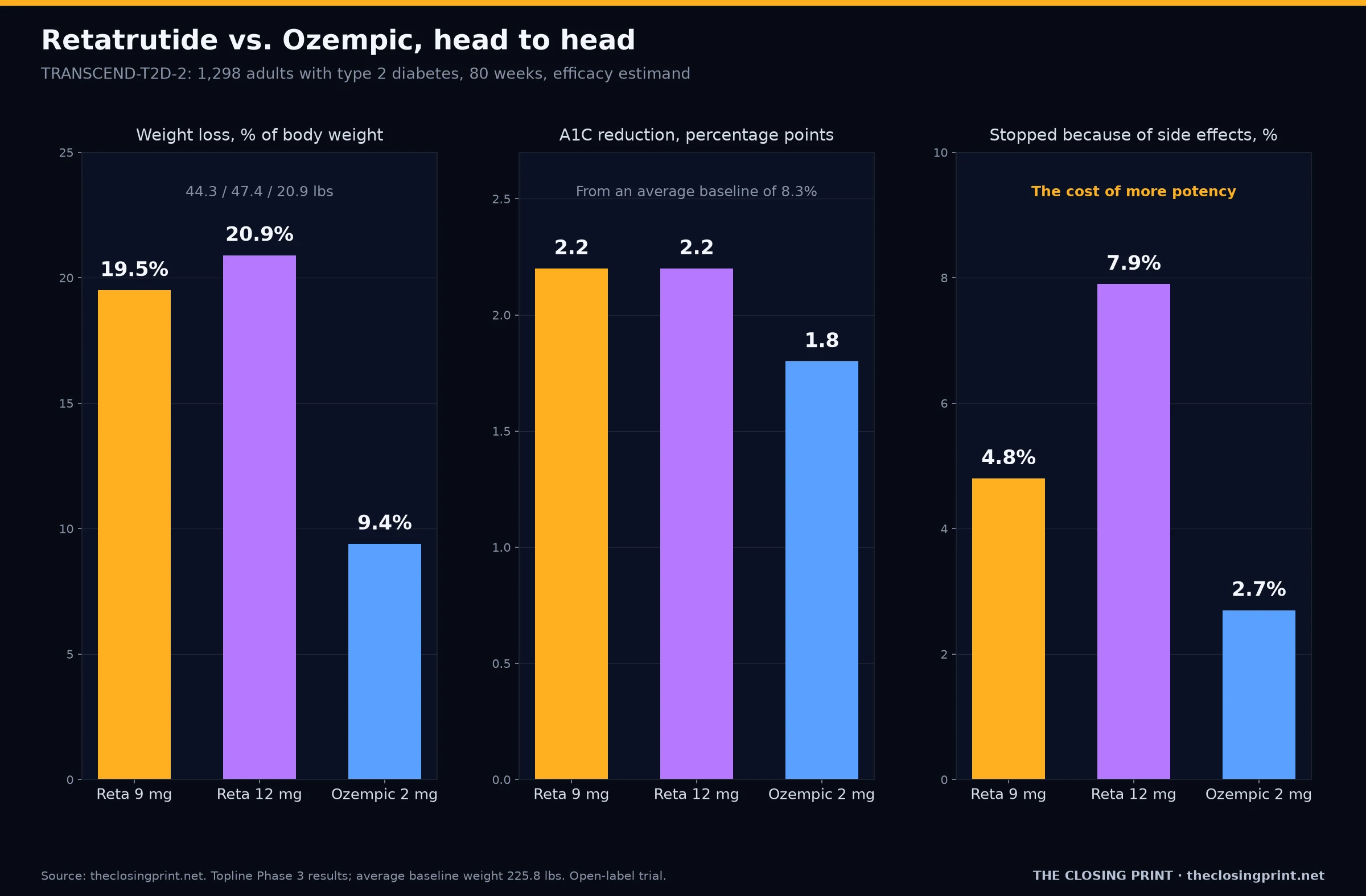
The tolerability numbers deserve as much attention as the efficacy. At 9 mg, stomach side effects were close to Ozempic’s, and constipation was lower on both retatrutide doses. The 12 mg dose had more vomiting (15.0% vs. 13.2%) and nearly three times as many people stopping because of side effects (7.9% vs. 2.7%). The 12 mg dose added weight loss, but no further A1C benefit. Dysesthesia, an unusual skin sensation, keeps showing up across the retatrutide program and will be watched closely by regulators.
The obesity data are even stronger. In TRIUMPH-1, people without diabetes on 12 mg lost an average of 28.3% of body weight at 80 weeks, and 25.9% on 9 mg, by the trial’s efficacy estimand. By the stricter treatment-regimen measure, which counts people who stopped the drug, the figures are 25.0% and 23.7%. In TRIUMPH-4, in people with knee osteoarthritis and obesity, retatrutide cut knee-pain scores by about 75%, and 73.0% of people on 9 mg had their pain cut by at least 70%. A filing is expected around early 2027.
Earlier coverage: our biotech sector outlook and this morning’s pre-market summary.
Sleep apnea: a second market for the same drugs
Obstructive sleep apnea is the clearest example of how these drugs move beyond weight loss into diseases that insurers already pay to treat. In December 2024 the FDA approved Zepbound as the first drug for moderate-to-severe sleep apnea in adults with obesity. In the SURMOUNT-OSA trials, people lost about 18% to 20% of their weight and had about 25 to 29 fewer breathing interruptions an hour (the apnea-hypopnea index, or AHI), against about 5 to 6 on placebo. Up to half reached remission or mild apnea without symptoms after a year.
That label matters commercially. Sleep apnea is a covered medical diagnosis, so it opens Medicare and commercial coverage for people whose plans exclude obesity drugs, and it competes with CPAP machines, which many patients stop using. Retatrutide looks at least as strong. In the TRIUMPH-1 sleep apnea group, which started with severe apnea (an average AHI of 58.6), the 9 mg and 12 mg doses cut AHI by 34.3 and 31.7 events an hour after 80 weeks, against 9.9 on placebo. In people who also had type 2 diabetes, the cuts were about 25 events an hour against 10.
| Sleep apnea trial | Drug | Baseline AHI | AHI change (events per hour) | Placebo |
|---|---|---|---|---|
| SURMOUNT-OSA, no CPAP, 52 weeks | Zepbound | about 52 | about -25 | about -5 |
| SURMOUNT-OSA, on CPAP, 52 weeks | Zepbound | about 50 | about -29 | about -6 |
| TRIUMPH-1-OSA, no diabetes, 80 weeks | Retatrutide 9 mg / 12 mg | 58.6 | -34.3 / -31.7 | -9.9 |
| TRIUMPH-2-OSA, type 2 diabetes, 80 weeks | Retatrutide 9 mg / 12 mg | 55.9 | -24.7 / -25.4 | -10.3 |
SURMOUNT-OSA figures are rounded. Retatrutide figures use the trials’ hybrid-treatment estimand. Trials differ in length and population, so the rows aren’t a head-to-head comparison.
For investors, the point is reach. Every new covered diagnosis, whether it’s sleep apnea, knee osteoarthritis, heart disease or psoriasis paired with obesity, adds patients at a price insurers are more willing to pay than for weight loss alone. That’s how Lilly can keep growing volume even as prices fall.
Foundayo and the rest of the pipeline
Foundayo, Lilly’s once-daily oral GLP-1 (orforglipron), was the one miss. Sales of $184 million were below the roughly $217 million to $229 million expected, and US prescriptions still trail the Wegovy pill from Novo Nordisk, which launched months earlier. The trials help explain why. The Wegovy pill produced about 14% weight loss over 64 weeks, and Foundayo about 11% over 72 weeks. Foundayo’s advantage is practical. It’s a small molecule with no food or water restrictions, it’s cheaper to make at scale, and it’s launching outside the US. Lilly also showed cardiovascular safety for it in its largest and longest diabetes study this quarter. We think it’s an international and maintenance-therapy story more than a US share-grab, and expectations for it just came down.
Other regulatory and pipeline news in the quarter:
- Approvals: Onswik, a once-weekly basal insulin for type 2 diabetes; Inluriyo with Verzenio for ESR1-mutated advanced breast cancer; Jaypirca for untreated CLL and SLL; Olumiant for severe alopecia in children 12 and older; Mounjaro for cardiovascular risk reduction.
- EloraTZP, a combination of the amylin drug eloralintide with tirzepatide, beat tirzepatide 15 mg on weight loss and A1C in Phase 2. Phase 3 starts this quarter. This is Lilly’s answer to Novo’s amylin combination, CagriSema.
- Deals: it closed AtaiBeckley (treatment-resistant depression) in Q3 and Merida Biosciences (autoimmune and allergic disease) after the quarter. The $4.2 billion of Q3 deal charges is the cost of building the next set of growth drivers.
- Oncology: new olomorasib lung cancer data and a next-generation antibody-drug conjugate for ovarian cancer at ESMO.
Pricing, Medicare and the government deal
Price is now Lilly’s main headwind, and the quarter shows it’s manageable. Zepbound’s net price fell after last year’s pricing deal with the Trump administration, which brought lower cash prices through direct-to-consumer channels in exchange for tariff relief and broader access. Medicare’s GLP-1 pilot started in July with a $50 monthly copay for eligible seniors. Investors worried the low price would cut into revenue more than added volume helped it. This quarter answered that: US prices were down 7%, volume was up 41%, and Lilly appears to be winning most new Medicare starts, roughly 70% by industry estimates.
The risks haven’t gone away. The Medicare pilot is temporary, so its future after the trial period is a policy question, and drug price negotiations and most-favored-nation-style pricing remain live in Washington. Some employers are also reconsidering whether to cover weight-loss drugs. Lilly’s own release notes the first three quarters benefited from favorable rebate adjustments, which won’t repeat every year. Our read is that the US price has largely been reset, and from here growth depends on volume and new indications.
Manufacturing and margins
Two years ago the problem was supply. Now it’s mostly capacity planning. Lilly broke ground in Houston and in Richmond, Virginia, this quarter, part of 10 new US manufacturing sites announced since 2020 and a building program of roughly $50 billion. US manufacturing also matters politically, because it’s a large part of how drugmakers have handled tariff threats.
Margins held up despite lower prices. The non-GAAP gross margin was 84.4%, up 0.8 points, helped by product mix and lower production costs. R&D rose 23% to $4.2 billion (17% of revenue), and selling and administrative costs rose 14% to $3.1 billion, much slower than revenue. By our math, Q3’s performance margin was about 54%, which is why Lilly could lift the full-year range to 52.0%-52.5% from 49.0%-50.5%. The tax rate is the one drag: the non-GAAP rate was 24.0%, up from 17.7%, because acquired R&D charges aren’t tax deductible.
Competition: Novo Nordisk and the rest
Novo Nordisk is the only rival with scale today, and it’s losing ground. Its stock is around $38.59, down about 25% over the past year, and its own 2026 outlook calls for sales and operating profit flat to down 6% at constant currency. Its strengths are the Wegovy pill, which leads the US oral market, and CagriSema, an FDA decision on which is expected this quarter. CagriSema’s weight loss has looked similar to Zepbound’s and below retatrutide’s. Novo reports Nov. 4.
Beyond Novo, Amgen (AMGN), Viking Therapeutics (VKTX), Roche (RHHBY), AstraZeneca (AZN), Pfizer (PFE) and several Chinese drugmakers are developing pills, monthly shots and multi-hormone combinations. None of them is likely to sell at scale before 2028. The more immediate threats are compounded and illegal versions. Lilly is now publicly pushing payment companies and platforms to shut down a black market in unapproved retatrutide.
| Stock | Price (10:19 ET) | Today | Note |
|---|---|---|---|
| Eli Lilly (LLY) | $1,384.07 | +7.4% | Hit $1,408.38 early, a record |
| Novo Nordisk (NVO) | $38.59 | +0.8% | Down about 25% over the past year; reports Nov. 4 |
| Viking Therapeutics (VKTX) | $27.56 | +8.7% | Obesity pipeline; volatile around Lilly news |
| Amgen (AMGN) | $465.22 | +3.0% | Obesity entrant; reports Nov. 3 |
| Hims & Hers (HIMS) | $29.63 | +1.1% | Telehealth seller of weight-loss treatments |
| Health Care Select Sector SPDR (XLV) | $183.55 | +2.1% | LLY is the fund’s biggest holding |
| SPDR S&P 500 ETF (SPY) | $769.42 | -0.4% | Tech-led weakness in the broad market |
The stock today and valuation
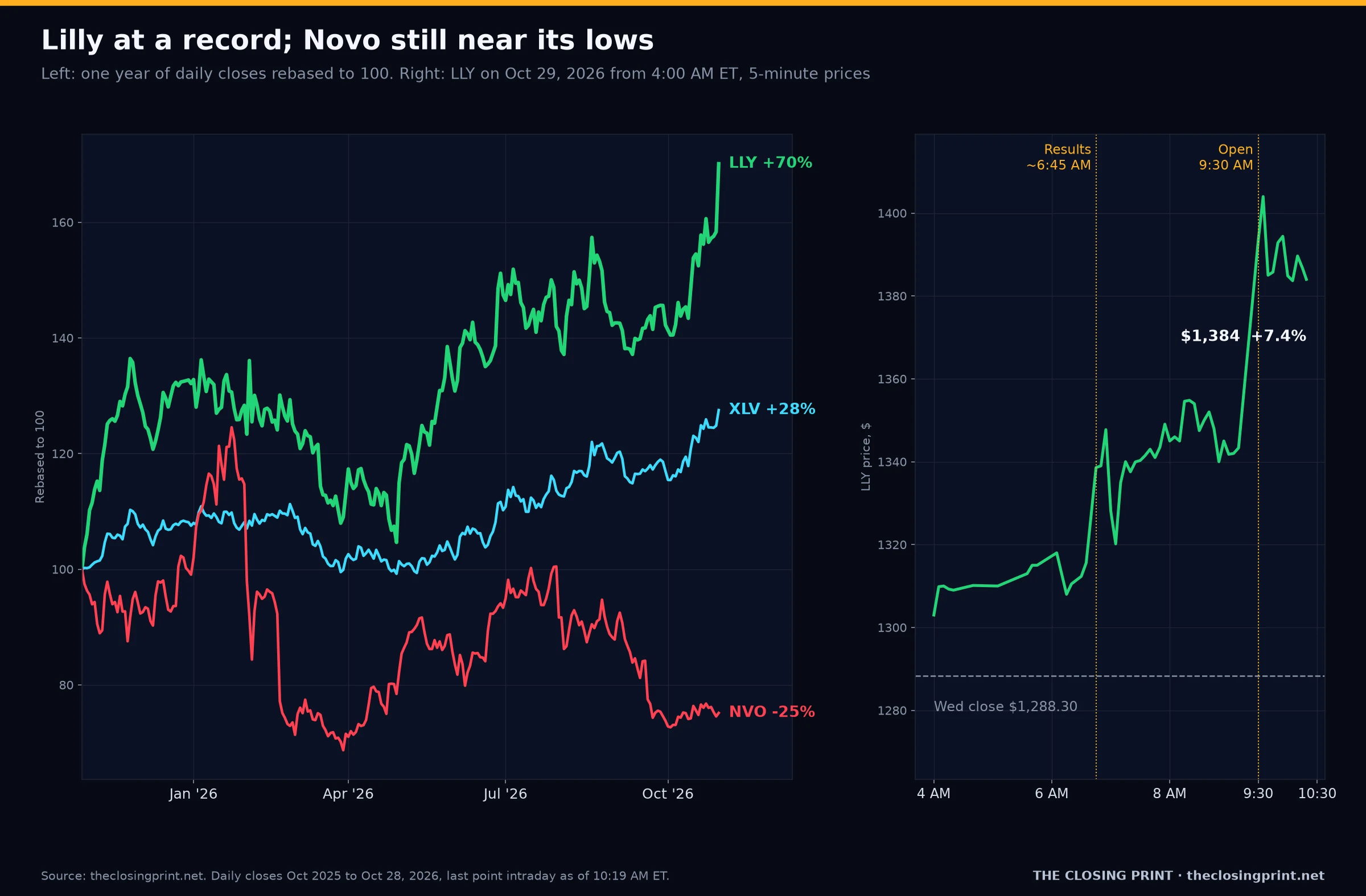
Lilly jumped when results came out around 6:45 AM, was about 4% higher before the open, and gapped up again at the 9:30 AM open. It’s at $1,384.07, +7.4% from Wednesday’s close of $1,288.30, after reaching $1,408.38, a record. The previous high close was $1,306.69 on Oct. 22. Over the past year the stock is up about 70% and is up about 28% this year. The Health Care Select Sector SPDR (XLV) is +2.1%, and Lilly is its biggest weight, while the S&P 500 is lower on tech weakness.
At about $1,384.07, Lilly is worth roughly $1.24 trillion. That’s about 39 times the $35.50 midpoint of 2026 EPS guidance, or about 35 times if you add back the one-time Q3 deal charges. It’s about 13.5 times the 2026 revenue midpoint. Those are high multiples for a drugmaker, but growth of nearly 40% isn’t typical either. The implied fourth quarter, about $11 of EPS with no deal charges, works out to more than $44 a year if it holds. On that run rate, the stock trades at about 31 times.
What’s priced in, in our view: tirzepatide keeps growing through 2027, retatrutide gets approved in 2027 and launches well, and US price cuts are mostly behind it. That’s a reasonable base case, but it doesn’t leave much room for a delay.
Risks
- Tolerability. Retatrutide 12 mg had more vomiting and nearly three times as many dropouts for side effects as Ozempic, and dysesthesia keeps appearing across its trials. Doctors may favor lower doses, which narrows the efficacy gap.
- Price and reimbursement. The Medicare pilot is temporary, employers are rethinking coverage, and US price resets can return through policy. Outside the US, prices fell 29% in the quarter.
- Competition. CagriSema’s FDA decision, Novo’s oral franchise and multi-agonist drugs from Amgen and others could pressure share and price by 2028.
- Manufacturing. New plants take years to qualify. Any quality problem at a key injectable site would show up quickly in sales.
- Cannibalization. Retatrutide would partly replace Zepbound and Mounjaro, so the gain is the difference between them, not the whole retatrutide number.
- Long-term safety. Retatrutide’s cardiovascular outcome data and long-term safety aren’t in yet.
- Valuation. At roughly 39 times guidance, a filing delay or one soft quarter would likely compress the multiple faster than earnings grow.
- One-time items. About $900 million of Q3 revenue was milestones and rebate adjustments, and Jardiance milestones are now finished.
Scenarios


Wick's pick: Base (50%). This was one of the best quarters a large drugmaker has posted, and the retatrutide data make Lilly’s position stronger, not weaker. But at around $1,384.07 and nearly 39 times guided EPS, the good news is mostly in the price. We rate LLY a Hold for new money and would add on pullbacks toward $1,300. We wouldn’t buy Novo Nordisk ahead of its Nov. 4 report.
What would change our view: a 2027 outlook well above consensus or an early retatrutide filing (more bullish), or a CagriSema label with better tolerability, a retatrutide safety signal, or an end to the Medicare pilot (more bearish).
What to watch
- Tue Nov 3: Amgen Q3 results, with an update on its obesity drug.
 .ics

- Wed Nov 4, 1:30 AM: Novo Nordisk 9M 2026 results, the first read on Wegovy and Ozempic after Lilly’s quarter..ics
- Tue Nov 10, 8:30 AM: CPI for October..ics
- Mon Nov 30: Medicare’s deadline to publish 2028 negotiated drug prices..ics
- Fourth quarter, no date set: an FDA decision on Novo’s CagriSema.
- Early February 2027 (estimated): Eli Lilly Q4 2026 results and first 2027 guidance..ics
Market data and opinions by Wick. This post is informational only and is not financial advice. Scenario odds and ratings are our estimates. Prices are intraday as of the time noted and may have changed. Clinical results described are toplines or trial data, and cross-trial comparisons are not head to head.
Add all 5 events to calendar (.ics) Times are ET. Each event has a 1-day reminder. Estimated dates are marked.