
Written about 9:55 PM ET Tuesday, Nov 10, 2026. All times Eastern. Company figures are from CoreWeave's third-quarter release and earnings call on Nov. 10 and its earlier quarterly releases; after-hours prices as of about 8:00 PM ET.
Revenue for the quarter was $3.66 billion, up 168% from a year earlier and above estimates of about $3.55 billion. The adjusted loss was 95 cents a share against roughly $1.16 expected. CoreWeave raised its 2026 revenue range to $13.0 billion to $13.3 billion, from $12.4 billion to $13.2 billion in August, and lifted adjusted operating income guidance to $1.275 billion to $1.375 billion, 26% higher at the midpoint. That matters because the stock had fallen about 41% in a month and sits about 65% below its 52-week high of $138.25, as rising rates turned the AI-infrastructure trade into a credit story.
Demand is not the problem
The backlog rose by about $28.5 billion in the quarter and is up 138% from $55.6 billion a year ago. Management said it has about 10 times more qualified demand than available capacity through the end of 2027, and that more than half of the backlog is tied to contracts where delivery should start by year-end. Active power passed 1.7 gigawatts, double the start of the year, with contracted power above 4.6 gigawatts and more than 1.3 gigawatts of that outside the U.S.
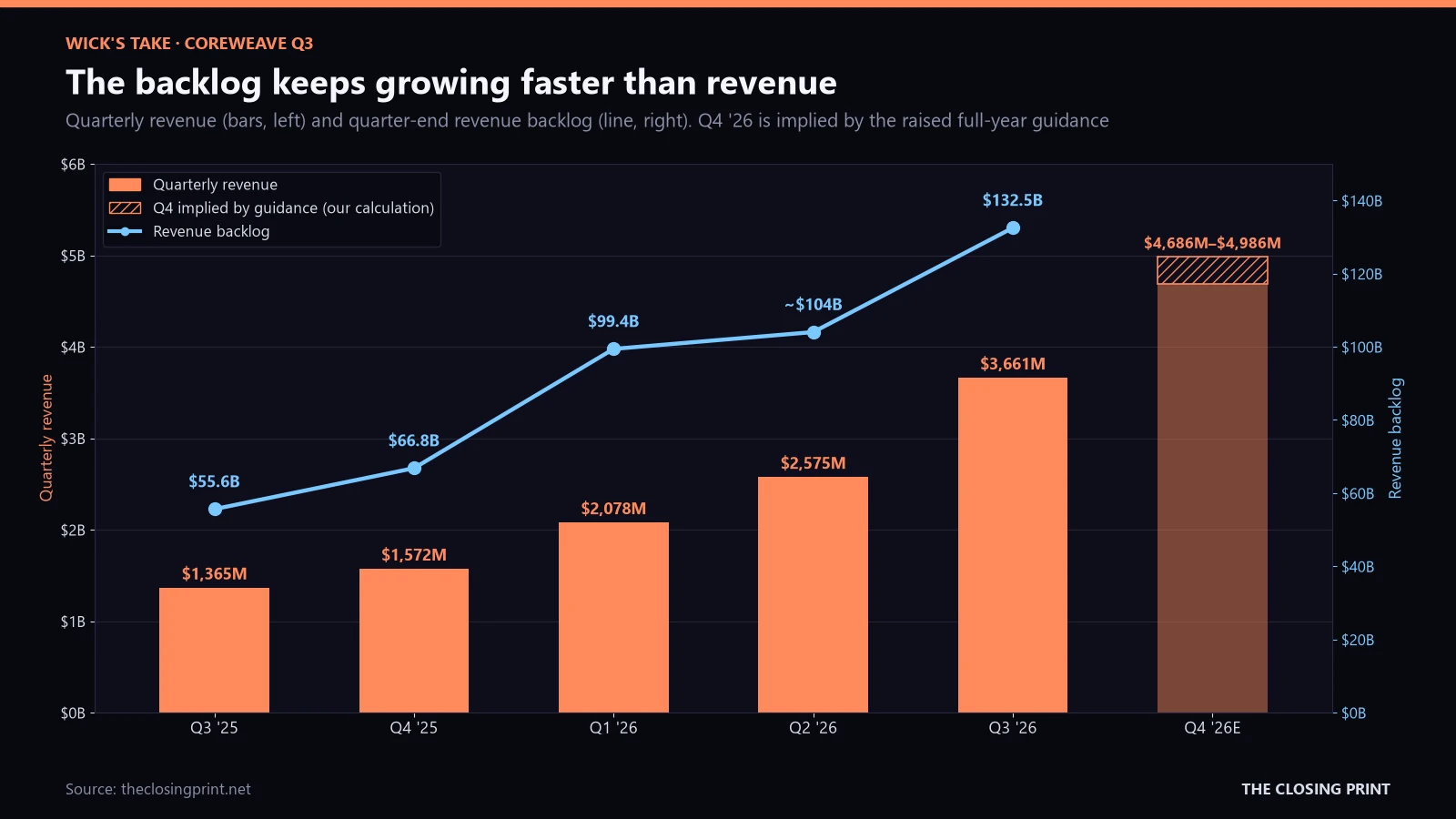
Pricing is the part that surprised us. CoreWeave raised prices by about 25% across its products in July and another 10% later in the quarter, and says prices kept rising in the fourth quarter. Short-term capacity is selling for more than $40 million per megawatt a year, while new four- and five-year contracts are moving to $20 million to $25 million. Even older Ampere and Hopper chips rose 30% to 50% in price from the second quarter. About 130,000 GPUs come off contract in 2027 and about 170,000 in 2028, and management put the extra annual revenue from re-signing them at today's prices near $4 billion in 2027 and close to $10 billion including 2028, with no new spending needed.
The funding plan is the real news
CoreWeave ended September with about $46.9 billion of debt and $6.5 billion of cash, restricted cash and securities. Quarterly capital spending jumped to $14.5 billion from about $9.4 billion, and the 2026 range is now $37 billion to $39 billion. Some of its bonds recently yielded more than 16%, up from the 15% level we flagged in our October neocloud deep dive. Against that backdrop, the call made four promises:
- No new unsecured debt at today's yields through 2027. Most remaining spending will be funded with delayed-draw term loans tied to specific customer contracts, which have priced 2.25 to 5.5 percentage points over SOFR.
- About $9 billion of customer prepayments and deposits in the next three months. More than $3 billion of that is for older gear that is already paid off, so no debt sits behind it.
- Less than $5 billion of new parent-level capital through 2027. A new investment-grade loan facility is due in the coming weeks at an expected 7% to 7.5% yield, financing more than 90% of the equipment cost.
- Adjusted net income in the first half of 2028 and for full-year 2028. If CoreWeave builds only for signed contracts, 2027 capital spending would be about the same as 2026.
The weighted average cost of its debt was 7.9% at the end of the quarter, down 2.5 percentage points from a year earlier, and CoreWeave says it has already repaid more than $4 billion of loans from contract cash flow.
The path to earnings, in one chart
Net interest expense was $846 million in the third quarter, up from $310 million a year earlier, and CoreWeave guided to $1.05 billion to $1.15 billion for the fourth quarter. Adjusted operating income was $379 million, nearly triple the second quarter. Using the midpoints of tonight's guidance, our calculation puts fourth-quarter adjusted operating income near $800 million, which would shrink the gap to interest expense to about $300 million from $512 million in the second quarter.
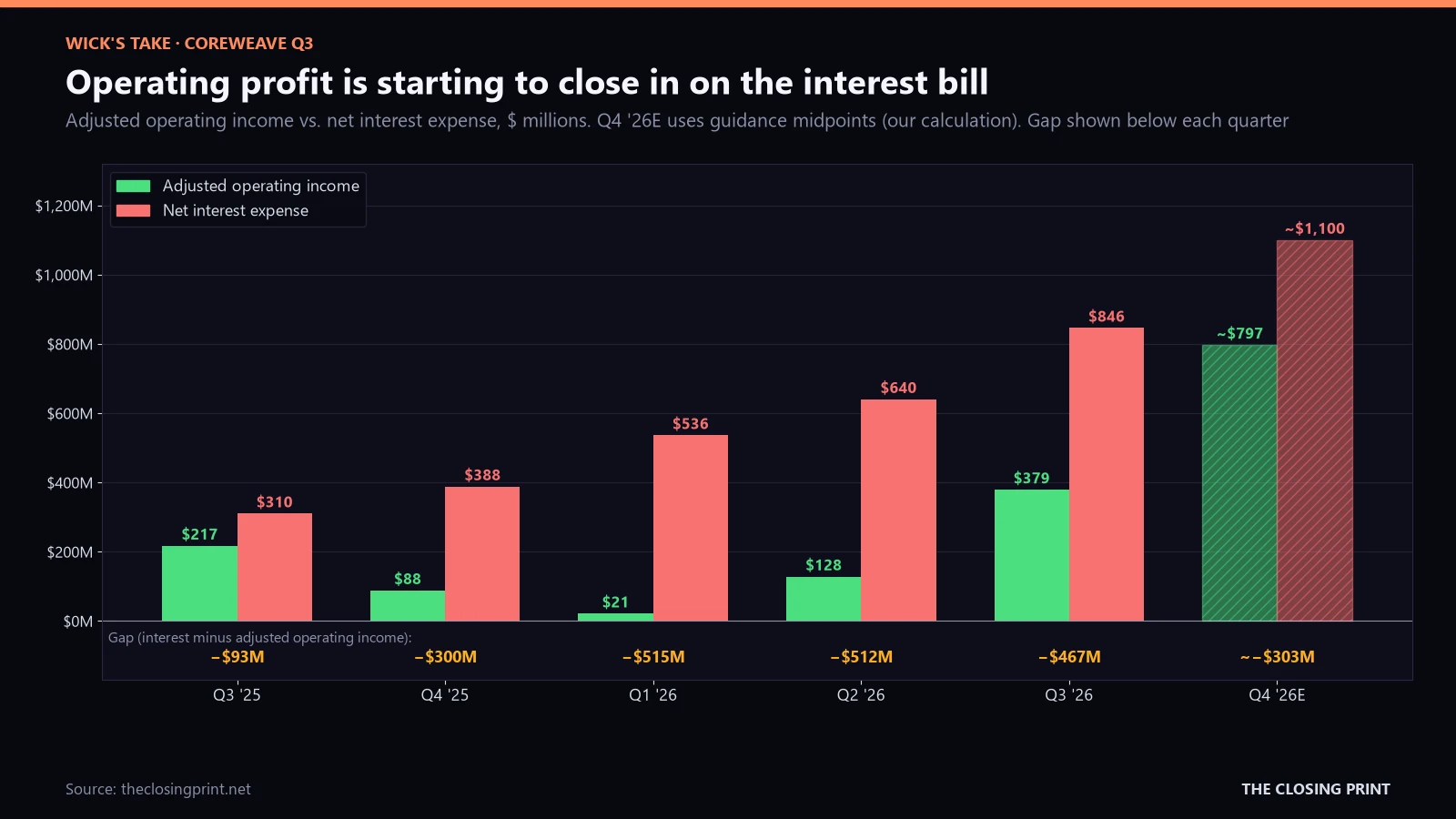
Adjusted EBITDA was $2.26 billion, a 62% margin, and operating cash flow was $2 billion. On a GAAP basis the company still lost $709 million, or $1.27 a share, because depreciation of $1.89 billion and interest more than absorb that cash profit.
What it means for the AI-infrastructure trade
| Stock | Close Tuesday | After hours (about 8 PM) | Why it matters |
|---|---|---|---|
| CoreWeave (CRWV) | $48.73 -0.5% | $52.58 +7.9% | Beat and raise, plus a funding plan without new unsecured debt. |
| Nebius Group (NBIS) | $134.00 -5.3% | $145.25 +8.4% | The closest peer. Down by a similar amount over the past month and reports Thursday. |
| IREN (IREN) | $19.73 -7.8% | $20.40 +3.4% | A bitcoin miner turned AI-cloud provider, trading on the same financing worries. |
| Oracle (ORCL) | $117.98 -1.5% | $120.75 +2.3% | A much larger AI-cloud borrower, facing the same rate and credit questions at bigger scale. |
| NVIDIA (NVDA) | $168.89 -5.5% | $170.48 +0.9% | Supplies the GPUs. Its slide this week is tied to the board probe and Washington, not to demand. |
The rate backdrop is the hard part. Today's hot October CPI pushed the 10-year Treasury yield to 4.98% and the 2-year up 17 basis points, and futures now price a December hike, as covered in our Post-Market Summary. CoreWeave's contract loans float over SOFR, so a hike raises the cost of new borrowing even if the company never goes back to the bond market. NVDA adds a second overhang, with its board investigating CEO Jensen Huang, which we covered in our Nvidia piece.
Politics is the third. Last week's midterms produced big Democratic gains, voters rejected dozens of local data-center measures, and Texas elected a governor who has criticized 20-year tax breaks for large data centers. CEO Michael Intrator said he expects no impact on deliveries, because most of CoreWeave's Texas power is either already running or fully permitted and under construction. He also argued that if the industry builds more slowly, installed GPUs become scarcer and pricing stays higher for longer.
Wick's take
This was the quarter CoreWeave needed. Revenue beat, margins got to double digits a quarter early, and the pricing data shows that compute is still scarce. The bigger change is the funding mix. By ruling out new unsecured debt and leaning on contract-backed loans and customer prepayments, management has tied its spending to customers who have already signed. A rough look at the numbers: at about $27 billion of market value, plus about $40 billion of net debt, the business is valued at roughly 3.3 times the $20 billion to $21 billion annualized revenue run rate it expects to exit 2026 at. That is not expensive for a company growing this fast, if the financing holds.
The risk is that rates and politics shift what that financing costs. Interest will top $1 billion this quarter, GAAP profits are still more than a year away, and much of the backlog sits with a few large AI labs and hyperscalers. If prepayments slip or the new investment-grade facility prices wide, the market will go back to treating CRWV as a credit story.
What would change my mind: a delay or downsizing of the investment-grade facility, or prepayments that come in well short of $9 billion. Either would say the funding plan depends on markets more than the call suggested.
What to watch (ET)
- Wed, Nov 11: stocks trade but the bond market is closed for Veterans Day, so the first full test of tonight's move comes without fresh Treasury pricing.
- Thu, Nov 12, before the open (expected): NBIS third-quarter results, the next read on AI-cloud pricing.
 .ics

- Fri, Nov 13, 8:30 AM: US October PPI, the next inflation report after today's hot CPI..ics
- Week of Nov 16: reported pricing window for the Anthropic IPO, a big test of appetite for AI risk (see our Anthropic piece)..ics
- Coming weeks: CoreWeave's new investment-grade loan facility. Watch the size and the yield against the 7% to 7.5% management expects.
- Wed, Dec 9, 2:00 PM: FOMC decision with new projections; press conference 2:30 PM..ics
Not financial advice. This is Wick's analysis and opinion, for information only. Company figures and guidance are as reported by CoreWeave; the fourth-quarter estimates, market value, net debt and valuation multiple are our calculations. After-hours prices are thin and can change before the open. Scenario odds are Wick's estimates, not forecasts of any outcome.