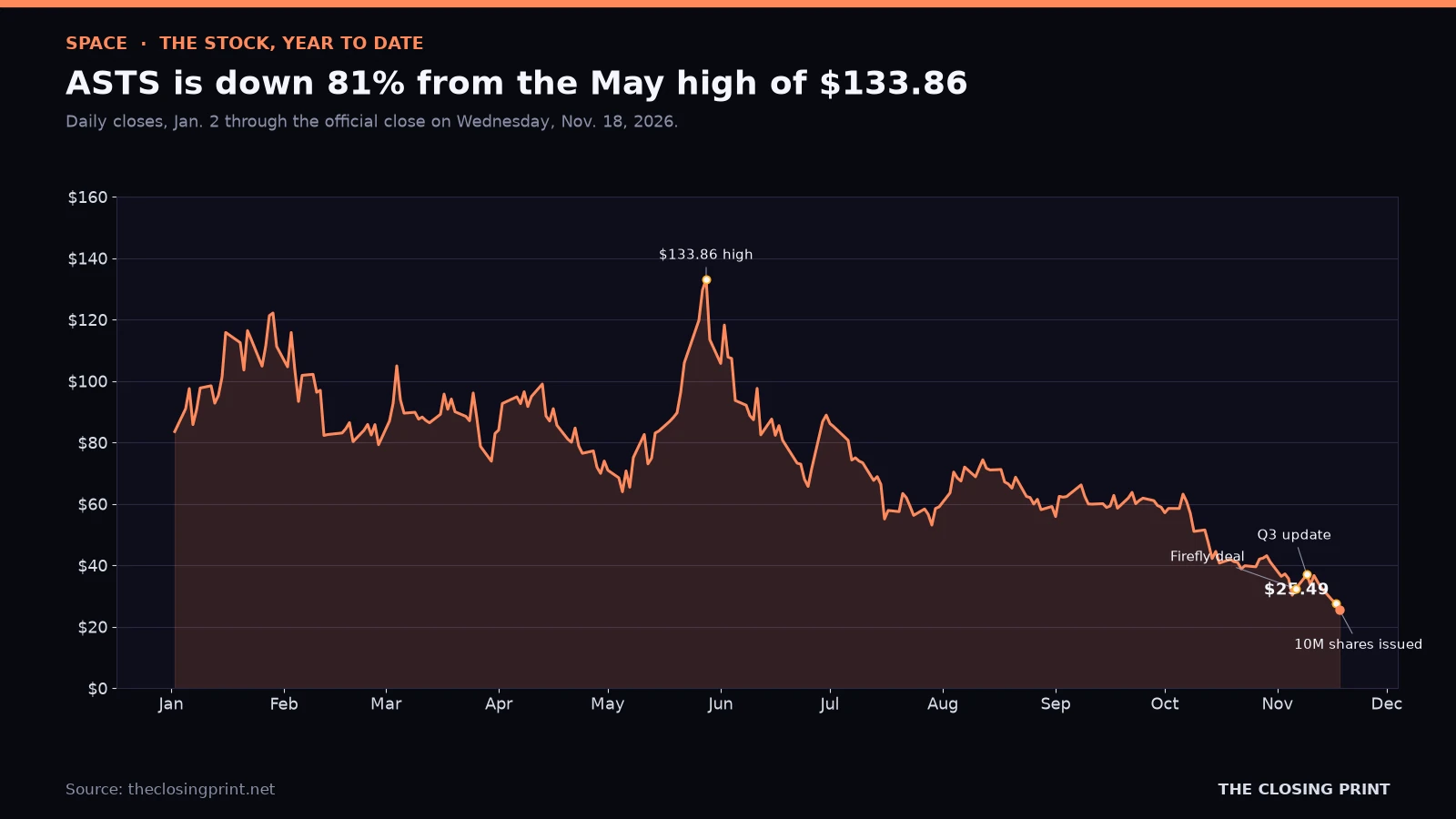
AST SpaceMobile (ASTS) is making new lows, and it is not just the tape. The stock closed Wednesday at $25.49, down 7.6%, after a 12.3% drop on Monday, and traded as low as $25.16. It has now fallen 22% since Friday’s close, 31% since the Nov. 9 close after earnings, and 81% from the May 28 high of $133.86. From the Jan. 2 close of $83.47, it is down about 70%.
The business has not collapsed. Revenue is still ramping, there is $3.2 billion of cash and restricted cash on the Sept. 30 balance sheet, and the company is still promising intermittent nationwide service in the United States and other key markets before year-end. What is wrong is the clock the stock was priced for, plus a fresh slug of shares issued this week to its rocket-engine supplier.
The launch calendar slipped, and the next satellites are still on the ground.
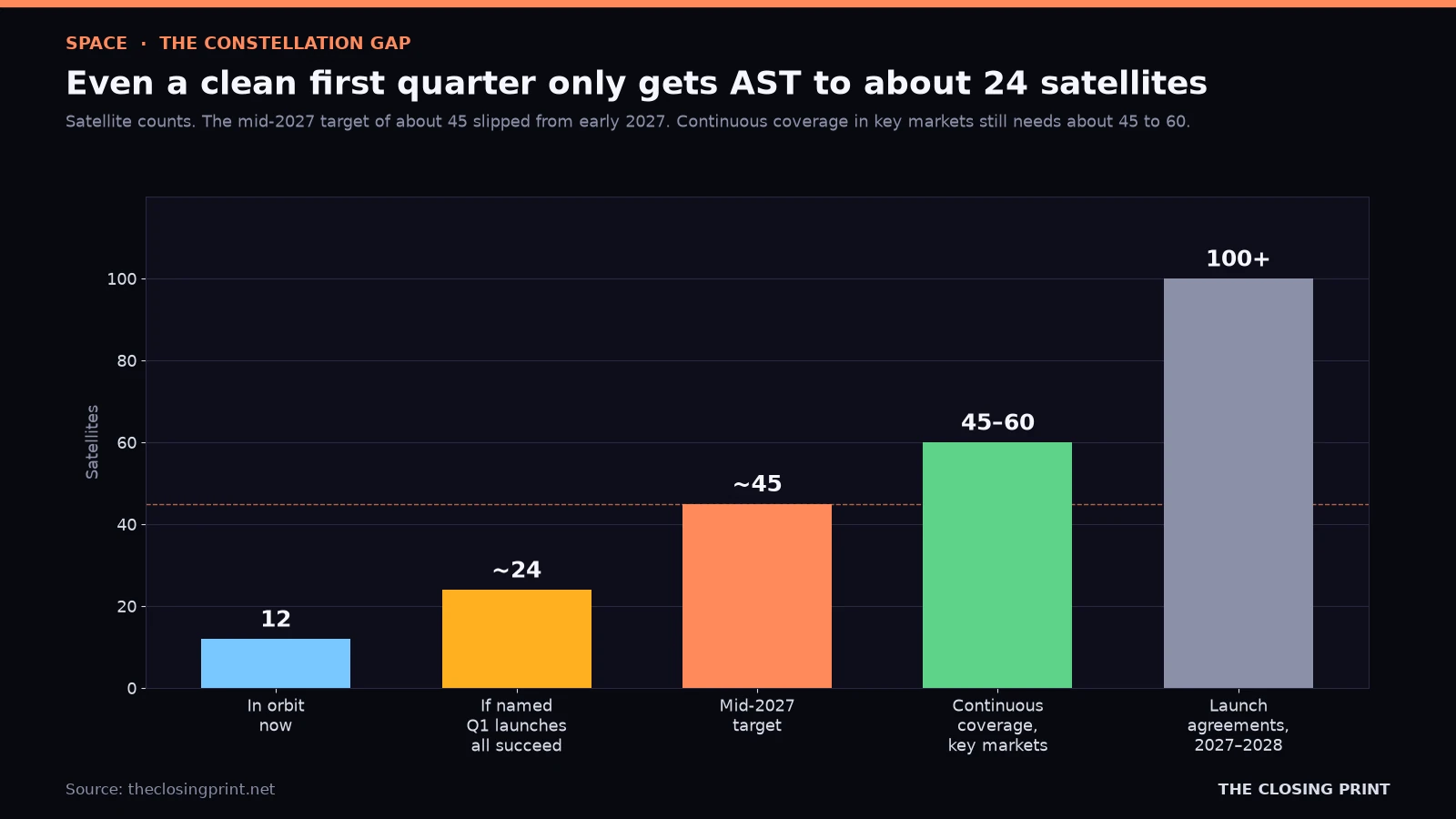
This is the issue that matters. In our October direct-to-cell piece, AST was targeting about 45 BlueBird satellites in orbit by early 2027, enough, in the company’s telling, to get toward continuous coverage in key markets. The Nov. 9 business update moved that target to the middle of 2027, based on launch availability. Continuous service in those markets still needs about 45 to 60 operational satellites. Beta trials for end users are expected in early 2027 and would ideally use about 25.
Twelve BlueBirds are in orbit today: the five Block 1 satellites plus BlueBirds 6 and 8 through 13. BlueBird 7 was de-orbited after an April launch put it in an orbit too low to sustain. BlueBirds 14, 15 and 16 were shipped to Cape Canaveral in September and are still awaiting a launch date from SpaceX (SPCX). BlueBirds 17, 18 and 19 are expected to ship by the end of November for a Blue Origin launch in early first-quarter 2027. BlueBirds 20 through 25 are slated to ship in December and January for Defense Priorities and Allocations System-rated launches, also expected in the first quarter.
If every one of those 12 named launches works, AST would have about 24 satellites in orbit. That is still about 21 short of the mid-2027 target of 45. The company says launch agreements now cover more than 100 BlueBirds to be deployed during 2027 and 2028, and it is aiming for a production rate of six ASIC-equipped satellites a month in December, with the new chips pulled forward to BlueBird 34. Manufacturing can close the gap. Launch slots have to show up for that math to work. That is why, in October, we said we would size the stock small until BlueBirds 14 through 16 actually fly. They still have not.
The year-end service target is narrower than it sounds. AST still expects intermittent nationwide service in the United States, Canada, Japan, Saudi Arabia and the United Kingdom before year-end, and it has validated beam handovers with AT&T (T). Intermittent service on a 12-satellite network, maybe 15 if SpaceX flies the Cape Canaveral trio in time, is a start. It is not continuous coverage, and it is not the constellation the May high was underwriting.
It issued 10 million shares to Firefly this week, with more possible.
On Tuesday the company filed to issue 10 million Class A shares to Firefly Aerospace (FLY) under a Nov. 6 intellectual-property license for Firefly’s Miranda and Vira engines. Those engines are meant to power Blacklift, AST’s own 20-ton reusable rocket, which is supposed to start putting BlueBirds into low Earth orbit in late 2028, up to five at a time.
The license is not a small check. AST will pay Firefly $400 million in cash and an estimated 10 million to 14 million Class A shares, with the final stock amount set by a forward volume-weighted average price. The 10 million shares are the first slice. Of those, 2.4 million may be sold right away; the rest are locked up at six months, one year and three years. Any extra shares from the VWAP true-up would come in a later registered offering, with similar lockups. Against 300.6 million Class A shares outstanding at Sept. 30, 10 million is about 3.3%. That is not a recapitalization. It is still new supply, and 2.4 million shares are immediately saleable, into a stock that is already making new lows.
The broader Firefly package is larger still. Firefly said the agreements, which also cover delivery of 27 Miranda engines and nine Vira engines for the first three Blacklift rockets, plus engineering support over three years, are valued at more than $1.3 billion, paid in cash and stock. Blacklift is a logical answer if launch availability is the bottleneck. It does not put a single additional BlueBird in orbit in 2027. It is a late-2028 solution to a 2026 and 2027 scheduling problem. The stock sold off the session after the share issuance showed up in the filing, which is the part of this week’s tape that is directly about dilution.
The company is not out of cash. The capital structure got heavier.
AST reported third-quarter revenue of $42.3 million, up from $14.7 million a year earlier, from gateway deliveries and U.S. government milestones, not from a commercial consumer network. The nine-month total is $88.6 million. Full-year guidance is still $150 million to $200 million, which means the fourth quarter has to deliver between about $61 million and $111 million. The company says that is consistent with its planned ramp, with upside from recent contracts. It is a steep finish to the year, and it is still a long way from supporting the valuation the stock had in May.
The net loss attributable to common stockholders was $132.4 million in the quarter, or $0.44 a share, and $554.3 million, or $1.87 a share, for the first nine months. Cash used in operations was $314.5 million over those nine months, and purchases of property and equipment were $1.15 billion. That spend is mostly the constellation, not overhead.
The Sept. 30 balance sheet showed about $3.2 billion in cash, cash equivalents and restricted cash, and $4.1 billion of long-term debt. The cash figure includes the July convertible-note proceeds. The company also points to about $1.0 billion of non-dilutive funding from Japan’s Ministry of Internal Affairs and Communications, with partner Rakuten, for midband satellite manufacturing and launches, and to a pipeline of about $1.2 billion in U.S. quasi-governmental financing for 2027. The Japan figure is the company’s description of the J-LEO agreement. The $1.2 billion is a pipeline, not a closed commitment. A U.S. Space Force contract for space-based sensing is worth about $100 million of revenue, and AST says it has 16 U.S. government awards to date.
None of that makes the stock cheap in the old way, and none of it makes the company insolvent. It does mean the funded story now sits on a much larger debt stack than it did a year ago, after several large convertible-note sales. A securities class action filed in the Western District of Texas, covering purchases from March 4, 2025, through July 15, 2026, alleges that comments about being fully funded were followed by more note offerings. Those are allegations, not findings, and the lead-plaintiff deadline was Nov. 13. It is an overhang, not a verdict.
The short book is large enough to cut both ways.
Recent short interest is about 67.5 million shares, or roughly 36% of the 188 million-share float, with about 4.7 days to cover. That is a crowded short. It helps explain why down days can feed on themselves and why a confirmed launch date can produce a violent bounce. It is not, by itself, a thesis.
Wick’s take
What’s wrong with ASTS is not a sudden hole in the business. What’s wrong is that the stock was priced for a faster constellation than the company can currently launch, and that this week it added new equity supply while that delay is still unresolved.
The May high of $133.86 assumed a path that has since slipped. Twelve satellites are flying, the next three have been sitting in Florida since September waiting on SpaceX, and even a clean first quarter of 2027 only gets you to about 24 satellites, not 45. Buying a rocket that might fly in late 2028 does not fix 2027. Paying for that rocket partly in stock, with 2.4 million shares unlocked on day one, is a reasonable way to conserve cash and a poor way to treat a broken chart.
I would not call the concern overdone. I also would not call the equity worthless. Cash is still large, manufacturing is scaling, the carrier channel and the government work are real, and intermittent service may yet turn on before year-end. Until BlueBirds 14 through 16 have a date and the mid-2027 target starts to look earned, this remains a high-volatility name with a heavy short book. Rallies will look better after a launch confirmation than before one.
What to watch
Watch for a confirmed SpaceX date for BlueBirds 14 through 16, and for BlueBirds 17 through 19 to actually ship by the end of November for the early-2027 Blue Origin window. Watch whether intermittent U.S. service is turned on before year-end, and how limited it is. Watch the VWAP true-up on the Firefly shares, and whether Firefly sells the 2.4 million that are already unlocked. The fourth-quarter print has to carry a large share of the $150 million to $200 million revenue guide. The $1.2 billion U.S. financing line is still a pipeline. And keep an eye on the short interest: with nearly 36% of the float short, the next launch headline will move this stock more than another day of quiet delay.
Comments