Who is buying now? After two decades watching Form 4s, the pattern hasn’t changed much. CEOs and senior officers sell for a dozen reasons: diversification, taxes, estate planning, option exercises, divorce. They buy for one. They think the stock is mispriced and going higher.
An open-market purchase puts real after-tax cash at risk with no forced-liquidity excuse. That asymmetry is why academic research has consistently treated insider buys as far more informative than insider sells.
What the research says
The foundational work is clear. Portfolios of stocks bought by insiders have earned abnormal returns of more than 6% a year after standard risk adjustments, while insider sales generated nothing statistically or economically significant. A study of every reported insider trade on the NYSE, Amex and Nasdaq from 1975 to 1995 found the same asymmetry: the information comes almost entirely from purchases, and the effect is concentrated in smaller companies, where information gaps are wider. Before size and book-to-market controls, stocks with heavy insider buying beat those with heavy insider selling by roughly 7.8% over the following twelve months.
Aggregate net insider buying has also predicted broad market returns better than simple contrarian strategies. More recent work finds the strongest signals come from “credible” purchases, the ones that meaningfully increase an insider’s wealth exposure to the company, which have produced six-month abnormal returns as high as 20%. Cluster buying, when several insiders buy in a short window, strengthens the signal further.
None of this is a mechanical edge. Transaction costs, delayed disclosure, and the fact that insiders are often contrarian buyers after sharp drawdowns all matter. The market underreacts, but the alpha is not free, and large, liquid names usually show weaker effects. Still, when a CEO writes a multi-million-dollar check with his own money after a 30% to 40% decline, it is worth paying attention.
Galaxy Digital: a $9.9 million CEO check
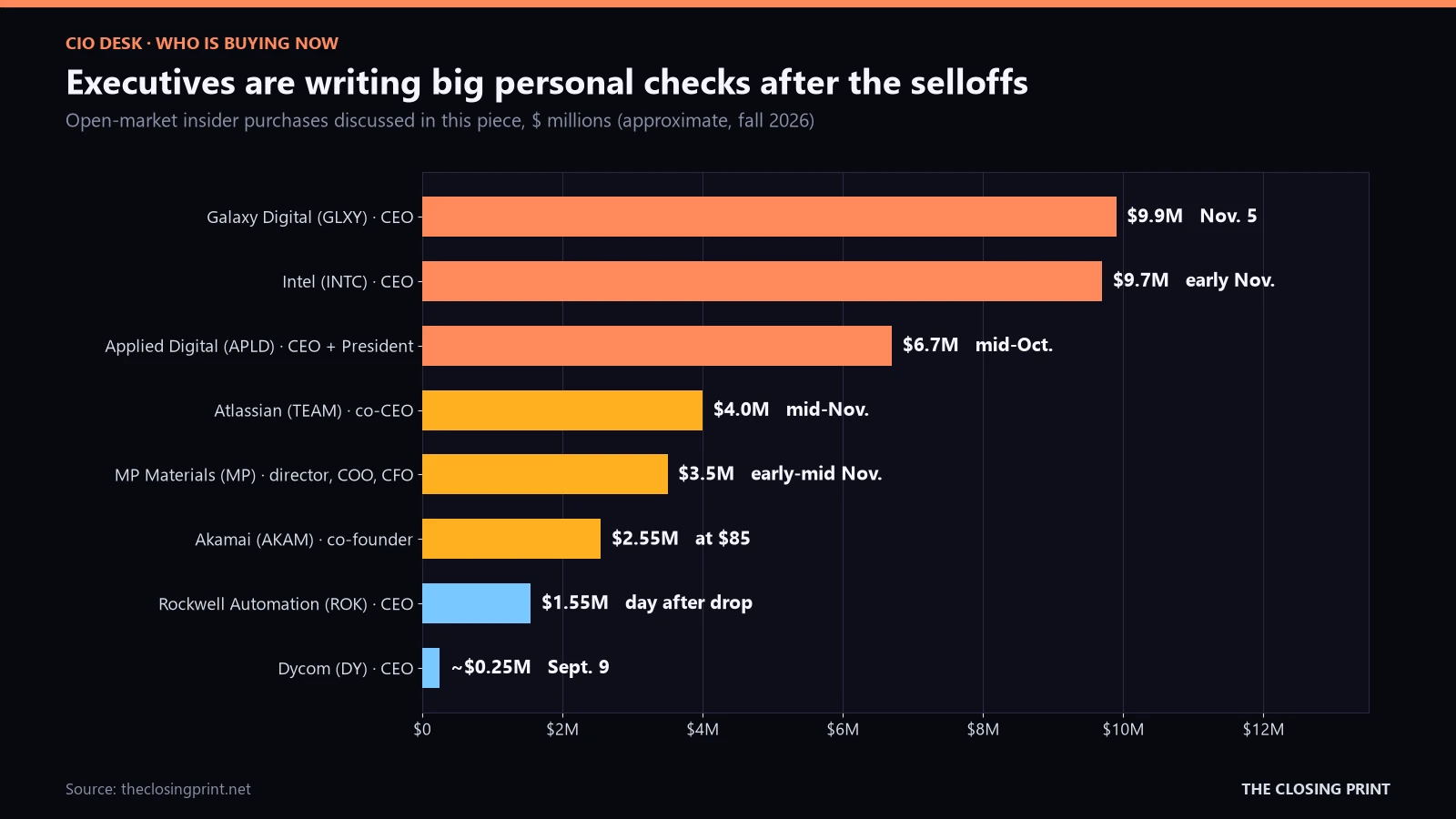
Galaxy Digital (GLXY) fits the pattern. On November 5, 2026, CEO Michael Novogratz bought 760,000 shares at an average of roughly $12.98, about $9.9 million of open-market purchases. The stock had just fallen more than 40% in a month. Smaller open-market buys by directors followed.
Novogratz has been clear that he sees a disconnect between the share price and the company’s assets and earnings power: an institutional digital-asset platform plus a fast-growing AI and high-performance-computing data-center campus, Helios, that is starting to generate contracted, high-margin lease revenue independent of crypto prices. CEO skin in the game after a sharp drawdown, in a name that still carries meaningful information asymmetry relative to mega-cap tech, is exactly the setup the research has historically favored.
Dycom: smaller dollars, same signal
Dycom Industries (DY) is another recent example in the same mold. On September 9, 2026, President and CEO Daniel S. Peyovich bought 850 shares at an average price of $296.76, roughly $252,000 of open-market buying. Two directors also bought shares in the same early-to-mid September window. Peyovich became CEO in late 2024 after serving as President and COO; he joined Dycom in 2021 after 21 years at Balfour Beatty Construction, where he ran the Northwest Division.
Dycom is the leading U.S. specialty contractor for telecommunications and digital infrastructure: fiber-to-the-home, wireless, utilities and, through a recent acquisition, building-systems work for data centers. It has delivered strong revenue growth, expanding margins and a record backlog near $12 billion, backed by multi-year master service agreements and demand tied to broadband expansion and AI infrastructure. The stock had already corrected hard from highs above $500 earlier in 2026 by the time of the purchases, and it has kept sliding into the low-to-mid $200s.
The buys are modest next to Novogratz’s check, but they are still personal capital committed by the CEO and board members after a significant drawdown, in a business with multi-year contracted visibility. That is the classic informational setup.
The cluster is getting bigger
The list does not stop there. In early November, the CEO of Intel (INTC) bought 150,000 shares for about $9.7 million right after the stock was crushed on weak guidance. The co-CEO of Atlassian (TEAM) has been buying aggressively, roughly $4 million in mid-November alone, and has publicly said he is prepared to put up to $250 million of his own money into the stock after AI fears knocked it hard off its highs. A co-founder of Akamai Technologies (AKAM) bought $2.55 million at $85, continuing a pattern of open-market purchases at prior lows. The CEO of Rockwell Automation (ROK) bought $1.55 million the day after a sharp earnings-related drop.
At Applied Digital (APLD), the CEO and President together bought about $6.7 million in mid-October amid the AI-infrastructure selloff. And at MP Materials (MP), a director, the COO and the CFO bought roughly $3.5 million in a tight early-to-mid November window after the stock fell from the mid-$70s into the mid-$30s.
Wick’s take: the burden of proof is on the bears
None of these are guarantees, and every name carries its own execution, cyclical or capital-intensity risk. But when this many senior executives write large personal checks at the same time after broad selloffs, it is hard to dismiss as noise. After twenty years, a cluster like this still shifts the burden of proof onto the bears.
Why not just buy the fund?
The Catalyst Insider Buying Fund (INSIX) is a mutual fund built around insider trades. It underperformed the Invesco S&P 500 Equal Weight ETF (RSP) from 2020 to 2023, then outperformed from 2023 to 2026. Even so, it still trails over the full stretch.
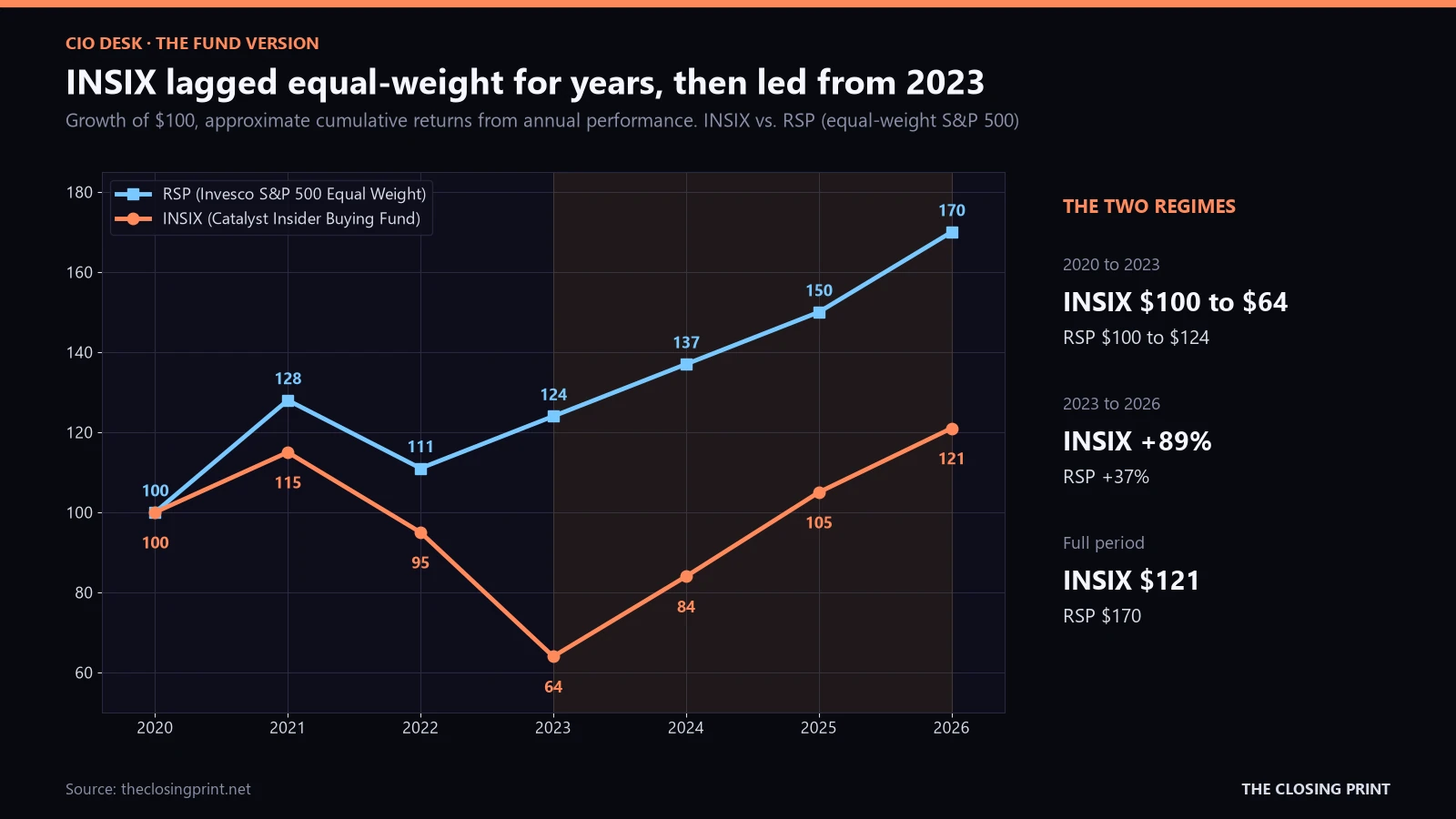
Buying single-name stocks you know, where insiders are buying in clusters or in size, looks like a more efficient use of capital than a broader, higher-expense mutual fund.
Comments