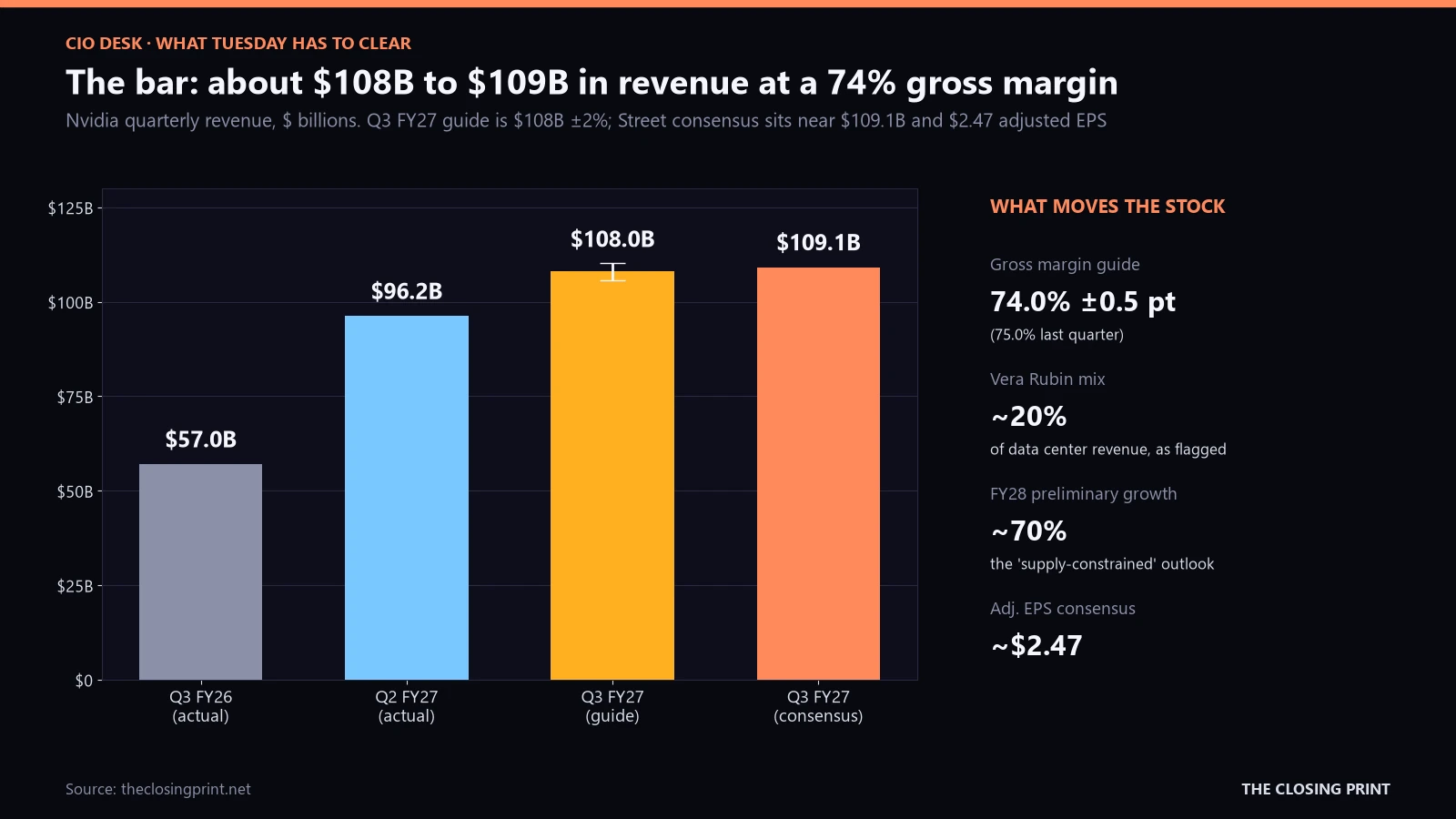
Nvidia (NVDA) reports after the close Tuesday, Nov. 17, with Colette Kress as interim CEO while she stays on as CFO. It is the first print without Jensen Huang, and the stock has de-rated hard, down more than 30% from its October peak. The company guided to about $108 billion in revenue (plus or minus 2%) at a roughly 74% gross margin, and the Street sits near $109 billion and $2.47 in adjusted EPS.
The print itself is unlikely to be the main event. Guidance, the Vera Rubin mix (previously flagged at about 20% of data center revenue), the margin trajectory under memory-cost pressure, and any China or export color will drive the reaction.
Wick’s take: margins are the whole story
Margins are the key now. Under Huang, Nvidia sold scarcity. If the roughly 20% of revenue booked to Singapore gets investigated and Kress promises more scrutiny, any compression in the quarter will push investors toward a peak-margin narrative. Memory-cost pressure was already guided, so the question is whether it deteriorates further or shows a recovery path into FY28.
On leadership and financing, listen for color on the succession process, any pullback in guarantees or support for neoclouds, and whether the full-stack platform story holds without the founder as the glue. Circular financing was already being reined in under Kress. Further tightening is plausible, and it would be healthy for the balance sheet even if it slows some peripheral growth.
Kitchen sink or clearing event?
More the latter. CEOs who are new to a company like to kitchen-sink the first earnings release to set a low bar. Kress is not new. She is a long-tenured Nvidia CFO who has been conservative on circular financing and neocloud support.
Expect her to use the leadership transition and the post-midterm political pushback on data centers to reset the FY28 trajectory modestly lower, or to caveat it more carefully than the prior preliminary outlook of about 70% growth, which was framed as supply-constrained. Actively kitchen-sinking to block a Huang return would be self-defeating for a company whose franchise still rests on the architecture and customer relationships he built. Kress’s incentives and track record point to continuity with more discipline, not scorched earth.
Positioning and takeaway
Valuation has compressed to levels that embed substantial leadership and growth-rate risk, with forward multiples now well below the S&P 500 and peers on growth that is still elevated but decelerating. The resignation was the first clearing event. A clean beat-and-maintain, or a modestly cautious but still high-growth guide, would be the second. A deliberate, deep kitchen sink is a low-probability outcome.
Near term. The stock can bounce on anything short of a material cut to the growth algorithm, especially with CTA and tech positioning skewed short. Retail, for its part, stepped in hard: last week’s dip drew the biggest week of retail net buying in NVDA on record.
Longer term. Risk/reward has improved after the de-rating for those who can tolerate transition volatility. Consider pairing long NVDA with selective shorts in more leveraged neocloud or financing-chain names if Kress signals tighter credit support.
Do not expect any announcement about Huang returning on the call. That is in the board’s hands and will take time. President Trump opened the door to a return in remarks Monday, an interesting contrast with Treasury Secretary Scott Bessent’s weekend talk-show comments, which focused on compliance rather than Huang’s personal life.
Game plan
Treat Tuesday as a clearing event with a conservative bias from a strong CFO. Look for the stock to trade lower after hours and then bounce into the cash open. Last Thursday, when Huang resigned, NVDA rallied about 10% off its lows once the cash session got going. Don’t expect a move of that magnitude Wednesday.
The second clearing event: ANT on Thursday
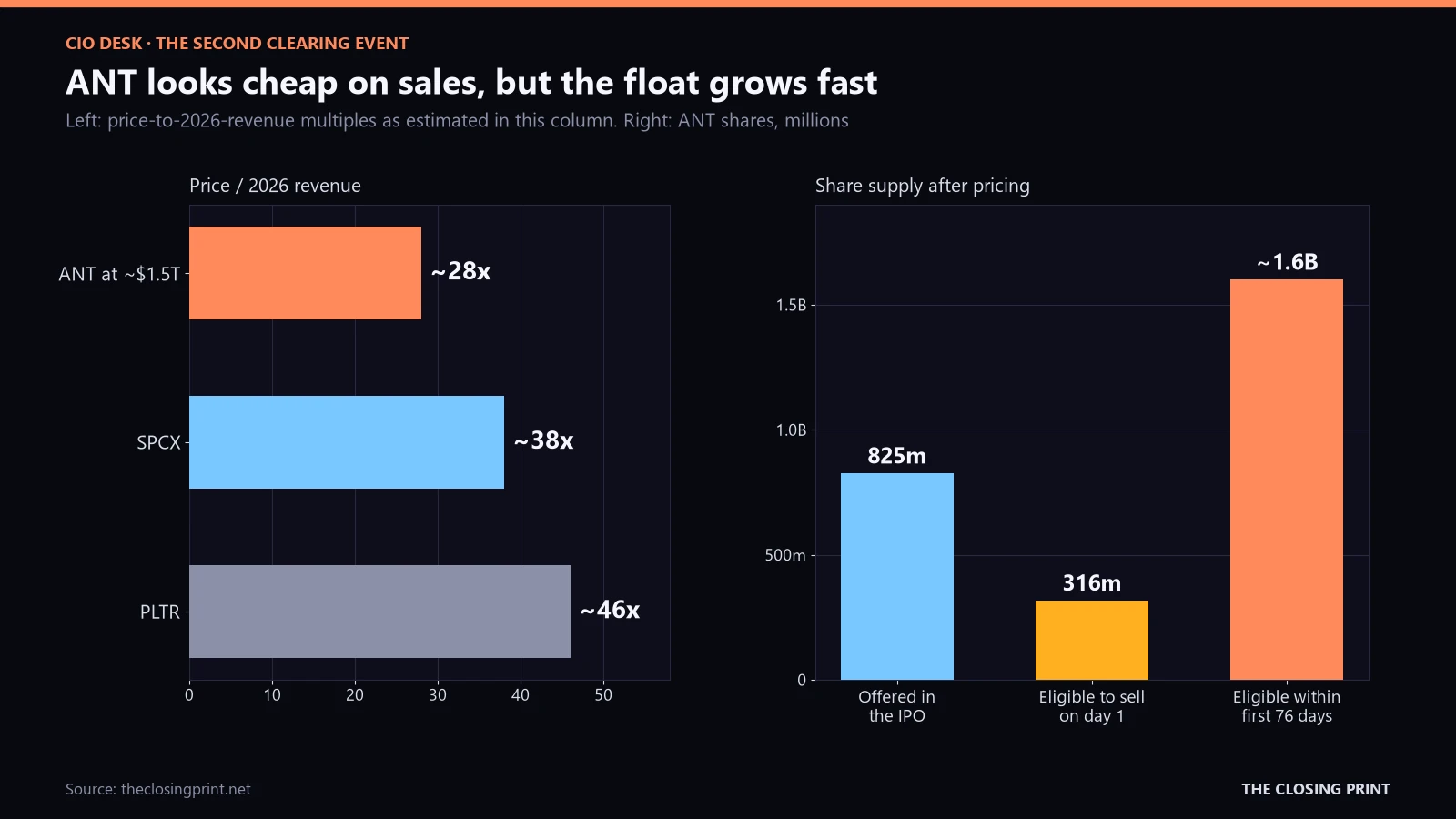
The tricky part is that the Anthropic (ANT) IPO prices this week and starts trading Thursday, and it is an equally important clearing event. It is comparable in size to the SpaceX (SPCX) listing but different in how quickly insider stock can hit the market. Up to 316 million shares could be sold on day one, against the 825 million offered in the IPO, and by our count about 1.6 billion shares become eligible for sale across the first 76 days.
If you can get an allocation, it is likely worthwhile. At about $1.5 trillion, ANT would trade near 28 times 2026 revenue, which is “cheap” next to SPCX at about 38 times and Palantir (PLTR) at about 46 times.
The geopolitical wildcard
The first-ever Trump, Xi and Putin summit is also set for Thursday, which leaves room for political headlines, though it looks more like diplomatic risk management than deal-making. No nuclear agreement is expected; one would be a considerable surprise. The US-China trade truce needs an extension in January, and an early agreement would be a positive.
Comments