Written about 1:00 PM ET Friday. All times Eastern. Friday prices are as of about 12:50 PM ET, with the regular session still open.
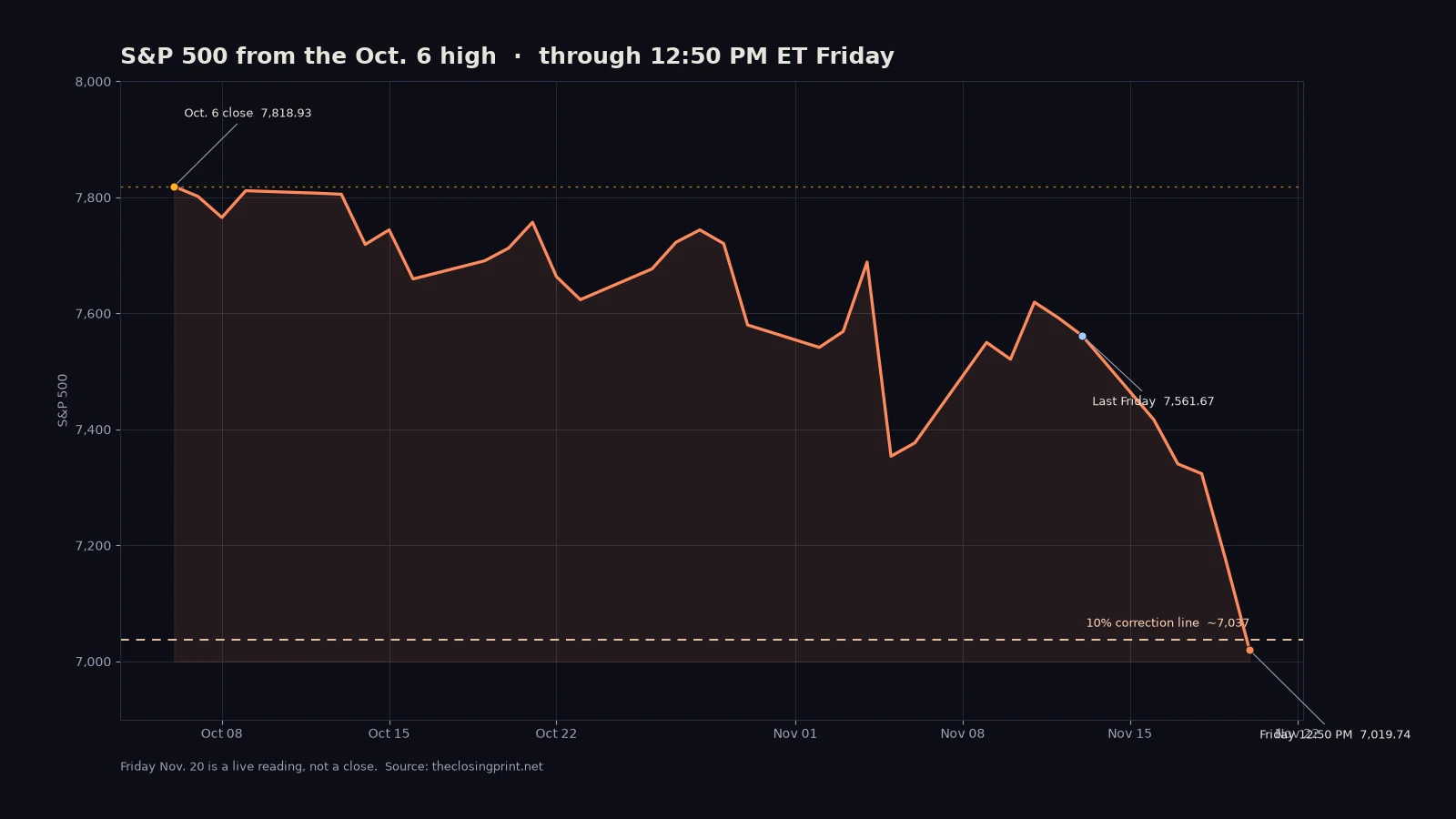
The S&P 500 is having the kind of week that usually needs a recession scare or a policy shock. This one is being driven by the trade that ran the market all year: artificial intelligence. As of about 12:50 PM ET Friday, the index was at 7,019.74, down 2.2% on the day and 10.2% below its Oct. 6 closing high of 7,818.93. That puts it through the 10% correction line near 7,037 on an intraday basis. It is also on track for a seventh straight decline, which would be the longest streak since the February 2020 pandemic slump. The six-session losing streak through Thursday was already the longest since April 2024.
From last Friday’s close of 7,561.67, the S&P is down 7.2% this week as of midday. The Nasdaq Composite is down 8.4% at 23,021, slightly below its Dec. 31, 2025 close of 23,241.99, and the Dow Jones Industrial Average is down 6.9%, or about 3,607 points, at 48,740 after breaking below 50,000 on Thursday. The CBOE Volatility Index (VIX) has jumped from 19.30 last Friday to 31.83. Japan and South Korea each fell about 5% in Friday’s session.
A week that never found a bid
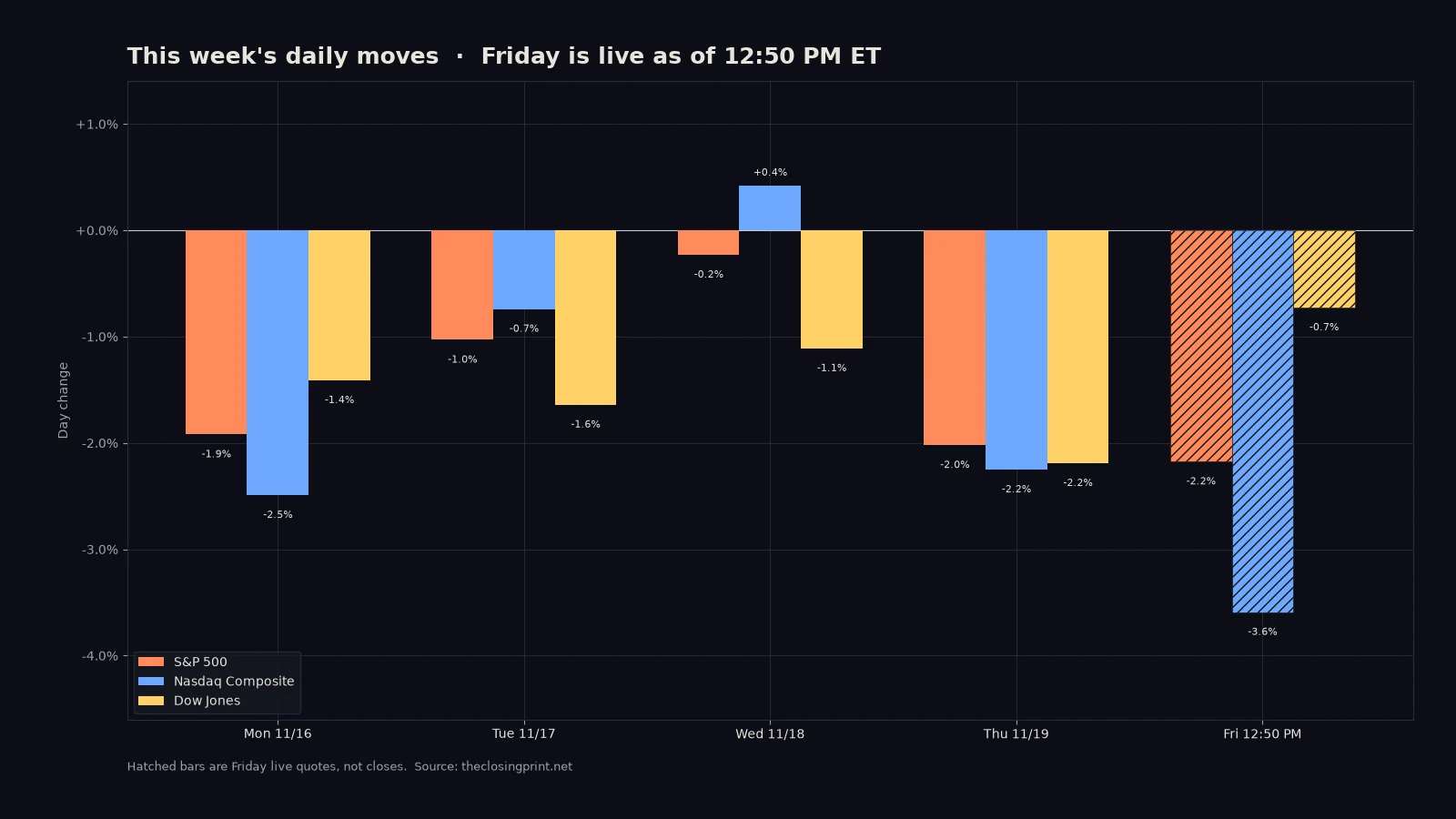
| Session | S&P 500 | Nasdaq | Dow | VIX | 10-year |
|---|---|---|---|---|---|
| Fri Nov 13 close | 7,561.67 | 25,136.27 | 52,347.55 | 19.30 | 5.15% |
| Mon Nov 16 | 7,416.59 (−1.92%) | 24,509.76 (−2.49%) | 51,608.17 (−1.41%) | 22.91 | 5.12% |
| Tue Nov 17 | 7,340.53 (−1.03%) | 24,328.38 (−0.74%) | 50,759.42 (−1.64%) | 25.46 | 5.10% |
| Wed Nov 18 | 7,323.63 (−0.23%) | 24,429.88 (+0.42%) | 50,198.17 (−1.11%) | 24.56 | 5.07% |
| Thu Nov 19 | 7,175.83 (−2.02%) | 23,879.20 (−2.25%) | 49,097.06 (−2.19%) | 28.44 | 5.04% |
| Fri Nov 20, ~12:50 PM ET | 7,019.74 (−2.2%) | 23,021.48 (−3.6%) | 48,740.40 (−0.7%) | 31.83 | 4.94% |
Monday, the AI selloff spread. Nvidia (NVDA) fell 4.1% after word that its board is not discussing a return for Jensen Huang, Treasury Secretary Scott Bessent called over the weekend for a “dramatic shakeup,” and the Commerce Department moved to close a loophole that let Chinese firms rent Nvidia computing power abroad. The Philadelphia Semiconductor Index dropped 5.3%, the Nasdaq lost 2.49%, and only consumer staples and utilities finished higher. The New York Fed’s Empire State manufacturing index came in at 7.8, against a consensus of 16.7.
Tuesday, the selling moved from chips to software after a string of technology and communications outages, including one affecting internal National Security Agency communications. Salesforce (CRM) fell 9.4%. All 11 sectors declined, 427 S&P 500 stocks fell, and the Dow lost 1.64%. After the bell, Nvidia reported fiscal third-quarter revenue of $115.8 billion against about $109 billion expected, with data-center revenue of $107.6 billion, and guided the fourth quarter to $130 billion, plus or minus 3%, versus roughly $125 billion expected, assuming no China data-center compute revenue. The stock rose only about 2% to 3% in extended trading. It was the first report under interim CEO Colette Kress.
Wednesday, health insurers sank on a proposed Medicare audit rule, with UnitedHealth (UNH) down 10.2%, so the Dow lost another 561 points even as the Nasdaq eked out a 0.42% gain. Minutes from the Federal Reserve’s Oct. 27-28 meeting showed almost every official expecting further rate hikes, and Governor Christopher Waller said the Fed should either hike by a half point in December or signal faster hikes in 2027. Nvidia faded its beat, falling 2.9% for a fifth straight loss. The S&P broke its 200-day moving average for the first time since April.
Thursday, an early 2% Nasdaq rally collapsed when Anthropic (ANT) started trading around noon. The S&P fell 2.02% to 7,175.83, the Dow lost 1,101 points (−2.19%) to 49,097.06, and 464 of 503 S&P 500 stocks declined. Anthropic priced at $83 on Wednesday night, raised $81.3 billion in the largest initial public offering on record, opened at $111.50, and closed at $97.17, up 17% from the offer price, after briefly valuing the company above $2 trillion. Traders sold other AI holdings into the event. Nvidia lost 3.3% for a sixth straight drop. Advanced Micro Devices (AMD) sank 7.7% after a short seller disclosed a position and alleged export-control breaches tied to China. Initial jobless claims rose to 203,000 against about 198,000 expected, and continuing claims jumped 70,000 to 1.763 million, the highest since late August. Walmart (WMT) slipped 1.0% after a disappointing annual sales forecast.
Friday, the selling went global overnight and then cut through the 10% line. Nasdaq 100 futures were down 1.5% before the open. The Nikkei 225 closed down 5.06% at 56,436.65, and the KOSPI closed down 5.21% at 4,869.96. By about 12:50 PM ET, Anthropic was at $83.95, down 13.6% and almost back to its offer price. Nvidia was at $135.56, down 7.1% and 16.8% from last Friday’s $162.85 close. Micron Technology (MU) was down 12.2%, Broadcom (AVGO) 11.7%, AMD 11.2%, and the iShares semiconductor ETF (SOXX) 8.6%. The Technology Select Sector SPDR Fund (XLK) was down 5.2%, while the Consumer Staples Select Sector SPDR Fund (XLP) was up 1.7%. The 10-year Treasury yield, which closed Thursday at 5.04%, was near 4.94%. Gold futures were near $3,527, down more than 4% on the day, and bitcoin had slipped below $60,000 to about $59,017. The University of Michigan’s final November sentiment index rose to 51.5 from 48.0 in October, and year-ahead inflation expectations fell to 3.7% from 4.7% — and the tape still sold off. Interviews for that survey ended Nov. 16, before the worst of this week.
Why the AI trade broke
The market spent two years treating AI spending as a straight line. This week it started treating that spending as a balance-sheet and policy risk.
First, leadership and policy at the center of the trade. Nvidia is working through a chief-executive transition after Huang’s resignation, and the board has said it does not plan to bring him back. Export-control tightening, including the move to close the overseas compute-rental loophole, and a short report on AMD added a political-risk layer to a group that was already expensive.
Second, a beat was not enough. Nvidia’s report was strong by any ordinary standard, and the stock still could not hold a gain. Wednesday it faded, Thursday it made a sixth straight decline, and Friday it was down another 7%. That is what a crowded trade looks like when investors are using good news to get out.
Third, the Anthropic debut turned into a liquidity event. An $81.3 billion IPO was supposed to reopen the AI trade. Instead, the major averages hit their lows as the stock opened Thursday, and the Nasdaq went from up about 2% to down 2.25%. Anthropic’s filing shows about $900 billion in purchase commitments, mostly for computing power, which is exactly the kind of number that makes investors ask how fast revenue can catch up to the capex cycle. On day two, the stock has given back almost the entire first-day pop and is hanging just above the $83 offer price.
The Fed took away the cushion
The usual pattern in a growth scare is that falling yields cushion equities. Yields are falling — the 10-year is down about 21 basis points from last Friday’s 5.15% close — but they are falling because investors are buying Treasuries for safety, not because the Fed has taken hikes off the table. This week’s minutes and public comments still pointed to a higher policy path, and officials have called AI-related demand a material inflation risk. Soft data did not change that message: Empire State missed, claims ticked up, and the Philadelphia Fed factory index fell to 6.3 against about 20.6 expected, its lowest since May, even as its prices-paid gauge jumped to 58.2.
That combination, a crowded growth trade plus a hawkish Fed, is why this selloff has been so hard to fade. Breadth was already poor before Thursday’s washout. Gold is not behaving like a haven — it is down sharply with equities — and bitcoin has broken below $60,000. The money that is coming out of AI is going into staples, utilities and Treasuries, not back into the rest of the risk complex.
Wick’s take
This is not a mystery. The market’s leadership broke, the Federal Reserve kept the hike threat alive, and there was no bid under the rest of the tape once AI started going down. A 2% reversal on the largest IPO ever, the day after a clean beat-and-raise from Nvidia failed to hold, is exhaustion, not one messy session.
As of midday Friday, the S&P is through the 10% line from the October high and sitting just above 7,000. Thursday’s base case of a 7,120–7,240 options-expiration range is already gone. A late-day bounce is possible — six, maybe seven, down days and a VIX above 30 often produce one — but we would not chase it. The close that matters is whether 7,000 holds into the weekend, and whether Anthropic can stay above its $83 offer price. If both fail, the same crowded names get another forced unwind next week.
What to watch into the close and the weekend: whether the S&P finishes below 7,037, which would confirm a correction on a closing basis, and whether it logs a seventh straight loss; Anthropic versus $83; Nvidia; and Monday’s open after a 5% down session in Japan and Korea. Our Week Ahead preview, Thursday’s post-market recap and this morning’s pre-market summary have the session-by-session record.
Market data and opinions by Wick. This post is informational only and is not financial advice. Friday levels can move until the close; prices may differ slightly between data vendors.
Comments