
Written about 10:30 PM ET Monday, Oct 26. Market prices are Oct 26 closes unless noted. All times Eastern. Prices marked “est.” are our estimates, not trades.
AASET 2026-1 at issuance
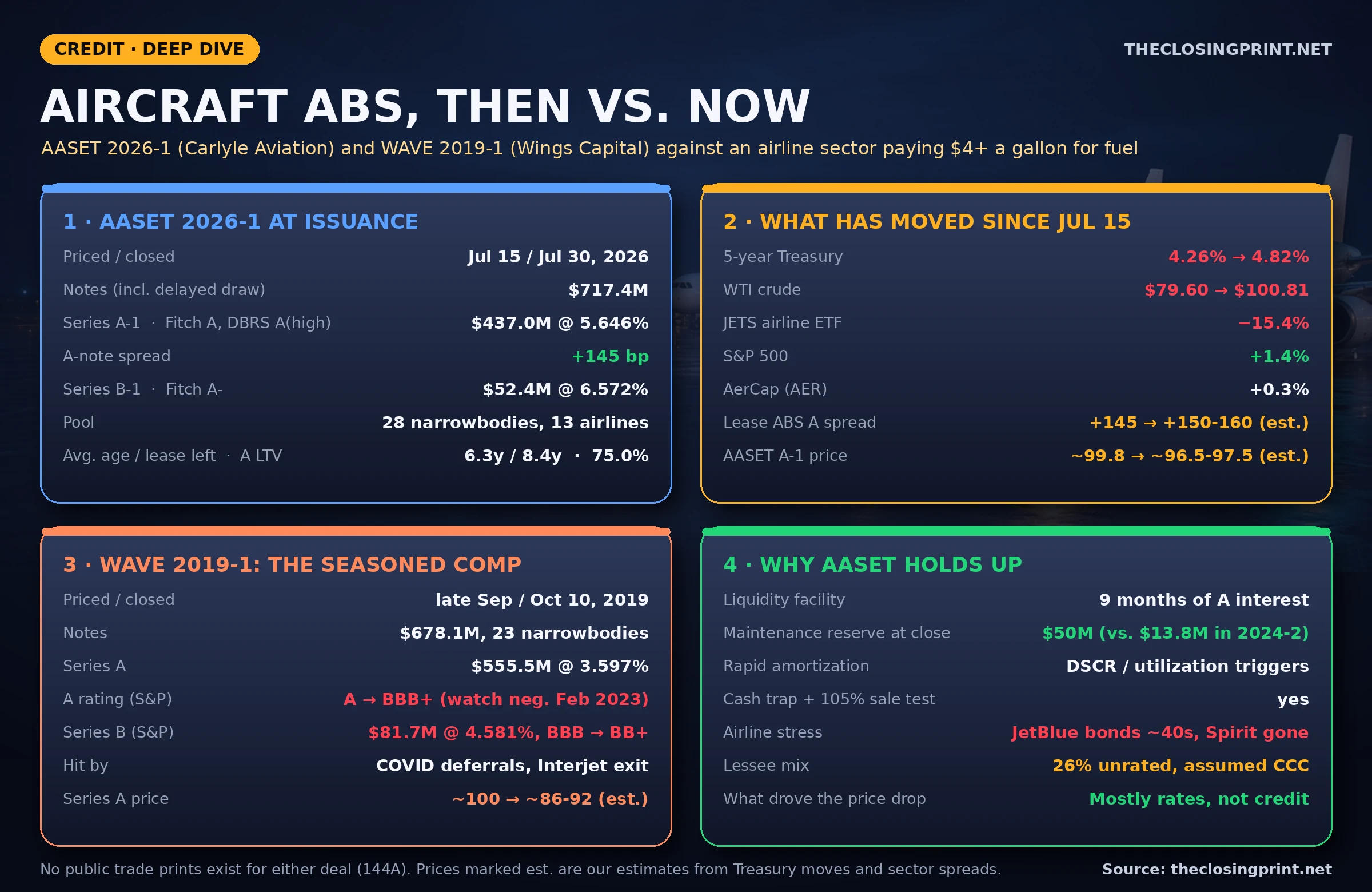
- Timing. Carlyle launched the deal in mid-July and priced it on Jul 15, 2026. Fitch issued its presale on Jul 14, and the deal closed on Jul 30. It was Carlyle’s first aircraft ABS of 2026. The proceeds refinanced AASET 2022-1 and bought eight more aircraft, four of them through the delayed-draw notes.
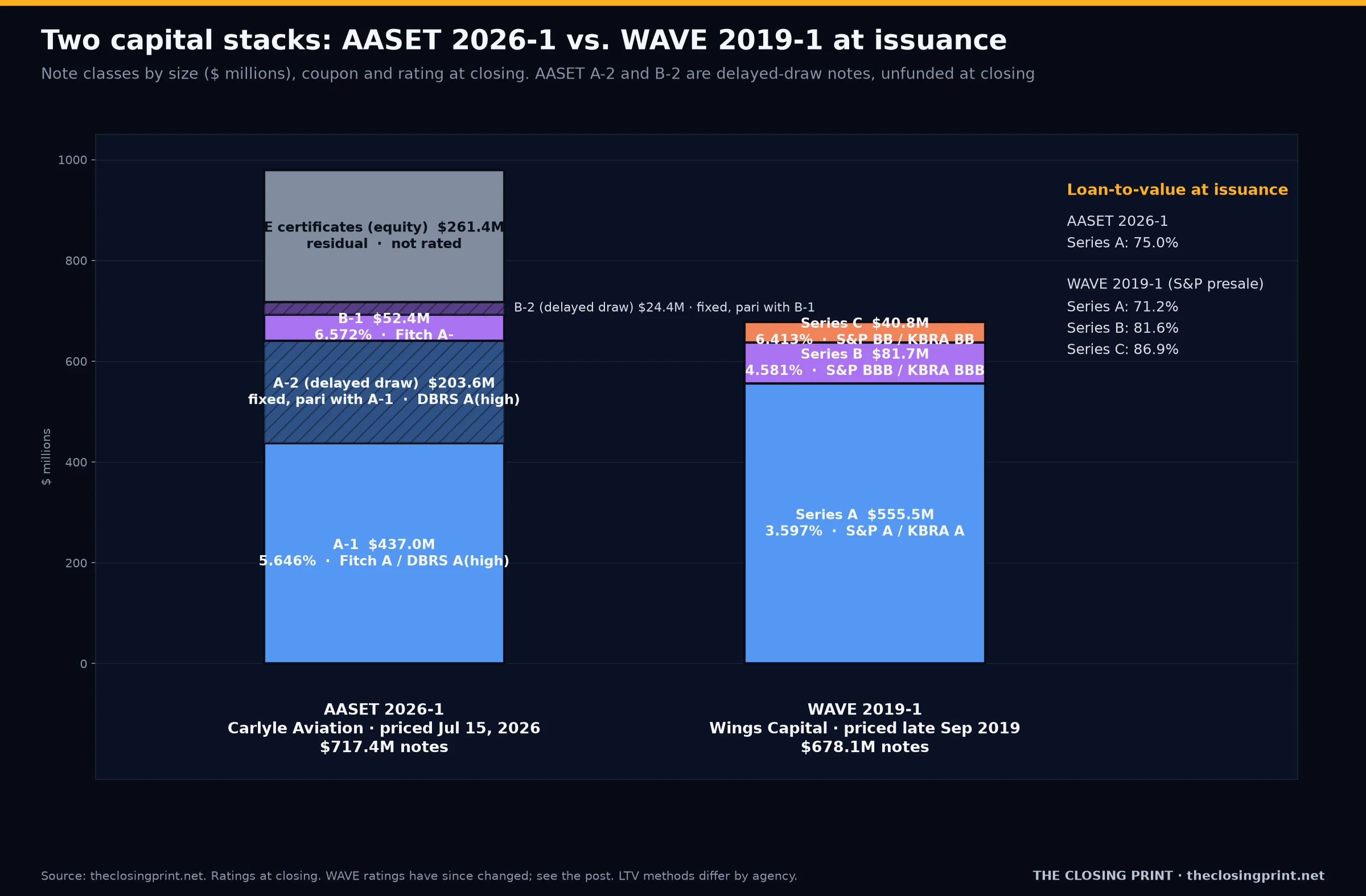
- Size and classes. $717.447 million of notes. That’s $436.983 million of Series A-1 at a 5.646% fixed coupon, $52.438 million of Series B-1 at 6.572%, and up to $203.595 million of A-2 and $24.431 million of B-2 delayed-draw notes. Behind them sit $261.4 million of E certificates, the equity. The notes pay monthly, the first payment was Aug 17, and the legal final maturity is Jul 16, 2051.
- Ratings. Fitch rated A-1 A(sf) and B-1 A-(sf). Morningstar DBRS rated A-1 and A-2 A (high)(sf). We couldn’t confirm Fitch’s ratings on the delayed-draw classes.
- Pricing. The A notes priced at +145 bp over Treasuries. That was only the second aircraft lease A note to price inside +150 since the Middle East war began in late February. Assuming the A-1 priced near par, its yield was about 5.7% (est.). The B-1 coupon implies a spread of roughly +230 bp (est.). We found no public figure for the book size or how much the deal tightened from talk, so we aren’t quoting one.
- Leverage. DBRS puts the Series A loan-to-value at 75.0%. Neither agency’s public release gives a weighted-average life, so the WALs below are our assumptions.
| Class | Rating at close | Size | Coupon | Spread at pricing | 144A CUSIP / ISIN | Reg S ISIN |
|---|---|---|---|---|---|---|
| A-1 | Fitch A(sf); DBRS A (high)(sf) | $436,983,000 | 5.646% fixed | +145 bp (A note) | 00042HAA0 / US00042HAA05 | USG0009HAA44 |
| A-2 (delayed draw) | DBRS A (high)(sf); Fitch: not confirmed | up to $203,595,000 | fixed, set at close | pari with A-1 | not public | not public |
| B-1 | Fitch A-(sf) | $52,438,000 | 6.572% fixed | ~+230 bp implied (est.) | 00042HAB8 / US00042HAB87 | USG0009HAB27 |
| B-2 (delayed draw) | not confirmed | up to $24,431,000 | fixed, set at close | pari with B-1 | not public | not public |
| E certificates | not rated | $261,411,561 | residual | retained equity | not public | not public |
We verified the check digit on every CUSIP and ISIN shown. For the delayed-draw notes and the E certificates we found no public identifier, so they are marked “not public.”
The collateral
- 28 narrowbody jets: A320neo and A321neo, A320ceo and A321ceo, and Boeing 737-800s. The oldest was built in July 2009, and the newest delivered in May 2026. Five of the 28 hadn’t been built yet at closing and deliver between August 2026 and September 2027. Four of them are the A321neos the delayed-draw notes will fund.
- Young, long-leased pool: a weighted-average age of 6.3 years, about 18.7 years of useful life left, and a weighted-average remaining lease term of 8.4 years. That’s longer than recent comparable deals, which means steadier cash flow.
- Lessees: 13 airlines in 12 countries at closing, and more to come as follow-on leases start. About 20% of the leases are with airlines that have public ratings, from the B category up to investment grade. About 26% are with unrated airlines that DBRS treats as CCC. The other 54% were judged to be B-category or better. The agencies’ public releases don’t name the lessees, so we don’t either.
- Stress test: in its “A” scenario, DBRS assumes about 74% of the lessees default during the first modeled recession, and the notes still pay.
The structure, and what protects the A notes
- Servicer: Carlyle Aviation Management (CAML), part of Carlyle Aviation Partners. DBRS rates it an acceptable servicer, with experience across several cycles.
- Liquidity facility: covers nine months of Series A interest and certain senior expenses.
- Maintenance reserve: $50 million at closing, up from $13.8 million in AASET 2024-2. That’s a big cushion for engine shop visits, which are the costliest risk in narrowbody leasing right now.
- Amortization: the notes pay down on a blended schedule, from 20 years straight-line for jets under 6 years old to 11.1 years for jets 15 or older.
- Triggers: if debt service coverage or aircraft utilization falls below set levels, a rapid-amortization event sends cash to principal. Any notes still out after seven years trigger the same thing, plus step-up interest. There are also cash-trap events, and any aircraft sale must bring in at least 105% of its share of the debt.
How AASET 2026-1 trades today
- No public prints. The notes are Rule 144A and Reg S. We found no publicly disseminated trade prints, dealer price color or price-based surveillance for any class. We also found no rating action since the Jul 30 ratings. Anyone quoting an exact price is quoting a private dealer run.
- Rates did most of the damage. The 5-year Treasury was 4.26% on Jul 15 and closed at 4.82% today. The 10-year went from 4.55% to 4.99%. A fixed-rate note with an assumed duration of about 4.3 years loses about 2.4 points from that rate move alone (est.).
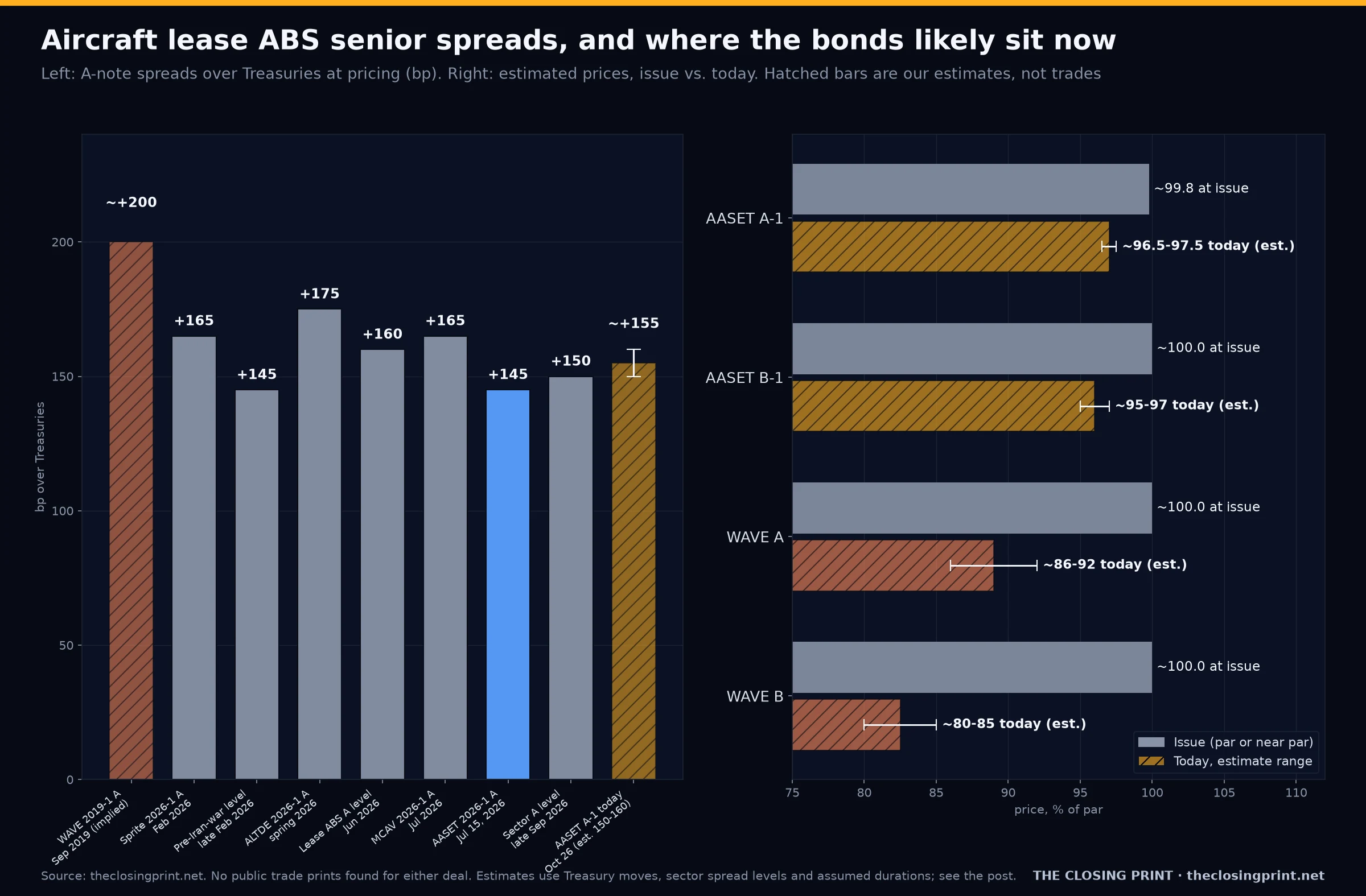
- Spreads barely moved. Senior aircraft ABS spreads sat at about +145 bp before the war, widened to about +160 in June, and were back near +150 by late September and market participants in September described senior spreads as the tightest on record. Few lease deals priced in August and September, so there’s little fresh new-issue evidence. We put the A-1 today at about +150 to +160 (est.).
- Our estimate: an A-1 yield of about 6.3% to 6.4%, and a price of about 96.5 to 97.5, against about 99.8 at issue. For the B-1, junior spreads have been more selective (C-tranche spreads widened about 40 bp this year), so we use +245 to +290 bp. That gives a yield of about 7.3% to 7.7% and a price of about 95 to 97 (est.).
- Credit looks intact. Holders have collected monthly coupons since August. The collateral is young narrowbodies on long leases, with a 75% senior LTV and a large maintenance reserve. Nothing public points to trouble at the deal level. The price drop is a rate story first and an airline-sentiment story second.
| Item | AASET 2026-1 then (Jul 15, 2026) | AASET today (Oct 26) | WAVE 2019-1 then (Sep 2019) | WAVE today (Oct 26) |
|---|---|---|---|---|
| Senior coupon | 5.646% | unchanged | 3.597% | unchanged |
| Senior rating | Fitch A / DBRS A (high) | unchanged; no rating action found | S&P A / KBRA A | S&P BBB+ by Feb 2023, then CreditWatch negative |
| 5-year Treasury | 4.26% | 4.82% | about 1.55-1.60% | 4.82% |
| Senior spread | +145 bp | ~+150-160 bp (est.) | ~+200 bp implied (est.) | ~+200-300 bp (est.) |
| Senior price | ~99.8 (est., near par) | ~96.5-97.5 (est.) | ~100 | ~86-92 (est.) |
| Mezz price (B) | ~100 (est.) | ~95-97 (est.) | ~100 | ~80-85 (est.) |
| Public trade prints | none found | none found | none found | none found |
Comparable deals in 2026
| Deal (sponsor) | Priced | Type | A spread | A coupon / yield | Notes |
|---|---|---|---|---|---|
| AASET 2026-1 (Carlyle Aviation) | Jul 15, 2026 | Lease, 28 narrowbodies | +145 bp | 5.646% | 2nd lease A note under +150 since late February |
| MCAV 2026-1 (AIP Capital) | Jul 2026 | Lease, 18 assets | +165 bp | 5.82% | B at +245; 2-3x oversubscribed |
| PKAIR 2026-2 (PK AirFinance) | Jul 30, 2026 | Loan ABS | +105 bp | 5.217% / 5.274% | AAA A note; loan ABS prices tighter |
| ALTDE 2026-1 (Altavair) | spring 2026 | Lease, mixed | +175 bp | 5.521% / 5.585% | A LTV 74%; WAL 4.9 years |
| Eclipse Aircraft 2026-1 (Sculptor / SMBC Aviation Capital) | May 2026 | Lease | not found | 5.626% (A), 6.451% (B) | A 144A CUSIP 27888VAA9, Reg S ISIN USG3037VAA38; B 144A CUSIP 27888VAB7, Reg S ISIN USG3037VAB11 |
| Sprite 2026-1 (World Star) | Feb 2026 | Lease, freighters | +165 bp | 5.285% yield | Mostly converted freighters |
| WAVE 2019-1 (Wings Capital) | late Sep 2019 | Lease, 23 narrowbodies | ~+200 bp implied (est.) | 3.597% | Seasoned; hit by COVID |
Two more read-throughs from unsecured lessor bonds: SMBC Aviation Capital sold $2 billion in July at +70, +85 and +112 bp for 3, 5 and 10 years, its tightest ever, and AerCap (AER) priced $900 million of 2031 notes at a 4.972% yield, +83 bp. In 2026 lenders are differentiating between airlines, not lessors.
WAVE 2019-1: the seasoned comparable
- Issuance. Wings Capital Partners priced WAVE 2019-1 in the last week of September 2019, and it closed on Oct 10, 2019. It sold $678.075 million of fixed-rate notes: $555.531 million of Series A at 3.597%, $81.696 million of Series B at 4.581% and $40.848 million of Series C at 6.413%. S&P and KBRA rated them A, BBB and BB. Coupons came in well below the presale assumptions of 3.825%, 4.875% and 7.000%, so demand was strong.
- Spread then. With the 5-year Treasury at about 1.55% to 1.60% that week, the A coupon implies a spread of roughly +200 bp, assuming a price near par (est.).
- Portfolio. 23 narrowbodies: nine A320-200s, one A320neo, seven A321-200s and six 737-800s. They were on lease to 17 airlines in 13 countries, with a weighted-average age of 4.5 years and 6.3 years of lease left. KBRA put the initial value at about $817 million. About 91% of the book value was with emerging-market airlines, among them Mexico’s Interjet, plus VietJet and Jetstar.
- Structure. A and B amortize straight-line over 14 years and C over 8. If the notes aren’t refinanced eight years after closing, around October 2027, all cash goes to principal. There was a $1.4 million maintenance reserve at closing, and Crédit Agricole provides the liquidity facility and a standby letter of credit. Wings and its Irish affiliate are the servicers.
- What happened since. The pandemic hit within six months. Airline lessees deferred or restructured rent, and Interjet, an early lessee, stopped flying. By February 2023 S&P had cut Series A to BBB+ and Series B to BB+. On Feb 15, 2023 it put both on CreditWatch negative, citing weaker lease collections, little principal paid, unpaid scheduled principal building up, falling debt service coverage, and leases coming due in a hard remarketing market. We couldn’t open the later S&P review to confirm how the watch was resolved, and we found no public Russia exposure for this pool.
- How much is left. The exchange listings still show the original amounts, which isn’t a current balance. We found no public current factor.
| Class | Rating at close (S&P / KBRA) | Size | Coupon | Talk (S&P presale) | LTV (S&P presale) | Identifiers found |
|---|---|---|---|---|---|---|
| A | A / A | $555,531,000 | 3.597% | 3.825% | 71.2% | Reg S ISIN USU94186AA83 |
| B | BBB / BBB | $81,696,000 | 4.581% | 4.875% | 81.6% | not public |
| C | BB / BB | $40,848,000 | 6.413% | 7.000% | 86.9% | not public |
| User-supplied | US94354KAA88 (CUSIP 94354KAA8): check digits valid; class not confirmed in a public source |
- How WAVE trades today. We found no public prints for any class. Our estimate assumes three to four years of remaining WAL and spreads typical for seasoned BBB+ and BB+ aircraft paper, about +200 to +300 bp for A and +400 to +550 bp for B. On that basis Series A is around 86 to 92 and Series B around 80 to 85, from about par at issue. Those are estimates, not trades. Most of the discount comes from the low 2019 coupons against today’s 4.8% Treasuries. The rest is the credit damage from the pandemic. Series C is too uncertain to price without trustee data, so we don’t.
- The lesson for AASET. WAVE had emerging-market lessee concentration, a small maintenance reserve and 2019’s low coupons. AASET has a long lease term, a $50 million reserve and 5.6% coupons. The structures are similar, but AASET starts from a much stronger position.
The airline sector in aggregate
| Airline | Since Jul 15 | 2026 YTD | Q3 2026 / Q4 guide |
|---|---|---|---|
| JETS ETF | -15.4% | -5.8% | Sector basket |
| Delta (DAL) | -7.7% | +15.3% | Q3 adj. EPS $1.72; FY guide cut to $5.10-5.60 from $6.50-7.50; Q4 fuel ~$4.25/gal |
| United (UAL) | -16.8% | -10.0% | Q3 adj. EPS $2.54, revenue +17%; recaptured 72% of higher fuel; Q4 fuel ~$4.80 |
| American (AAL) | -21.9% | -20.4% | Q3 adj. loss $0.28; FY adj. loss $1.00-1.60; Q4 fuel ~$4.70 |
| Southwest (LUV) | -12.6% | +5.1% | Q3 adj. EPS $0.66, RASM +21.6%; Q4 fuel ~$4.55 |
| Alaska (ALK) | -27.0% | -30.5% | Q3 GAAP loss $1.32/share; Q4 adj. loss $2.00-2.50; FY loss $5.00-5.50 |
| JetBlue (JBLU) | -57.6% | -47.9% | Q3 adj. loss $0.60; $2.2B liquidity; creditors hired advisers |
| Ryanair (RYAAY) | -19.8% | -25.5% | European low-cost bellwether |
| IndiGo (NSE) | -12.0% | -10.1% | Largest A320neo-family operator; as of Oct 23 close |
| S&P 500 | +1.4% | +12.1% | Benchmark |
| AerCap (AER) | +0.3% | +3.7% | Largest lessor; Q3 results Oct 28 |
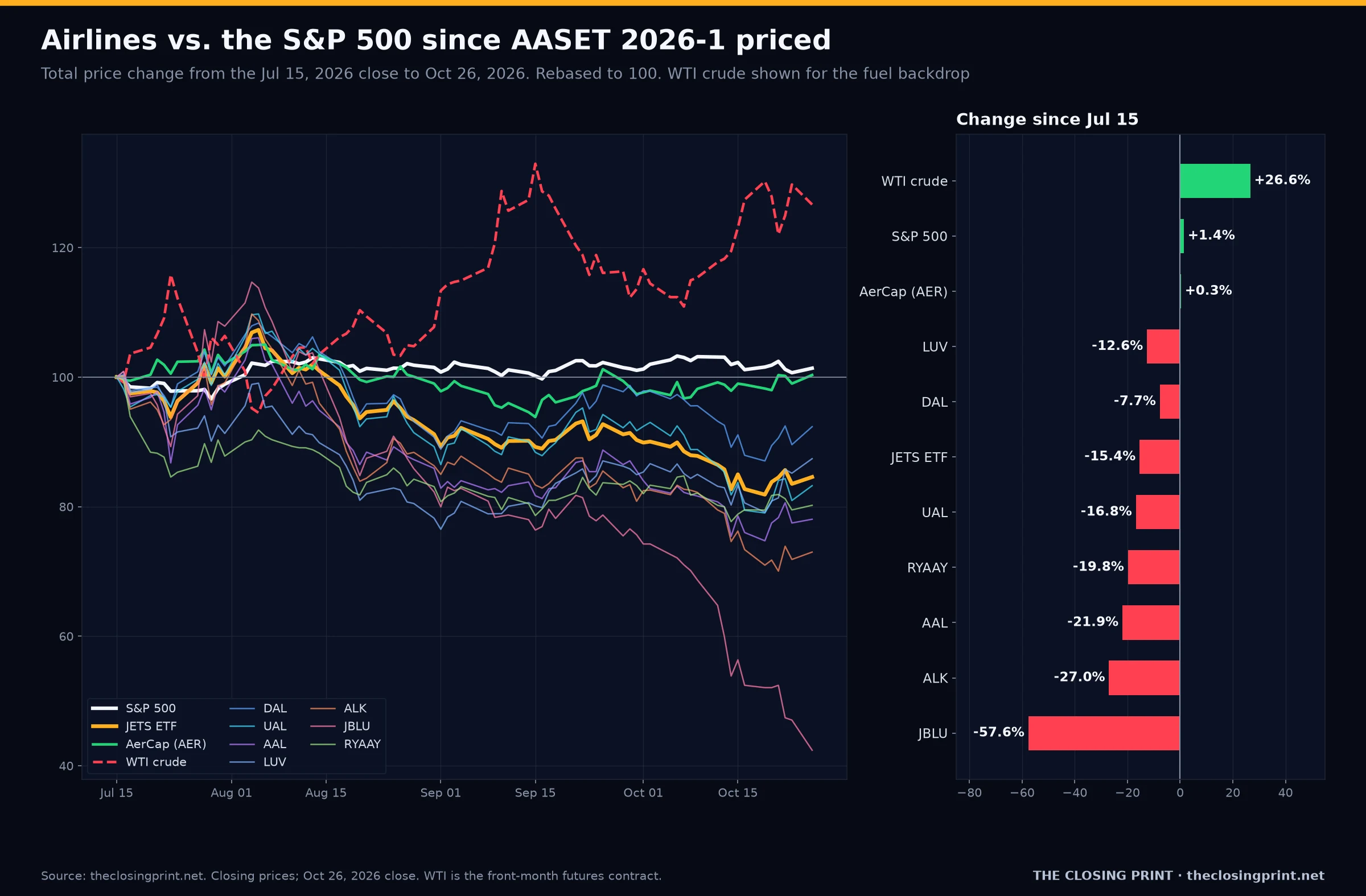
- Fuel is the story. WTI closed at $100.81, up 26.6% since AASET priced and 75.6% this year, and Brent closed at $109.71. Heating oil futures, the closest proxy for jet fuel, are at $4.71 a gallon, more than double where the year started. That’s about $97 a barrel over WTI, a very wide distillate crack (est., heating-oil proxy). Q4 guides assume $4.25 to $4.85 a gallon, against about $2.50 in Alaska’s original 2026 plan.
- Demand is holding. All four big U.S. carriers reported record Q3 revenue. Fares were up about 23% year over year in the seven months through September, and United’s unit revenue rose 16% and Southwest’s 21.6%. But fares only partly cover fuel: United recaptured about 72% of its higher fuel cost and JetBlue about 87%.
- Capacity is being trimmed. Q3 capacity was roughly flat to up 2%. Alaska cut its schedule in the last few months and guides Q4 capacity up only 1% to 1.5%. Tighter capacity supports fares and keeps demand for used narrowbodies high.
- Credit is splitting. The majors are fine: United has $17.7 billion of liquidity and 2.4x net leverage, Delta about 2.2x gross leverage, and Alaska $3.3 billion of liquidity with $20 billion of unencumbered assets. The weak tail is not. Spirit Airlines stopped flying on May 2 and is liquidating. JetBlue’s $2 billion of loyalty-backed 2031 notes fell to about 40 cents on the dollar last week from about 80 at the start of October, and a creditor group has hired restructuring advisers. JetBlue says it has $2.2 billion of liquidity and enough to cover the next 12 months. High-yield and investment-grade bond ETFs are down 1.8% and 2.1% since Jul 15, mostly from rates.
- Lessors are steady. AerCap is flat since Jul 15. It signed 85 leases and 34 purchases in Q3 and reports on Oct 28. Appraisal data show new A320neos still lease for at least $400,000 a month. Older jets have softened: a 12-year-old 737-800 fell from $255,000 to $228,000 a month, and an A320-200 from $253,000 to $220,000, since the July 2025 peak. Values are still supported by scarce engines and parts.
How airline stress reaches the bonds
- Lessee defaults are the first channel. The weak names are cash-poor low-cost and emerging-market carriers, the kind behind AASET’s 26% unrated slice. A default means downtime, repossession and remarketing costs, and that pushes DSCR toward the trigger.
- Lease rates and values are the second. If airlines shrink, used-jet lease rates fall further, and so do the sale prices behind the 105% disposition test. For now, A320neo-family jets in short supply cushion both.
- Sale-leasebacks cut the other way. Cash-strapped airlines sell and lease back jets, which feeds lessors new deals at good yields. AerCap has said a prolonged oil spike could bring it opportunities.
- Net: for AASET’s A notes the airline risk is mostly price volatility, not loss. Young narrowbodies, 8.4 years of lease, a 75% LTV, nine months of liquidity and a $50 million reserve make the senior class hard to impair. The B-1 has less cushion, and it’s where airline headlines would show up first.
Scenarios and Wick's pick
- Fuel relief (20%): oil falls back toward $80, airline stocks rally and Treasury yields ease. Senior aircraft ABS tightens to about +140 bp, and AASET A-1 climbs back to about 99 to 100 (est.). WAVE A recovers toward the low 90s.
- Grind (55%): oil stays between $90 and $105. Airline margins stay thin but the majors stay profitable, and the weakest carriers restructure without spreading the damage. Lessors keep placing jets. AASET A-1 holds about +150 to +170 bp and a price of about 96 to 98 (est.), with every payment on time. WAVE keeps paying down and stays in the high 80s.
- Airline credit event (25%): a JetBlue restructuring is followed by more emerging-market defaults, oil goes above $110 and Treasuries don’t rally. Senior aircraft ABS widens 40 to 75 bp, and AASET A-1 falls to about 93 to 95 (est.), with B-1 hit harder. We still don’t expect a loss on the A-1 given its LTV and liquidity. WAVE B, already BB+, is the most exposed of the classes discussed here.
Wick's pick: the grind. AASET 2026-1 is trading like a sound senior bond that lost money to rates, not credit, and the structure was built for the airline stress we’re seeing. The airline sector is splitting: Delta, United and Southwest pass most fuel costs on to passengers, while JetBlue and the low-cost tail pay for the rest. That split shows up in AASET’s B-1 and in seasoned paper like WAVE more than in new A notes. If you hold or can buy the A-1 in the mid-to-high 90s, we’d see the carry and the pull to par as the trade. We’d want a wider entry before adding B-1, and we’d watch JetBlue and oil, not the S&P, for the next move in aircraft ABS spreads. Treat WAVE as a rates-and-recovery story priced at a discount, not a fresh credit call.
What to watch
- Wed Oct 28, 8:30 AM: AerCap Q3 2026 results call, with lease rates, aircraft values and airline stress.
 .ics

- Wed Oct 28, 10:30 AM: EIA weekly petroleum status report, with distillate and jet fuel stocks..ics
- Wed Oct 28, 2:00 PM: FOMC rate decision, the biggest swing factor for fixed-rate ABS prices..ics
- Mon Nov 16 (estimated): AASET 2026-1 monthly payment date, the next coupon and principal distribution..ics
Market data and opinions by Wick. This post is informational only and is not financial advice. Bond prices marked “est.” are our estimates from Treasury moves, sector spread levels and assumed durations. They are not trade prints or dealer quotes, and actual levels can differ materially. Scenario odds are estimates and can be wrong.
Add all 4 events to calendar (.ics) Times are ET. Each event has a 1-day reminder. Estimated dates are marked.